TAG Cracks Open A Red Bull, Vulcain Gets Great Colors, And New Watches From Raymond Weil And Jacob & Co.
Hey friends, welcome back to It’s About Time. A brief one today, as I'm slammed with work. But, if you want to read more watch and adjacent content, and you missed the new Caseback magazine I launched this weekend, you can enjoy the first issue here, absolutely free. Future issues will be for paid subscribers.
THIS IS SUPER IMPORTANT! Ever since I moved to this new platform, deliverability of emails has been so-so. Some are delivered to a lot of inboxes, some are routed to people's promotions tabs. In case you haven't been getting your emails, check the promotions or junk folders and move it to the primary. That way you'll always get it.
I write this newsletter on my own, and paid subscribers are what keep it running. If you'd like to support it, you'll also get The Caseback, a weekend magazine with longer writing, every Sunday.
The paid subscription is discounted for just a few more days, so get it now.
👂What’s new
1/ TAG Heuer Gives the Formula 1 Solargraph A Red Bull Racing Livery

Red Bull’s 2026 has been rough by its own standards, but Max Verstappen has just won back-to-back in Malaysia and Singapore, so there's some optimism stirring in the Red Bull paddock. Good timing for TAG Heuer to mark 10 years with the team, and four Verstappen titles, with a new Formula 1 Solargraph. If you haven’t followed the revival, this is the 38mm solar-powered Formula 1 that TAG brought back in 2025 and has since released in brights, pastels, an Indy 500 version and an orange Zandvoort edition. This one is painted in the colors of Red Bull, but I have to say good work TAG Heuer for not making this a Red Bull commercial by not using the logo. Good work.
The case is sandblasted stainless steel, 38mm wide and 10.2mm thick, with a lug-to-lug of 42mm. Those are friendly numbers, with the short L2L working on a lot of wrists, and the matte finish suits the sporty nature. The scalloped bezel is blue TH-Polylight with a white minute scale printed around it. Sapphire crystal on top, screwed caseback out back, water resistant to 100 meters. The team and brand logos are placed on the caseback over a checkered-flag pattern.
The dial is sunray blue with a red minute track at the edge, a yellow central seconds hand, and a yellow frame around the date at three. It’s loud, nut it works. The shield-shaped markers at six, nine and 12 remain, and the rest of the applied indices are filled with Super-LumiNova that glows green.
Inside is the TAG Heuer calibre TH50-00, a solar quartz movement. A minute of direct sun gives you a day or reserve, a full charge takes under 40 hours of light, and that charge lasts 10 months in a drawer. If it does stop, 10 seconds of light restarts it, and TAG rates the accumulator for up to 15 years. The bracelet is a sandblasted three-row steel design that closes with a folding clasp with two safety pushers and has an extension link.
The TAG Heuer Formula 1 Solargraph x Oracle Red Bull Racing (ref. WBY111F.BA0042) goes on sale 20 October at 7AM UTC, priced at €2,200. I'm not sure whether this is a limited edition, though. TAG Heuer calls it a special edition. See more photos here and the watch on the TAG Heuer website.
2/ Vulcain Adds Pink, Turquoise and Green to the 38mm Skindiver Nautique GMT
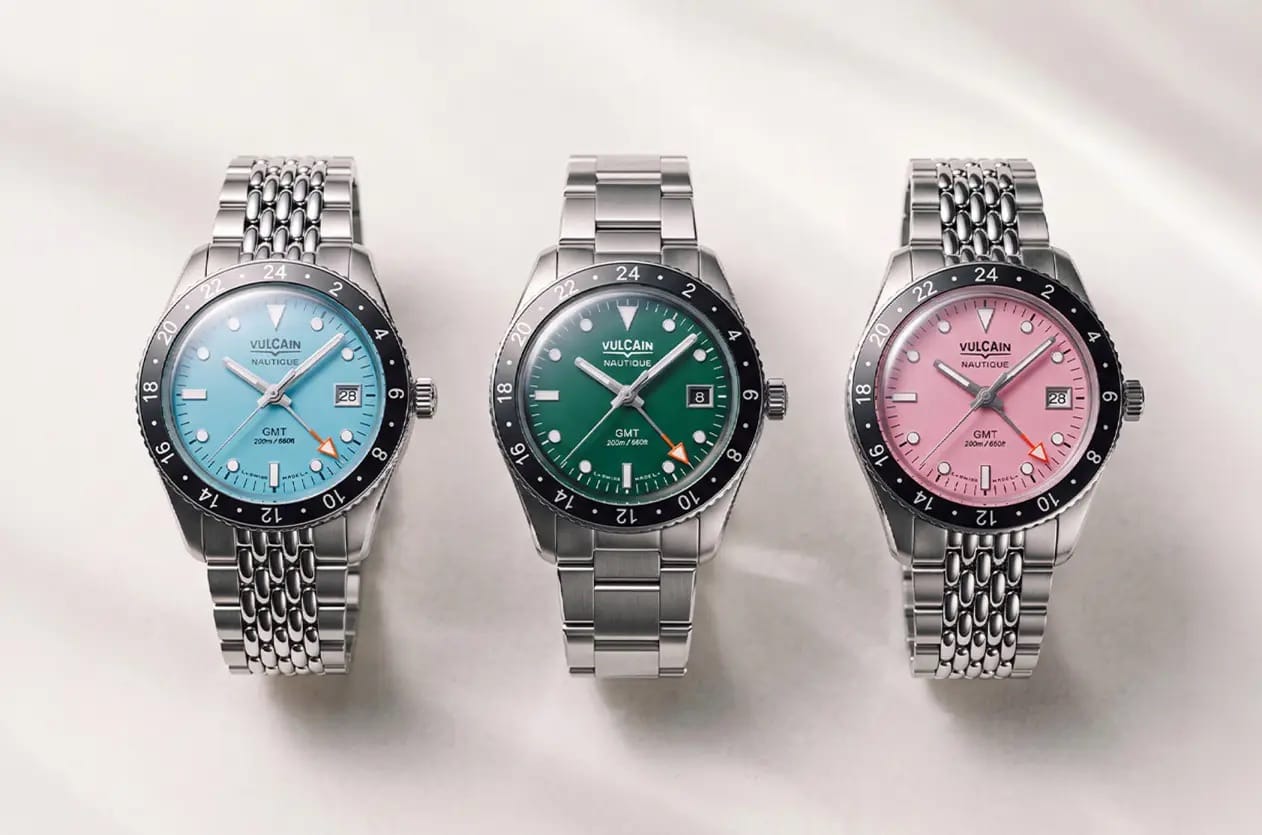
As the name might suggest, the Skindiver Nautique is Vulcain’s version of the skin diver, a compact, slim-lugged dive watch that existed before tool divers got big and heavy. It also has a very robust collection of dial colors and variations. They also made a GMT variant, that up to now came with blue, black and white dials, with a brief excursion into purple with a limited edition. Now, the GMT gets three very nice dials: pink, turquoise and green. All packed in a very nice case.
The case is 316L steel, brushed vertically, 38.3mm wide and 12.2mm thick. That’s a sensible size for a GMT, and the skin diver inspiration help it wear smaller still: thin lugs and an unguarded crown, which still screws down. On top is a double-domed sapphire crystal, the caseback is solid steel, and the black ceramic insert has a 24-hour scale in white and turns both ways.
The dials are the novelty and it's a bit difficult to choose which one I like most. Turquoise is likely the brightest and the most fun. Pink might be a bit controversial, but I think I might like this one the most. The green is the most classic of the three. Every color keeps the same layout, with oversized hour markers, broad faceted batons in white Super-LumiNova, a framed date at 3, and a GMT hand tipped with a red-edged arrow.
Inside is the Soprod C125, an alternative to the ETA 2893 and Sellita SW330. It beats at 4Hz has 42 hours of power reserve. The 24-hour hand sets independently, making this a caller-style GMT: great for keeping home time while you travel, slower for jumping the local hour when you land. You can have it on of two steel bracelets, one vintage-style and one bead-of-rice, or on black rubber with a pin buckle.
All three are, unfortunately, limited editions, with the pink and turquoise limited to 100 examples each; while the green is limited to 50. Price is set at €2,130. See more photos here and the watches on the Vulcain website.
3/ Raymond Weil Gives the Freelancer a Worldtimer’s Dial
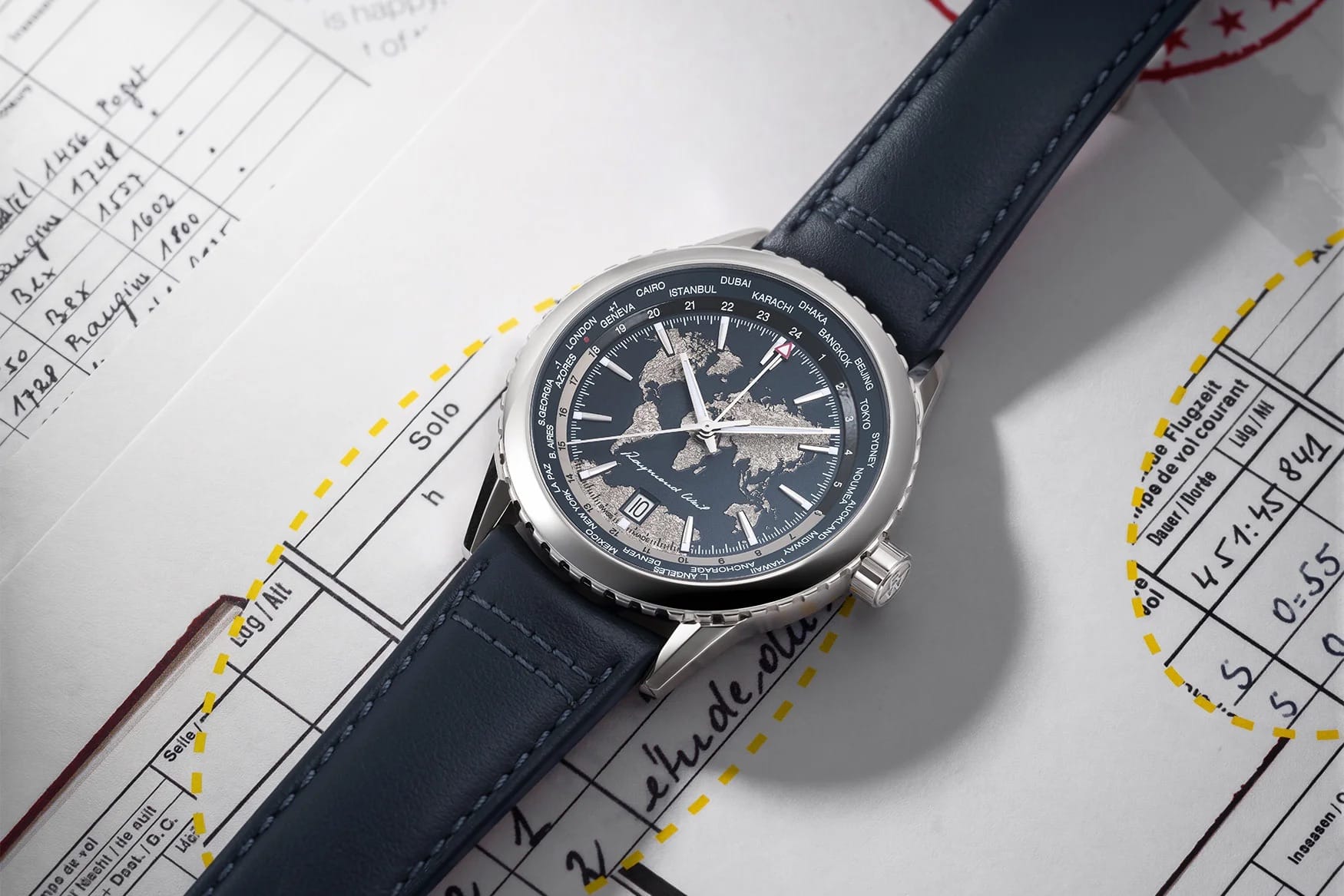
Look at the dial of this watch and you’d guess worldtimer. Look at the price and you’d think again. Not saying there aren't any affordable worldtimers, but they do tend to be a bit on the pricier side. At least the true worldtimers. The Raymond Weil Freelancer World-Traveller, on the other hand, is a GMT with a hand-turned city bezel, which gets you most of the way to a true 24 city worldtimer. And it's good enough for me.
The steel case is 40mm wide and 10.25mm thick, brushed and polished, with a fluted crown and sapphire front and back. Those are decent proportions. The bezel is new: notched and fluted so you can grip it and line the cities up against the inner ring. Water resistance is 50 meters.
The dial is obviously the main attraction here. It’s a Mercator-style relief of the world, stamped and then laser-textured, with champagne continents raised off midnight blue water. A 24-hour ring around the dial repeats the scheme, champagne for daylight and blue for night, while the city names sit on an outer blue track. The GMT hand gets a red outline and green Super-LumiNova on its arrow tip, matching the lume on the hands and index tips. Raymond Weil’s handwritten signature replaces the logo above a framed date at six, which is a nice touch.
Inside is the RW3230, Raymond Weil’s name for the Sellita SW330-2, essentially an SW300 with a GMT module added. It beats at 4Hz, with 56 hours of reserve, and the crown jumps the GMT hand in one-hour steps. For anywhere else, you turn the bezel until your city meets the 24-hour scale. It’s manual, but it works. The strap is midnight blue leather with matching stitching on a steel folding clasp with a double push-button release.
The Raymond Weil Freelancer World-Traveller is limited to 260 pieces, priced at €4,395. See more photos here and the watch on the Raymond Weil website.
4/ Jacob & Co. Brings Back the Palatial Flying Tourbillon Minute Repeater With a Red Dial
If for nothing else, Jacob & Co. will be remembered for making quite extravagant watches. From the first watch that put them on the global map, the Five Time Zone, all the way to the completely bonkers Astronomia creations, it's clear that Jacob has no patience for conventional watches. Look at, for example, the Opera Godfather to the Twin Turbo Furious, their minute repeating watches. You can't find anything like that anywhere else. And like it or hate it, you can't deny they're original. But it wasn't always like that. In 2014, they released the Palatial, their first repeater and what has to be their most conventional chiming watch: a round case, no triple-axis anything, no hidden automaton. Now, for Jacob & Co.’s 40th anniversary, they're bringing it back with a limited edition of 12 pieces.
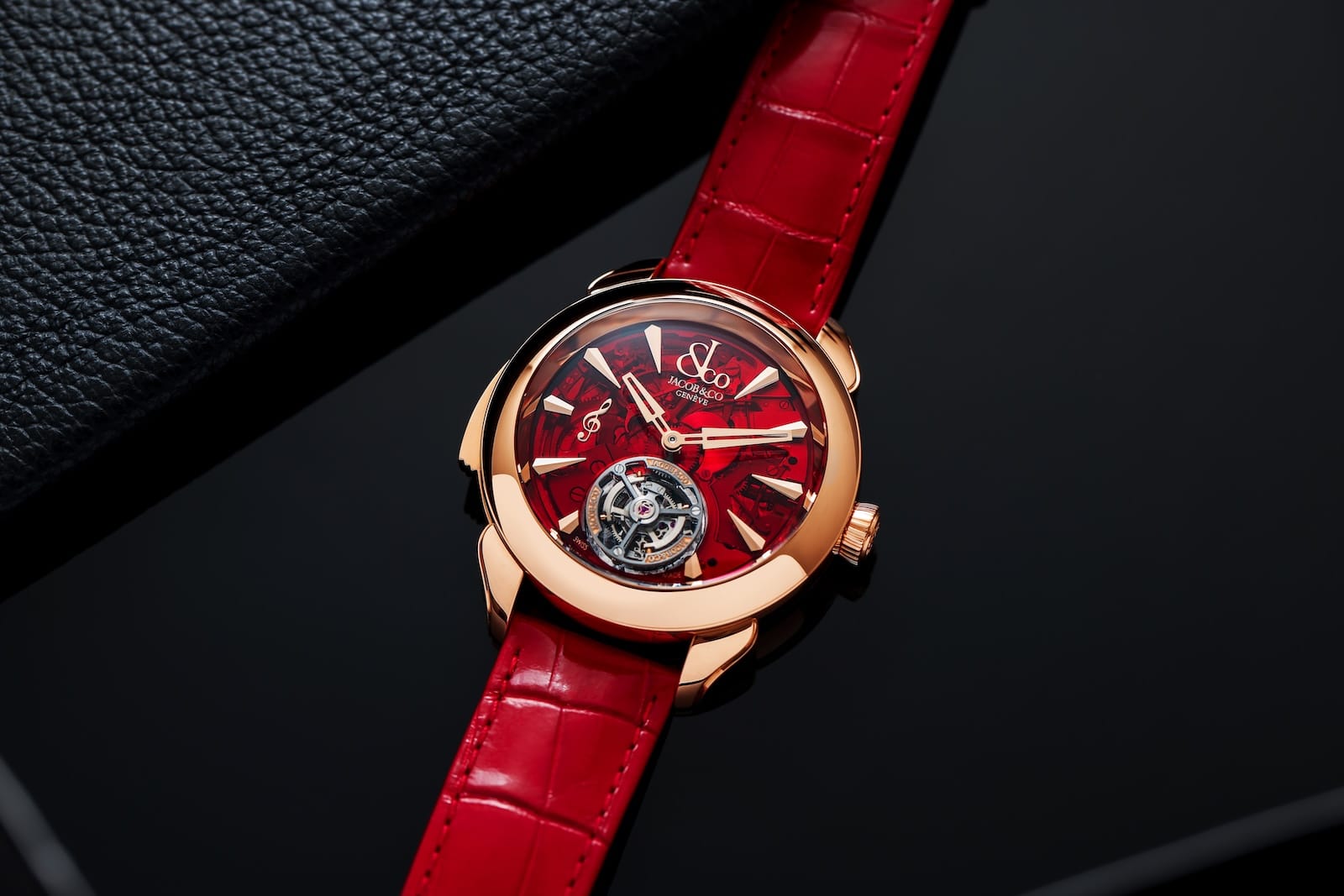
The case is made out of 18k rose gold, 43mm wide and 12.3mm thick, fully polished, with the sculpted lugs of the original carried over. There’s sapphire front and back, and water resistance of 30 meters, which is about what you’d expect. Maybe even more. But most surprising is that thickness. Just 12.3mm for a tourbillon repeater? That's wild!
The dial is made out of transparent red mineral glass, so the repeater works sit in plain view, letting you watch the racks, cams and hammers do their job, without having to cut out a piece of the dial. You get faceted rose gold indices, a gold colored Jacob & Co. logo at 12, a brushed gold treble clef at 9 and skeletonized hands are shaped like metronomes. At 6 o'clock is a huge opening for the turbillon.
The hand-wound calibre JCCM04 is built in partnership with Geneva’s Régence group, and it has a long paper trail: developed at BNB Concept, picked up by Pierre Favre’s MHC, which later folded into Timeless under Régence. It has 308 parts and 29 jewels, a one-minute flying tourbillon beating at 3Hz, and a 90-hour power reserve. It now also has a silent-running centrifugal governor, which regulates the strike without the background whir that some repeaters have. The hammers and the cathedral gongs, which wrap the full circumference of the calibre for a longer, fuller tone, have been reworked as well. Through the caseback, the bridges are grey-toned with Côtes de Genève. The strap is red alligator with a rose gold buckle.
The Jacob & Co. Palatial Flying Tourbillon Minute Repeater (ref. PT500.40.NS.AC.ABALA) is limited to 12 pieces and priced at $390,000. See more photos here and the watch on the Jacob & Co. website.
I write this newsletter on my own, and paid subscribers are what keep it running. If you'd like to support it, you'll also get The Caseback, a weekend magazine with longer writing, every Sunday.
The paid subscription is discounted for just a few more days, so get it now.
⚙️Watch Worthy
- A review of the BA111OD’s new Chapter 4 Onyx and Infinity Flying Tourbillon
- Hands on with the Panerai Luminor Destro PAM01732
⏲️End links
- On the 40th anniversary of what the Associated Press and United Press International both ranked as the second-most important story of 1966—behind the Vietnam War—the magazine asked eyewitnesses to recount the nation's first mass shooting event in a public space. Revisited now, on its 60th anniversary.
- A personal account of what happens when a writer's father has both a lifelong avoidance of traditional medical care and a Stage 4 cancer diagnosis. Poring through texts, emails, and her father's search history, Trisha Thadani uncovers how her father was targeted by these purported healing centers and practitioners, and how they did him wrong.
- Video gambling terminals, which are regulated, and sweepstakes machines, which are not, have expanded exponentially in the greater Chicago area. More than 200 municipalities allow video gambling in varying degrees, while 60 do not allow it in any form. The areas that allow it are discussing scaling back, and the ones that have banned the machines are weighing adding them. What's the right approach?
👀Watch this
I don't know, everyone is hating where Jaguar is going, but I'll say I'M digging the new design language.
Thanks for reading
Vuk
P.S. If you have any questions, suggestions, gripes or anything else, just reply to this email. It comes straight to me and I try responding to everyone.
Subscribe to It's About Time to get daily