- It's About Time
- Posts
- Watches and Wonders Reporting Winds Down With A Jaeger-LeCoultre Barage, Amazing Stuff From Bulgari, And Releases From Alpina, Norqain, Pequignet, Hautlence and Urwerk
Watches and Wonders Reporting Winds Down With A Jaeger-LeCoultre Barage, Amazing Stuff From Bulgari, And Releases From Alpina, Norqain, Pequignet, Hautlence and Urwerk
JLC brings back hope in their greatness

Vuk Radic
April 21, 2026
Coverage of Watches and Wonders is brought to you by

Hey friends, welcome back to It’s About Time. Hey, long time no read! The last days of Watches and Wonders were just too packed for me to even open up the computer, let alon write. And after that the trip home was just a shitshow that I don’t want to remember. Hence, a day late, but still covering the awesome watches I saw in Geneva. More to come, including a full debrief with the favorite stuff I saw, later in the week.
HELP RUN THIS NEWSLETTER
If you like this newsletter, and would like to support it, there’s two ways you can do it. First, the completely free one — just share it with your friends. That’s it.
However, if you would like to help me pay for all the services that are needed to run it, you can get a premium subscription, one that gets you a TON of extra content every week.
A paid subscription will get you:
the satisfaction of helping run your favorite watch newsletter
no ads
weekly Find Your Next Watch posts
early access to reviews
Watch School Wednesday posts
a look at watches you haven't seen before
historical deep dives
In this issue
Jaeger-LeCoultre Releases Wearable Chronometres, and Three Complications For The Serious Collector
Bulgari Came To Watches & Wonders With One Message: Smaller Is Better And Thinner Is Always Possible
Alpina Refreshes The Startimer Pilot With A Slimmer Case, Better Proportions And Great Colors
A Duo From Hautlenece As Strange As You Would Expect From Them
Urwerk Goes Full Jewelery With The Incredible UR-101 Diamond Sky
👂What’s new
1/
Jaeger-LeCoultre Releases Wearable Chronometres, and Three Complications For The Serious Collector

Jaeger-LeCoultre brought a lot to Geneva this year — which is either exciting or overwhelming depending on how you feel about the brand. I lean toward the former. The headliner is obvious: the Master Hybris Inventiva Gyrotourbillon à Stratosphère, a triple-axis tourbillon in platinum that took two decades of multi-axis development to arrive at its current form. We'll get there.
But the release I keep coming back to is the Master Control Chronometre trilogy, because it does something the high-complication stuff can't: it makes you want to wear it. Three watches — a Date, a Date Power Reserve, and a Perpetual Calendar — all sharing compact cases, integrated bracelets, and a new certification called the High Precision Guarantee that replaces the old 1000 Hours Control. The HPG tests cased watches across four dimensions of daily wear: altitude, shocks, positions, and temperature, with testing conducted over three days. It also certifies the aesthetic finishing of each movement across eight traditional decorating techniques. Whether this represents a meaningful upgrade over the 1000 Hours Control or mostly a rebranding is a fair question. But more important than the new testing method is the new integrated three-row bracelet with brushed links and polished bevels. It closes with a hidden double-folding buckle and at first test feels like one of the best integrated bracelets in the market right now.
The entry point into the trilogy is the Date — the most straightforward of the three and probably the most wearable. At 38mm wide and 8.4mm thick, it is genuinely compact by modern standards, and the proportions suit the dressy character of the case. The calibre 899 inside is just 3.3mm thick, which explains how Jaeger kept the case so slim. Available in steel with a blue-grey gradient sunray dial at €14,700, or pink gold with a bronze-coloured dial at €54,500. The date window at three is framed and matched to the dial colour, which is a small detail that matters more than it sounds when you're looking at the watch on the wrist. The dial is finished with applied dart-shaped indices, Dauphine hands, Arabic numerals at twelve, six, and nine, and a peripheral seconds and minutes track with dots at five-minute intervals — consistent across all three references and a clear nod to the precision-instrument character of the family.
The Date Power Reserve steps up to 39mm wide and 9.2mm thick, adding a layout directly inspired by Jaeger's iconic 1951 Futurematic. Two circular sub-dials sit balanced on the nine-to-three axis: the power reserve at nine with a red warning indicator, and the date at three with a red accent on 31. It's a handsome arrangement, and the red accents give the dial a bit of warmth without tipping into sporty. Only available in steel, powered by the new calibre 738 — 4.97mm thick, with an openworked 22k gold rotor visible through the sapphire caseback. Priced at €17,700.
The Perpetual Calendar is the most complex of the three and, in the pink gold version, probably the most beautiful. Running on the latest generation of calibre 868, the movement accounts for months of different lengths and leap years automatically, and if kept wound, won't need a manual calendar correction until 2100. All calendar indications can be adjusted simultaneously via a single corrector. The dial carries four snailed sub-dials with opaline borders: months and year at noon, days of the week at three, date at nine, and moon phase at six — with a hammered gold or platinum moon depending on the reference. The case measures 39mm wide and 9.2mm thick. Steel with a blue-grey gradient dial at €47,400; pink gold with a bronze-coloured dial at €87,000.
Above the trilogy sit two high-complication pieces that inhabit a different world entirely. The Master Hybris Mechanica Ultra Thin Minute Repeater is a ten-piece limited edition built around calibre 362, which Jaeger first unveiled in 2014 as the slimmest automatic minute repeater with a tourbillon regulator. At 4.7mm thick with 537 components, the movement integrates the striking mechanism, a 59-component flying tourbillon, and a peripheral rotor on ceramic ball bearings onto a single plane — nothing is superimposed, everything is conceived as a unified whole. The flying tourbillon has no upper bridge, reducing structural height; the rotor sits at the periphery rather than the centre to preserve the ultra-thin profile. Sapphire bridges replace conventional ones throughout, and because setting ruby jewels directly into sapphire isn't possible, pink gold chatons were used instead. The minute repeater itself uses trebuchet-style articulated hammers striking square-profile gongs, activated by a retractable button at ten o'clock rather than the conventional slide — a second button at eight locks and releases it. Jaeger's patented silent time-lapse reduction mechanism minimises the pause between hour and minute chimes for a fluid acoustic sequence. Fourteen finishing techniques, 48 inner angles, 60 hand-bevelled components, seven weeks of assembly. Housed in a 42mm by 8.25mm pink gold case. Price is on request.
The Master Grande Tradition Tourbillon Jumping Date is a 100-piece limited edition running calibre 978, which debuted in 2006 and won the first modern chronometry competition — a 45-day trial in Le Locle testing precision, shock resistance, and magnetism. The tourbillon weighs under 0.5 grams, comprises 77 components, and sits in a large aperture at six. The calibre's signature complication is its jumping date: golden printed numerals run around the periphery of the dial, with 15 and 16 straddling the tourbillon and separated by nearly 90 degrees. A long gold pointer hand with a red-tipped JL anchor indicates the date, and at midnight on the fifteenth of each month, it performs a smooth jump from 15 to 16 — leaping over the tourbillon in the process. The 24-hour disc at noon indicates day and night, and can also be set independently as a second time zone. The dial is pink gold with deep-blue translucent enamel over a barleycorn pattern, with openworked sections at the tourbillon, the calendar driver mechanism at nine, and a third aperture at two revealing structural screws. Ten decorating techniques applied to the calibre, more than 30 components decorated by hand, 48 hand-bevelled angles. The 42mm pink gold case is 12.5mm thick; power reserve is 45 hours. Price is laso on request.
And then there is the Gyrotourbillon à Stratosphère, which sits above all of the above. The original double-axis Gyrotourbillon debuted in 2004 and covered 70% of positional variation. The new triple-axis version covers 98%. Three titanium cages rotate at different angles and speeds: the inner at 20 seconds, the central at 60 seconds, the outer at 90 seconds. The cylindrical balance spring — a shape that beats concentrically regardless of amplitude, position, or power reserve — runs on ceramic ball bearings. The entire tourbillon comprises 189 components and weighs 0.78 grams. Calibre 178 is manually wound with a 72-hour power reserve, decorated with 16 different finishing techniques, 55 hand-bevelled components, 64 inner angles, and 33 solid gold components. The movement is visible from both sides: the triple-axis tourbillon commands the aperture at six on the dial side, while a polished openworked steel bridge — inspired by Jaeger's 1946 pocket watch tourbillon — frames it from the back, surrounded by white gold bridges in Côtes de Genève. Housed in a 42mm by 16.15mm platinum case paired with a blue alligator strap. Twenty pieces. Price, you guessed it, is on request.
You can see all the updates on the Jager-LeCoultre website.
2/
Bulgari Came To Watches & Wonders With One Message: Smaller Is Better And Thinner Is Always Possible

Twelve years ago, Bulgari made a bet that ultra-thin could be more than a party trick, that a watch could be genuinely flat and genuinely wearable, complicated and still elegant, record-breaking and still relevant the morning after the press conference. Geneva 2026 is where they collect on it, with three Octo Finissimo releases that push in different directions: smaller, more accessible, more precious, and in one case, simply more proof that 1.85mm is still possible in platinum.
The headliner is the new 37mm Octo Finissimo Automatic, and the size reduction is one of the more significant ones in recent history. I don’t remember the last time 3mm made such a difference. Everyone who tried it on was blown away. While the 40mm version wore like a credit card on your wrist, this one makes an interesting bangle. It’s a hair thicker than the 40mm version, but still insanely thin at 6.45mm. The case itself is available in sandblasted titanium, satin-polished titanium, or 18k yellow gold — all with a black ceramic crown insert and a transparent caseback. The dial follows the family template: Arabic numerals at 12 and 6, baton indices, faceted Dauphine hands, and a small seconds sub-dial offset to 7-8 o'clock. Water resistance is 30 meters.
Bulgari didn't just shrink the watch. They built an entirely new movement for the smaller case: the BVF 100, developed over three years, measuring 31mm across and just 2.35mm high. That's 0.12mm thicker than the BVL 138 from the 40mm version, but 20% smaller in volume, and the extra thickness bought something useful — a 72-hour power reserve, up from 60 hours. The barrel walls were shaved to their structural minimum to fit the largest possible mainspring, and the platinum micro-rotor was made slightly smaller but thicker to maintain winding efficiency. Finishing on the BVF 100 is more elaborate than the 40mm version, with radiating Geneva stripes on the bridges rather than straight Côtes de Genève. The sandblasted titanium version starts at €17,700, the polished titanium at €18,500, and the yellow gold at €50,700.
Bulgari also brought a 37mm Octo Finissimo Minute Repeater. The 40mm minute repeater set the record for the world's thinnest in 2016, running the manual-winding BVL 362 at 3.12mm with 362 components. The new 37mm version uses the same movement and maintains the same 6.85mm case height, which means it now shares the world's thinnest minute repeater title with its larger sibling. The titanium case isn't decorative: it's structural. The case is hollowed internally, the dial incisions around the numerals and indices are engineered to let sound escape, and the gongs are attached directly to the case, making the titanium itself the resonator. Power reserve is 42 hours. Price is €195,000.
Last, there's the Octo Finissimo Ultra Tourbillon Platinum, which exists in a different category entirely — a limited edition of ten pieces at €659,000. The titanium original held the record for the world's thinnest flying tourbillon at 1.85mm; the platinum version doesn't break a new record, it just restates the existing one in a heavier, more complex material. The architecture is unchanged: movement and case integrated into a single horizontal plane, the caseback doubling as the mainplate, barrel and gear train and tourbillon arranged side by side rather than stacked. Platinum adds weight and manufacturing difficulty without adding thickness. New here are blue PVD accents on the skeletonised time display and mainplate, and an exposed ratchet wheel in sandblasted steel with geometric engraving. The hand-wound BVF 900, developed with Concepto, runs at 28,800vph with a 42-hour power reserve, using ball bearings to minimize friction in a movement that is, at 1.85mm total case thickness, almost impossibly thin.
See all of these updates on the Bulgari website.
3/
Alpina Refreshes The Startimer Pilot With A Slimmer Case, Better Proportions And Great Colors

The Startimer Pilot has been part of Alpina's lineup since 2011, doing exactly what you'd expect from a Swiss aviation watch in this price range: big numerals, sensible layout, nothing fussy. This new version doesn't reinvent the watch, but it does fix the one thing the original got wrong, which was a slightly oversized, underrefined case.
The case drops to 40mm wide and comes in at 10.14mm thick, much slimmer than the previous 41mm version. Sure, 40mm isn’t small, but it’s much more wearable than the previous version. The case is made out of steel, with beveled edges that direct attention toward the gently curved lugs. The knurled bezel is gone, replaced with a smooth, unmarked bezel. The crown is large and knurled for easy one-handed operation. The lug width is 20mm, down from the previous 21mm oddball sizing, which means your strap collection actually works here. Water resistance remains the same at 100 meters.
There are four dial variants available: green and blue with beige lume-filled numerals in a steel case, a black dial in the same steel with matching beige lume, and a black-dialed version in black PVD coating. The applied Arabic numerals are oversized enough to look almost three-dimensional against the grained dial surface, rising off the texture with a sculptural quality. The scripted Alpina logo in white sits at 12, the date window at 6 in black with white numerals, and "Startimer" is written in red below center.
Inside is the AL 525 calibre, a La Joux-Perret automatic that both brands share through Citizen ownership. Beats at 4 Hz, 68 hours of power reserve, closed caseback with an engraved aviator motif. The straps include dark and brown leather for the green and blue dial, while the black dial has a black Cordura strap with red stitching. The PVD gets a light brown NATO with matching hardware.
The steel models are priced at $1,795 and the PVD version at $1,895. See more on the Alpina website.
4/
Norqain Brings The Ice Cream Watch Back, Now With Sprinkles

Last year's Norqain Freedom 60 Chrono Enjoy Life was the kind of watch I didn't expect to like as much as I did. The pastel tri-color sub-dials, the ice cream cone that appears in the date window on certain days of the month… it was a charming execution of a silly idea. For 2026, Norqain has taken that same concept and cranked it up considerably. The new Freedom Chrono Enjoy Life "Sprinkles" drops the pastel restraint entirely in favor of full-color, candy-colored dials in Blue Raspberry and Strawberry, with actual glowing sprinkles scattered across the surface.
The case is carried over from the previous model: 40mm wide, just under 15mm thick, stainless steel with brushed flanks and a polished top surface. A box-type sapphire crystal sits over the dial and does produce some of that funhouse edge distortion that’s supper appropriate for this watch. Pushers at 2 and 4 o'clock flank a signed screw-down crown, and on the opposite side, Norqain's engraved nameplate can be personalized with a custom message. Water resistance is 100 meters.
Both the Blue Raspberry and Strawberry versions use a single bold color as the base, with plain white sub-dials in a tri-compax 3-6-9 layout. The sprinkles, applied with Super-LumiNova, are scattered across the dial. Indices and hands remain legible, sub-dial markings are high-contrast, and the central chronograph seconds hand is the only casualty, going a bit thin and shiny against all that color. The ice cream cone date easter egg returns, now also decorated with sprinkles.
Power comes from the Norqain Calibre N19, the same lightly modified Sellita SW510-A as last year, running at 4Hz with a 62-hour power reserve. The tri-compax layout has 30-minute and 12-hour counters alongside the small seconds. The bracelet is a 316L stainless steel three-link unit with a brushed-and-polished finish and rounded links. There's no quick-release, which is a mild annoyance given how Norqain says they will have a white glow-in-the-dark sprinkle rubber strap available. Could have been cool to quickly exchange them.
The Strawberry (N2201.19S04.K01.S01) and Blue Raspberry (N2201.19S04.A01.S01) versions of the Norqain Freedom Chrono Enjoy Life "Sprinkles" are priced at $6,290 on the steel bracelet. See more on the Norqain website.
5/
Pequignet Adds A Chronograph To The Royale Paris Collection
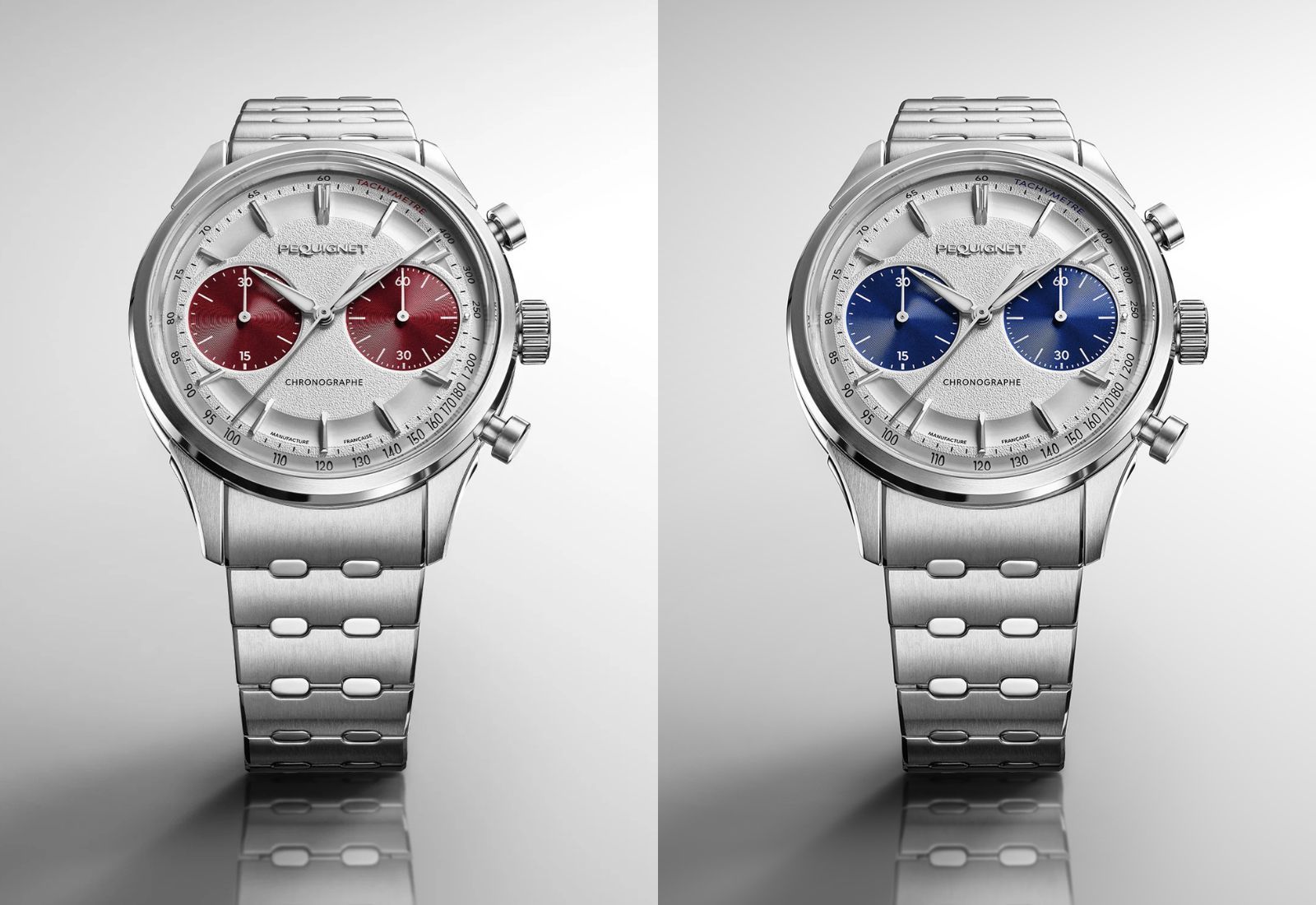
I said last time that Pequignet doesn't get enough attention, and here they are proving the point again. Pequignet was founded in Morteau in 1973, went through a rough patch before being acquired by Enowe in 2021, and has been making a strong case for itself ever since. The Royale Paris Chrono is the first chronograph in the collection, and it arrives with the same signature case architecture: those individually produced lugs, the satin-brushed surfaces with polished bevels, now wrapped around a more complicated movement.
The case is 39.5mm wide and 12.7mm thick, built in 316L stainless steel. The recessed flanks give it a sportier profile than the dress-watch silhouette of the manual version, and the classic piston-style chronograph pushers suit the overall tone well. On top is a box-style sapphire crystal. Brushed surfaces alternate with polished bevels throughout, a finish carried onto the steel bracelet — wide brushed central links flanked by two smaller polished connectors. The bracelet is interchangeable.
The opaline matte off-white dial looks great. There's a wide circular trench cut between the tachymetre scale and the central section, and the faceted hour markers bridge that gap, connecting the two grained zones of the dial. It's an unusual construction that gives the dial a ton of depth. The two large sub-dials sit horizontally across the centre, recessed and snailed in either blue or red. Lume appears only on the hour and minute hands.
The movement is the Calibre Initial Chronograph, developed with an unnamed Swiss manufacture, and it's the fifth movement Pequignet has released. The base Calibre Initial is 4.2mm thick, and the chronograph version uses a cam-actuated column, which the brand claims handles shocks better than a column-wheel setup. They don’t, however, give more stats beyond that. We do know that the bas movement beats at 4Hz and has a 65 hour power reserve. So should be in that range.
The Royale Paris Chrono is available from 15 May 2026, priced at €6,450. See more on the Pequinet website.
6/
A Duo From Hautlenece As Strange As You Would Expect From Them

Hautlence has been a reliable source of genuine surprise at every major event. The Neuchâtel brand, founded in 2004, never shows up with mild iterations — they show up with things that require a second look, and sometimes a third. At Watches & Wonders this year they have two releases, and they sit at opposite ends of even Hautlence's wide range, despite looking fairly similar. One is a new collection built around a completely new case direction for the brand. The other is a three-piece limited edition that opens like a communicator from a 1960s science fiction series and contains a flying tourbillon. Wild.
The Kubera, named after the Hindu god of wealth and underground treasures, introduces an octagonal square-shaped case that departs from Hautlence's signature TV-shaped rectangles while keeping everything else the brand is known for: unusual time display, integrated bracelet, geometric intensity. The eight-sided case is built in stacked tiers, rising in layers like a miniature stepped pyramid. Those same tiers continue down through the integrated bracelet, which tapers toward a folding clasp with micro-adjustment. The bracelet links, armour-like and progressively smaller as they descend, give the whole construction a texture that's been compared to an armadillo from certain angles. The sandblasted surfaces are interrupted by thin polished bevels, and the bezel sits in a dramatically recessed area above the octagonal case bed. The case is made out of stainless steel, 36mm wide, 43.8mm long, 11.3mm thick.
The dial continues the architectural logic. An engraved geometric pattern sits beneath olive green lacquer, and the whole surface, depending on the angle, appears to look like the four faces of a pyramid. Time is displayed without hands: a jumping hour appears in an octagonal window at noon, with a turquoise background, and the minutes are shown by a circular cursor in the same turquoise that travels around the dial on a hidden track. The colour coordination between those two display elements is a considered detail — it ties a fairly busy visual program together.
The movement is a La Joux-Perret automatic base, paired with an Agenhor-developed module that handles the jumping hours and peripheral minutes display. It beats at 4Hz with a 70-hour power reserve. The "Series 1" designation in the name signals that this is intended as a platform — expect further references down the line. The Kubera retails at CHF 35,600, without taxes. See more on the Hautlence website.
Then there is the Retrovision '64. Hautlence has done this before — the Retrovision '47 was modelled on vintage radios, the Retrovision '85 on robots — and the formula has always been the same: take a pop culture object from a specific era, convert it into a timekeeping machine, keep the theatrics. The '64 takes the handheld communicator from 1960s science fiction television as its reference point, which means a flip-top cover, a crown at noon, and a brown PVD titanium case with red gold PVD accents. The cover itself is perforated in a grille pattern and also finished in red gold PVD. The case measures 61.2mm long, 41.8mm wide, and 15.6mm thick.
Open the cover and you get the time layout. At the bottom, a linear retrograde jumping hour track displays the hours in orange-lacquered numerals against a matching orange arrow indicator. Above that, a golden-framed minutes display runs on a green-and-orange lacquered track with Globolight numerals and an orange-tipped lumed hand. The centre of the dial is cut away, revealing the movement, and in that opening, offset to one side, there is a one-minute flying tourbillon with a double hairspring.
The D50 automatic calibre has 239 components and 39 jewels. It beats at 21,600vph and delivers 72 hours of power reserve. The watch comes on a black rubber strap with a titanium pin buckle. Limited to three pieces and priced at CHF 129,700, without taxes. The watch is still not on the brand’s website, but I assume it’s coming soon.
7/
Urwerk Goes Full Jewelery With The Incredible UR-101 Diamond Sky
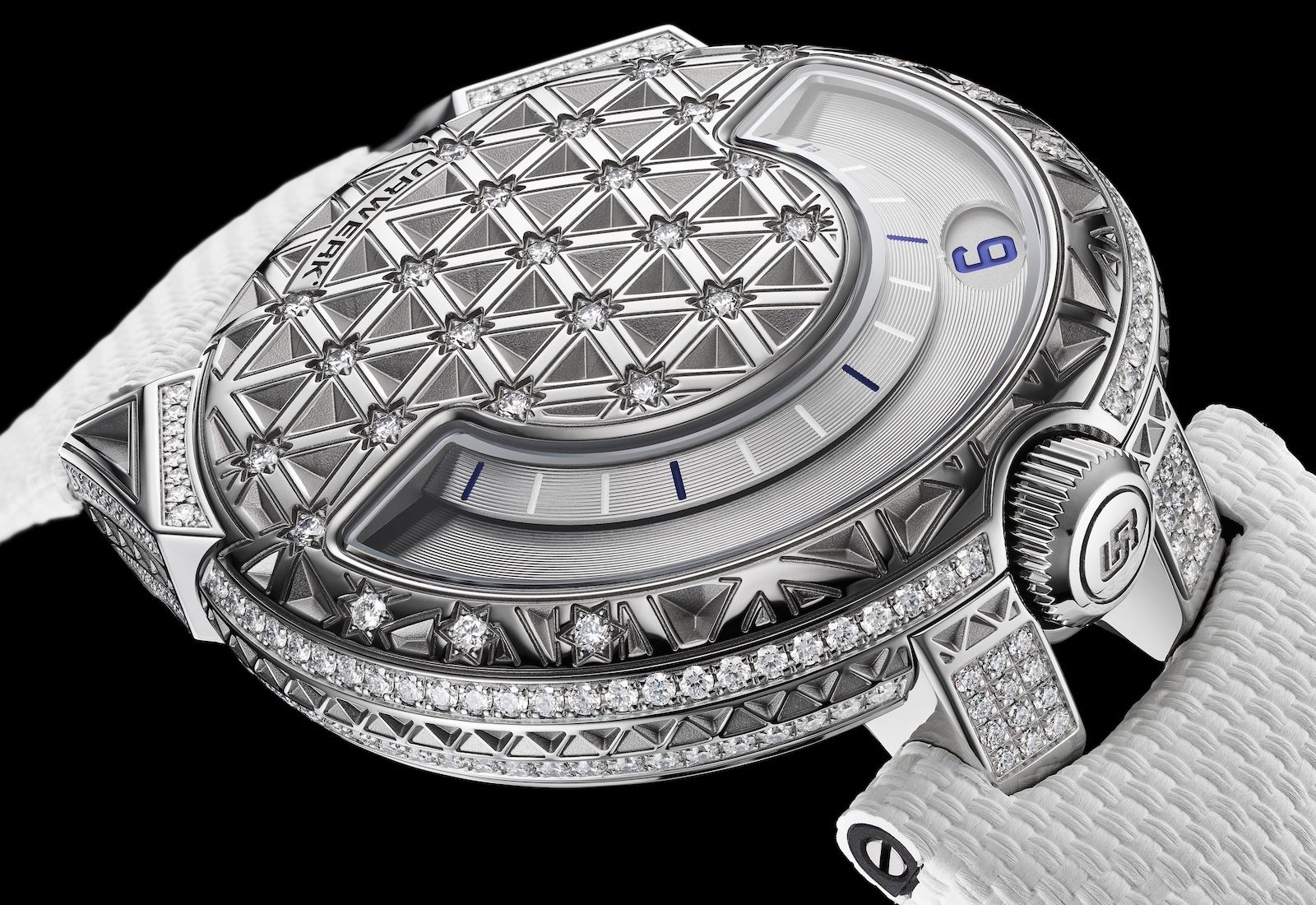
The UR-101 has been having a moment. Earlier this year, Urwerk relaunched it with a bronze, hand-painted case textured to resemble dinosaur scales — a bold, tactile thing that made the watch feel alive again after nearly three decades. Now, imagine the exact opposite watch, and you get their new UR-101, the Diamond Sky. Where the T-Rex was raw and geological, this is precise and just sexy: 214 responsibly sourced diamonds set into a geometrically engraved steel case, forming something closer to a star chart than a jewelry watch. Urwerk doesn't do jewelry halfway.
The case is 41mm wide and 9.33mm thick, which makes it the slimmer of the two UR-101 relaunches. Consider that. It’s a domed watch, one that has a wandering hour complication, and it still comes under 10mm. Pretty impressive. That top domed case then has an engraved geometric network that’s incredible to behold up close. The diamonds are set into the intersections of the network and there’s a total of 1.63 carats. The crown sits at 12 o'clock with a pusher on the caseback for setting. Water resistance is 30 meters.
The display is unchanged from the UR-101's original concept. Two rotating satellites carry the hours along a 180-degree minute track, left to right, with each hour giving way to the next in a continuous motion. Super-LumiNova on the numerals and minute markers keeps the time legible in dim light.
Inside is calibre UR-1.01V, the same movement used in the T-Rex — a Vaucher base with Urwerk's in-house wandering hours module built on top. It runs at 28,800 vph, has a 48-hour power reserve, and is finished with sandblasting, snailing, and satin brushing on a mix of brass, copper, and ARCAP. The strap is white textured rubber with a black calfskin lining, closed with a steel pin buckle.
The UR-101 Diamond Sky is limited to 25 pieces, priced at CHF 85,000 excluding taxes. See more on the Urwerk website.
📢 Closing message
Ancestra 蛟 (Jiāo) — Born from the World’s Oldest Dragon: A Dress Watch 6,700 Years in the Making
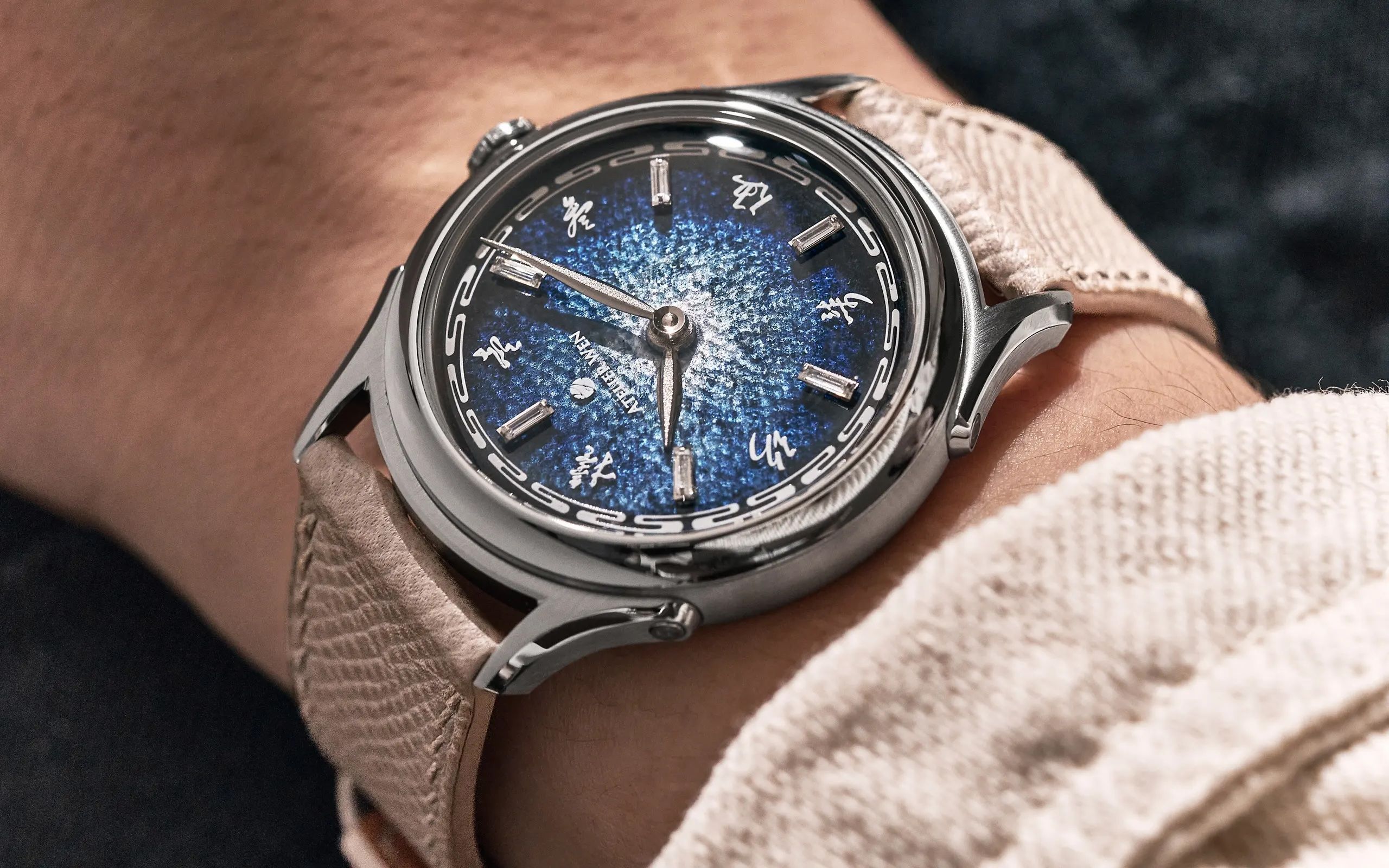
While the Perception proved Atelier Wen’s technical credentials, the Ancestra reveals the brand’s deeper ambition: to act as a bridge between China’s ancient artistic heritage and the traditions of fine haute horologie. The 38mm 904L steel case takes direct inspiration from the 猪龙 (zhū lóng) — the pig-dragon jade carvings of the Hongshan culture (4700–2900 BC), humanity’s earliest known dragon depictions.
The detached, screw-fastened lugs curve sharply downward to ensure wrist-friendliness at 46mm lug-to-lug and 11.3mm height. The dial is a hand-hammered grand feu enamel fumé by Kong Lingjun’s Beijing workshop, grading from pale silver at the centre to deep cobalt at the periphery, achieved across six kiln firings.
Baguette-cut lab-grown diamonds mark alternate hours. The caseback displays 446 characters from the ancient poem 天问 (tiān wèn) laser-etched onto the Pequignet EPM03’s three-quarter bridge, which delivers 65 hours of power reserve, regulated to -4/+6 seconds per day.
⚙️Watch Worthy
A selection of reviews and first looks from around the web
⏲️End links
A bunch of links that might or might not have something to do with watches. One thing’s for sure - they’re interesting
Craig Fehrman was working on a book about the Lewis and Clark expedition when he was attacked by a dog. He recovered, but the violent experience—which was something the expedition crew was no stranger to—ruptured the boundaries between his life and his subjects’ lives. Names and dates were important, but they were also an abstraction of sorts; his solution was to dig for the crux of what people actually experienced.
What links ranches in Montana and the Brazilian Amazon? The ultra-rich—who extract monumental wealth from one landscape and then store and protect it in another. In this tale of ecological hypocrisy, Joseph Bullington explores the radically different standards imposed on two ecosystems. One is being lost, the other we can never enter. The ultimate case of “Not In My Back Yard.”
Tessa McLean profiles Darwin, California, a small community near Death Valley National Park. Once a mining town, Darwin has attracted people for its cheap housing and the sense of solitude and freedom in the desert. But the rise of ghost-town tourism, a declining and aging population, and a struggling water system now threaten Darwin’s survival. Its residents are hoping the right kind of newcomers will find their way there.
👀Watch this
One video you have to watch today
My brain is fried from this week, so I’ll just spend all sunday watching art restoration videos to relax.
What did you think of this newsletterYour feedback will make future issues better |
Thanks for reading,
Vuk
Reply