- It's About Time
- Posts
- Timex Releases The Deepwater Arctic; Ressence's Type 11, First With Own Movement; Bell & Ross Simplifies Wild BR-X3; Kiwame's Third Chapter; A Champagne Louis Moinet; Rexhepi's First Chronograph
Timex Releases The Deepwater Arctic; Ressence's Type 11, First With Own Movement; Bell & Ross Simplifies Wild BR-X3; Kiwame's Third Chapter; A Champagne Louis Moinet; Rexhepi's First Chronograph
A new chapter opens up for Ressence with a brand new movement

Vuk Radic
April 08, 2026
Sponsored by

Hey friends, welcome back to It’s About Time. Watches and Wonders will be a wild show. I have more than 50 meetings scheduled, and I’m lining up some very interesting updates to the newsletter so make sure you don’t skip next week’s issues (maybe even drop a follow on instagram, as I’ll try to do some live streaming there). But while preparations are intense, I was caught by surprise by the massive Universal Geneve release today, so find those tomorrow, just know I have it covered.
HELP RUN THIS NEWSLETTER
If you like this newsletter, and would like to support it, there’s two ways you can do it. First, the completely free one — just share it with your friends. That’s it.
However, if you would like to help me pay for all the services that are needed to run it, you can get a premium subscription, one that gets you a TON of extra content every week.
A paid subscription will get you:
the satisfaction of helping run your favorite watch newsletter
no ads
weekly Find Your Next Watch posts
early access to reviews
Watch School Wednesday posts
a look at watches you haven't seen before
historical deep dives
Your Retirement Savings Need to Outlast You

Most retirement plans underestimate two things: how long your savings need to last, and how quietly inflation erodes them along the way.
The 15-Minute Retirement Plan helps you close both gaps with practical guidance on longevity risk, purchasing power, and building a financial plan that doesn't run out before you do.
If you have $1,000,000 or more saved, download your free guide to start.

In this issue
Timex Releases The Deepwater Arctic, A Very Solid Diver At A Great Price
Ressence Takes A Big Step With The Brand New Type 11, Their First Watch With A Proprietary Movement
Kiwame Tokyo Launches Third Chapter Of Watches With The Approachable MUNE Series
Louis Moinet Releases A Champagne Version Of Their 1816 Chronograph
Rexhep Rexhepi Debuts His First Chronograph With The Chronograph Flyback RRCHF
👂What’s new
1/
Timex Releases The Deepwater Arctic, A Very Solid Diver At A Great Price

Timex has been building out the Deepwater line steadily, and the pieces keep getting better. The Meridian came in at 44mm and leaned into bold proportions; earlier this year, the Reef kept things at 41mm with a composite case option. The Arctic lands somewhere in between in spirit, if not size — 40.5mm, tighter, more polished — and makes a strong case that Timex is now thinking seriously about this segment.
The case is 40.5mm wide and 11.5mm thick, stainless steel with straight lugs and polished chamfers that give it a sharper profile than the Meridian's sportier look. The ceramic bezel insert engraved with dive markings and has a lumed pip at 12. A sapphire crystal sits on top, AR-coated. Water resistance is 200 meters via a screw-down crown and solid caseback.
For the first time in the Deepwater line, Timex introduces Arabic numerals at the four cardinal positions, paired with applied trapezoidal hour markers at the other positions. Both are filled with Super-LumiNova, as are the hands — broad-arrow minute, bold hour, arrow-tipped seconds. The two core references are black dial/black bezel and blue dial/blue bezel. The third adds gold-tone hands, indices, and numerals against a black dial, with a brown polished ceramic bezel and matching gold-tone accents on the bracelet's center links. On paper it could easily go wrong; in practice it’s the most interesting of the three.
A quartz movement powers everything, which makes obvious sense given the price and the 11.5mm case thickness. The bracelet is a five-row design with brushed outer links and polished center links.
The black and blue steel models are priced at €289, with the two-tone variant at €299, and they are available now. See more on the Timex website.
2/
Ressence Takes A Big Step With The Brand New Type 11, Their First Watch With A Proprietary Movement
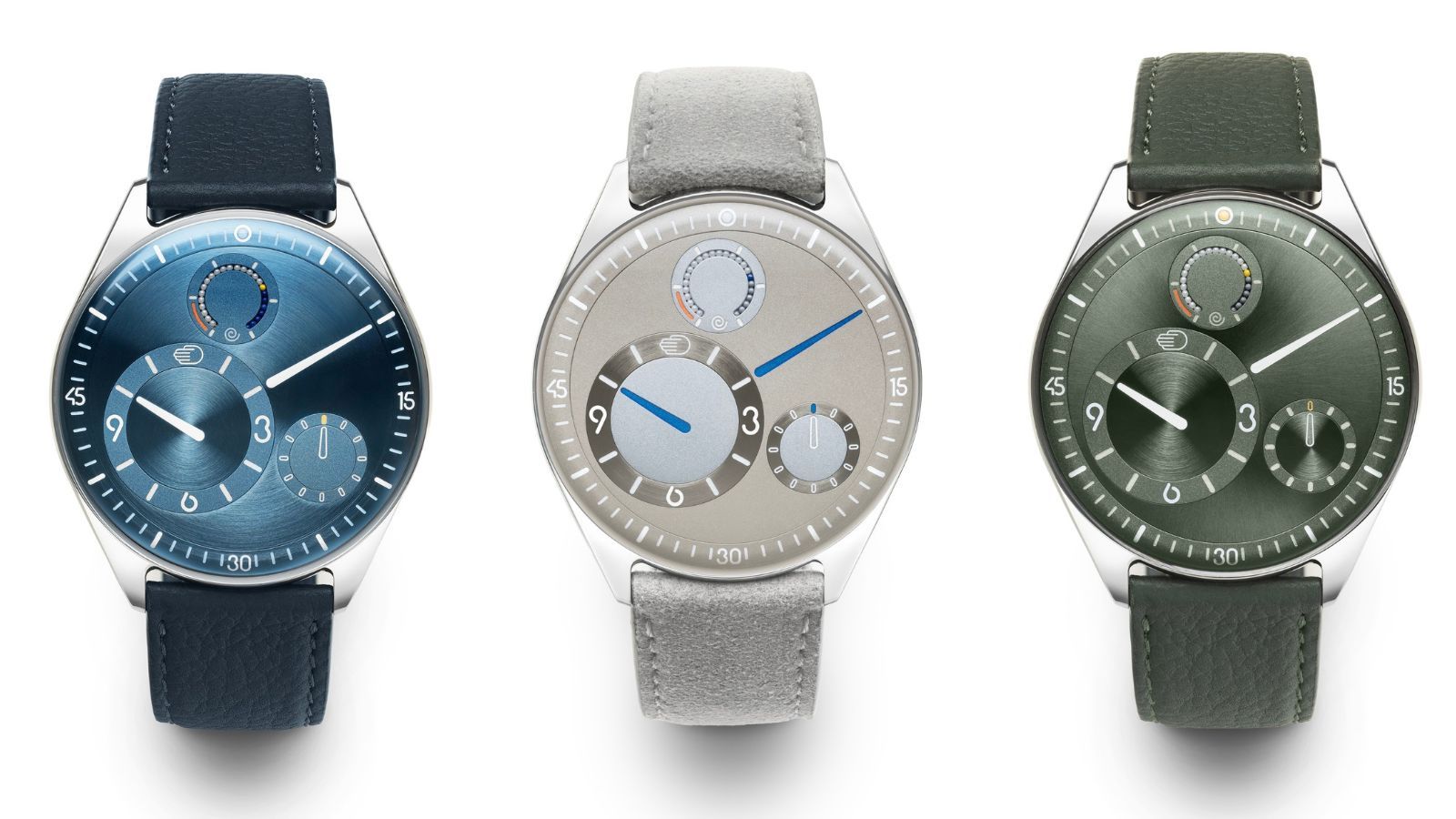
Ressence has been doing something genuinely unusual since Benoît Mintiens founded the brand in Antwerp in 2010: replacing hands with a dial system where everything rotates, all the time, and nothing is static. I've been covering Ressence for years, and you know how much Iove the brand. A VC Overseas Everest GMT and a Ressence Type 3 are my ultimate 2-watch collection. And every time a new Ressence comes out, I lose my mind, because I love them so much. But this one, the Type 11, is something that will make all of you excited, not just me. With the Type 11, Ressence is introducing their first proprietary movement, which is a big deal since they’ve been making watches for almost two decades based on heavily modified ETA automatics with a wild magnetic connection between the movement and a module that controls the orbiting dials. The new movement changes the relationship between movement and dial entirely: where they were previously two separate modules stacked together, they now form a single integrated unit.
The 41mm wide, 11mm thick polished titanium case will look familiar to anyone who knows Ressence — the pebble profile, the flush sapphire, no crown breaking the silhouette. That’s because the winding is once again done on the caseback, here with a hinged lever that pops up for easier and more secure use, and there’s a small aperture on the caseback. To be honest, I have no idea what that’s for. The main advantage of a propriatery movement is the fact that they could keep the watch at 11mm, even with the hugely double domed crystal on top. Water resistance is 30 meters, but who cares.
The dial runs in three colorways — Pine, Sky, and Latte — each with a sunburst finish at the center, circular finishing inside the hour and seconds sub-dials, and a grained texture on the outer minutes track. The layout of minutes and hour indicators ramains very familiar, but there’s a new power reserve indicator at 12 o’clock which is pure Ressence — made up of hand painted ceramic balls that roll to indicate how much power is available.
The new movement inside is called the RW-01, made by Concepto, and has an ultimately strange, almost triangular architecture. But it’s really beautiful, and it’s a shame they still don’t have a way to show the movement through the caseback.. The new movement comes with a 60 hour power reserve, which is a significant update from the ETA powered 36 hours. The movement still has the ROCS module that Ressence used previously, but here it’s integrated into the movement, riding on titanium ball bearings. Strap options include leather, rubber, a leather-rubber hybrid, and a titanium Milanese mesh bracelet.
The Type 11 is available from May 2026, priced at CHF 23,000 excluding taxes. See more on the Ressence website.
3/
Bell & Ross Simplifies The Wild BR-X3 By Dropping The Tourbillon And Makes It Slightly More Accessible
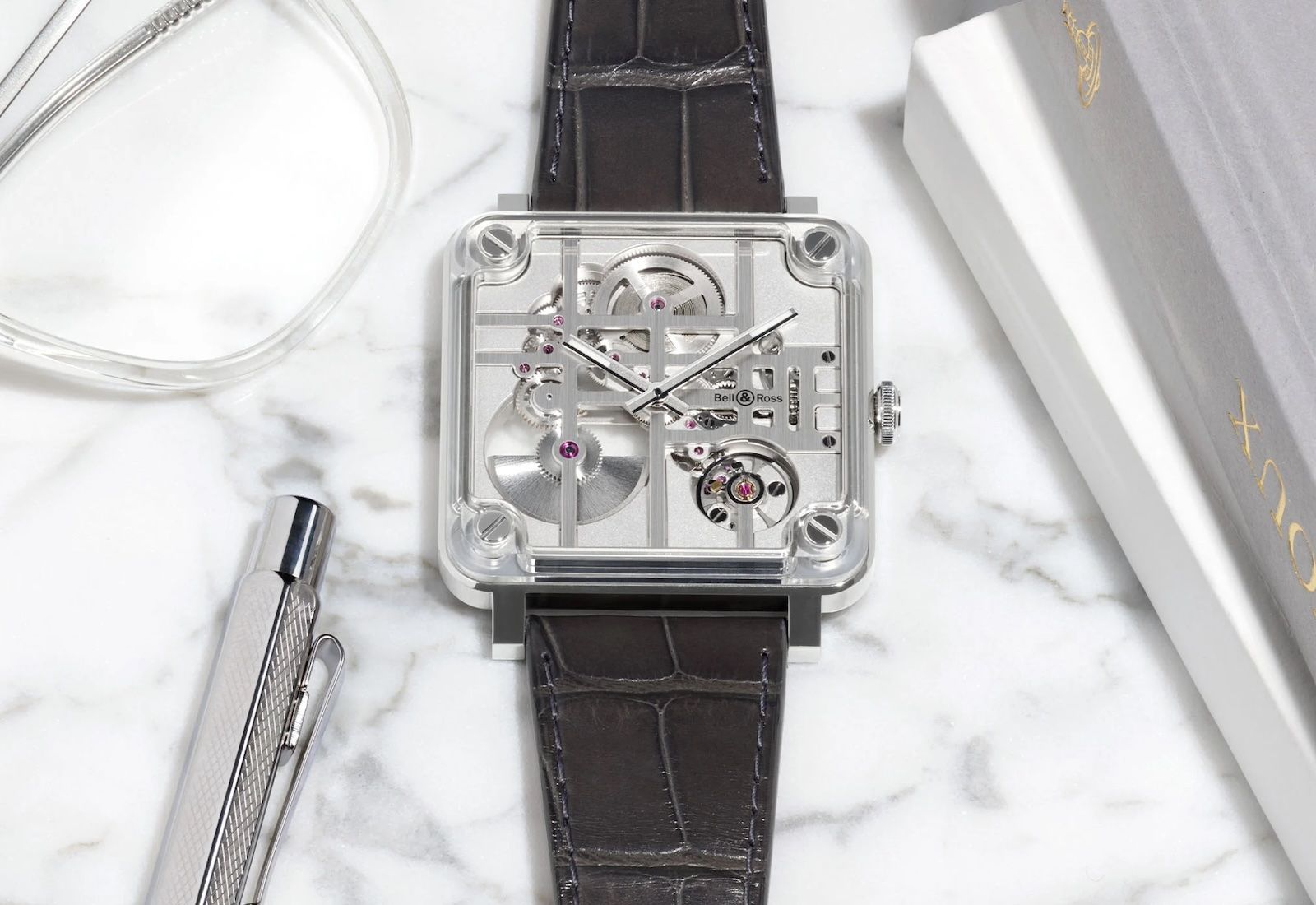
Bell & Ross introduced the BR-X3 Tourbillon Micro-Rotor earlier this year — a fully skeleton-cased, €89,000 statement piece limited to 25 watches. This is the follow-up, and the one that makes the concept (just slightly more) accessible to more than 25 people. The BR-X3 Micro-Rotor strips out the tourbillon, keeps everything else that makes the original interesting, and comes in at €22,000 with a run of 99 pieces.
The case is 40mm wide and 9mm thick, steel, with a mix of satin and polished finishing. The front and back extend all the way to the edges to give you a full look at what’s happening. Here the case and movement plate are built as one — the central plate is structural. Four corner screws are in place, as always. Water resistance is 50 meters.
No dial, as you'd expect. Two central lume-filled hands tell the time, and from there the architecture takes over: bridges and plates arranged across the open space, balance wheel ticking away at 4 o'clock. There’s no running seconds hand, but the balance wheel in motion fills that role well enough. The overall palette is steel and grey — microblasted and brushed surfaces, polished edges catching the light.
The movement is the proprietary BR-CAL.390, developed with Concepto specifically for this watch. It’s an automatic with a micro-rotor integrated into the layout rather than sitting on top, which helps with the 9mm thin construction. Power reserve is 48 hours. The watch ships on a grey calfskin strap with a faux alligator texture, matched to the steel and grey tones of the case.
The Bell & Ross BR-X3 Micro-Rotor is priced at €22,000 and limited to 99 pieces. See more on the Bell & Ross website.
4/
Kiwame Tokyo Launches Third Chapter Of Watches With The Approachable MUNE Series

Kiwame Tokyo is a young Japanese brand from Asakusa with a clear mission: affordable, honest watches that don't apologize for what they are. Their first releases, the Kurotsuki and Usuki, turned heads for their great designs and even better bang for buck. The IWAO Field series followed last year with a sportier take, but similar philosophy. Now comes the MUNE Series, which circles back to where Kiwame started.
The case is carried over from the original collection: 38mm wide, 9.5mm thick, with a stepped, bevelled bezel, flat sapphire crystal, and a lug-to-lug of 46mm. The middle section mixes polished and brushed surfaces, the caseback screws down, and 100 meters of water resistance comes courtesy of a push-pull crown — respectable for a dress-leaning watch at this price. The proportions and design hit the Calatrava-adjacent sweet spot without actually being a dress watch.
The collection launches with two dials: the MUNE Usuki in a warm, lacquered ivory and the MUNE Kurotsuki in black, with noticeably more depth and contrast. Both have applied Arabic numerals, finished in matte black on the Usuki and vertically brushed on the Kurotsuki. The index at 12 o'clock is shaped after the ridge of a traditional Japanese roof (mune, in Japanese — hence the name), and baton hands with a central ridge carry lumed inserts. The seconds hand references the roof of Asakusa's Kaminarimon Gate in miniature. It all sounds like a lot, but the result is coherent.
Inside is the Miyota 9039, running at 4Hz with a 42-hour power reserve — the same automatic movement Kiwame used before, time-only. Accuracy is rated at -10/+15 seconds per day. The watch comes on a calf leather strap with quick-release spring bars.
The MUNE Usuki and MUNE Kurotsuki are priced at $690, available from April 15th. See more on the Kiwame website.
5/
Louis Moinet Releases A Champagne Version Of Their 1816 Chronograph

The 1816 is one of Les Ateliers Louis Moinet's anchor references, named after the year Louis Moinet completed what turned out to be the world's first chronograph — his Compteur de Tierces, built to time the movement of stars. I've seen this watch in person at Geneva Watch Days, and the dial architecture, which mirrors the layout of that original instrument, is genuinely compelling. For 2026 and the 210th anniversary of that invention, the brand is releasing a new edition of the 1816 Chronograph in champagne.
The case stays exactly where it's always been: 40.6mm wide, 14.7mm thick, grade 5 titanium with a mix of polished and satin-brushed surfaces. The Directoire-style semi-bassine profile, with its smooth case middle and double gadroon flanks, is distinctive and looks nothing like anything else. Two pushers flank a crown engraved with a fleur-de-lys. Water resistance is 30 meters.
The dial is the novelty here. Twenty-three components make up a champagne-toned construction that arranges its subsidiary dials exactly as Moinet did in 1816: small seconds and 30-minute counter on the top half, flanking the central chronograph hand, with the 12-hour totaliser below. The hour counter uses Roman numerals in reference to the original piece. Rhodium-plated rings give the counters structure and legibility. Blued steel hands throughout, luminescent tips on the skeletonized hour and minute hands. The champagne hue also appears on the middle links of the titanium bracelet, which is a nice touch.
Inside is the brand's own LM1816 calibre: 330 components, 34 jewels, column wheel, hand-wound, 48-hour power reserve at 28,800 vph. The caseback shows the usual Louis Moinet visual drama — contrasting bridges, blue screws, red rubies. The swan-neck regulator and instantaneous minute counter are visible for those who know what to look for. The bracelet is made out of grade 5 titanium with champagne DLC on the intermediate links.
The Louis Moinet 1816 Chronograph in champagne, reference LM-150.20.30, is priced at CHF 28,900 excluding taxes. See more on the Louis Moinet website.
6/
Rexhep Rexhepi Debuts His First Chronograph With The Chronograph Flyback RRCHF

Rexhep Rexhepi has been one of independent watchmaking's most closely watched figures since the moment Akrivia launched in 2012, and the LV collaboration from 2023 only accelerated that attention. In the three years since the Chronomètre Contemporain II, he's been quiet on new models — understandably so, given that he makes roughly fifty watches a year and the waitlist pressure that comes with that. The new Rexhep Rexhepi Chronograph Flyback RRCHF is his first chronograph, and what a chronograph it is. The work of a genuine master.
The case is 38.8mm wide and, not shockingly from RR, under 10mm thick. Still, a real achievement for a flyback chronograph. It comes in either platinum or rose gold, with a stepped bezel, curved elongated lugs, and rounded-rectangular pushers. The lug design is a direct nod to the late Jean-Pierre Hagmann, the Geneva casemaker who collaborated with Akrivia until his death last year and whose fingerprints are all over Rexhepi's aesthetic language. Water resistance is not listed in the press material. The caseback is bassine-shaped, which keeps the watch sitting comfortably flat on the wrist.
Two dial configurations are available: a green-blue enamel in the platinum case, and black enamel in the rose gold. The hour and minute display is pushed to a subsidiary subdial at 12 o'clock, giving the oversized chronograph seconds hand the full run of the dial. A minute counter and small seconds create a pyramidal visual hierarchy. The sub-dials use tinted sapphire, letting the movement show through. Numerals and markings echo the RRCC family, and the hand-made stepped steel hands are exactly as intricate as you would expect.
The movement is fully in-house and hand-wound, with a horizontal clutch and column wheel chronograph mechanism. A single large barrel gives 72 hours of power reserve. The balance beats at 21,600 vph with a Phillips overcoil. What's most striking architecturally is the symmetry: the layout reads almost like a mirror image from top to bottom and left to right, with the chronograph mechanism sitting between the barrel above and the gear train and large balance wheel below. The finishing is deep Geneva stripes, sharp internal bevels, and a centre bridge in two materials — steel and maillechort — polished to a standard you won't find outside of perhaps five other workshops. The strap is hand-sewn nubuck leather, made near Akrivia's Geneva headquarters.
The Rexhep Rexhepi Chronograph Flyback RRCHF is priced at CHF 150,000 in either case material. Production is around fifty watches total per year across all Akrivia references. More at akrivia.com.
⚙️Watch Worthy
A selection of reviews and first looks from around the web
⏲️End links
A bunch of links that might or might not have something to do with watches. One thing’s for sure - they’re interesting
“What makes one person fold into despair and another walk through the countryside looking for graves?” For the first issue of Now Voyager, John Gibler tells the story of Araceli Salcedo Jiménez, whose daughter, Rubí, was abducted from a bar in Veracruz, Mexico, in 2012. Since then, Jiménez has coordinated search parties that have surfaced the remains of dozens of Mexico’s disappeared—but never those of her daughter. Gibler folds years of reporting into a story that braids Rubí’s disappearance with Jiménez’s perilous search.
When tools like Chat-GPT first gained widespread popularity, their tendency to hallucinate citations and references led to shame for scientists and attorneys who slipped those citations into their own briefs and studies. The pattern was troubling, but also avoidable—a little extra due diligence could weed out the confabulated referents. But as Nature finds in a collaboration with the screening company Grounded AI, scientific studies are increasingly filled with hallucinations that are slipperier than they appear. A title that matches up with a cited author’s area of study; co-authors that have published together previously; even volume/page numbers that sync to the supposed journal and date of publication. The result is a piece of microfiction, an imagined work of research that is fully plausible, but doesn’t actually exist. Remember when we bemoaned the erosion of “truth” just one short decade ago? As it turns out, we ain’t seen nothin’ yet.
Some time ago, Paul Collins began documenting deaths that occurred in clothing donation bins, whose designs are hostile and can be lethal, depending on the interaction. In his enthralling feature, Collins explores issues of design, regulation, homelessness, and invisibility, utterly transforming our understanding of a commonplace community fixture.
👀Watch this
One video you have to watch today
Two great things about this video: Jack Black enters the five-timers club on SNL, which very few people have done; and, how have Jack Black and Jack White never gone on tour?
What did you think of this newsletterYour feedback will make future issues better |
Thanks for reading,
Vuk
Reply