- It's About Time
- Posts
- The Watches And Wonders Reporting Continues With A Slew Of Pateks; Great Releases From Oris; And Cool Stuff From Zenith; Frederique Constant; Chopard; Piaget And Moser
The Watches And Wonders Reporting Continues With A Slew Of Pateks; Great Releases From Oris; And Cool Stuff From Zenith; Frederique Constant; Chopard; Piaget And Moser
I can't remember the last time I saw this many releases from Patek

Vuk Radic
April 17, 2026
Coverage of Watches and Wonders is brought to you by

Hey friends, welcome back to It’s About Time. Another weird timing for the newsletter, but as readers I’ve met here in Geneva can attest, it’s still complete chaos! Can’t wait to get home and sleep for 48 hours straight.
HELP RUN THIS NEWSLETTER
If you like this newsletter, and would like to support it, there’s two ways you can do it. First, the completely free one — just share it with your friends. That’s it.
However, if you would like to help me pay for all the services that are needed to run it, you can get a premium subscription, one that gets you a TON of extra content every week.
A paid subscription will get you:
the satisfaction of helping run your favorite watch newsletter
no ads
weekly Find Your Next Watch posts
early access to reviews
Watch School Wednesday posts
a look at watches you haven't seen before
historical deep dives
In this issue
Oris Revives the Star After 60 Years and Rebuilds the Artelier Complication From the Dial Down
Zenith Strips Down The El Primero And Revives A Legend At Watches & Wonders
Frederique Constant Updates The Classic Worldtimer With New Case, Dial And Movement
Piaget Brings Gadroons To The Polo Signature Date In Two Sizes, Two Metals
H. Moser & Cie. Uses Tantalum For The Case And Dial Of The New Endeavour Perpetual Calendar Concept
👂What’s new
1/
Patek Philippe Marks 50 Years Of The Nautilus With Three Stripped-Back Editions, And 13 Other Watches

There are 16 new references from Patek Philippe this year, which is a lot for a brand that usually treats restraint as a virtue. The Nautilus turns 50, the Cubitus gets its first grand complication, and somewhere in the middle of it all there's a pocket watch and a automaton wristwatch that together probably cost more than a house. Not everything here requires equal attention, but a few of these are genuinely significant.
The headliner, if there is one, is the 6105G Celestial Sunrise and Sunset — a 47mm astronomical grand complication in a no-lug case, displaying the night sky as seen from Geneva, moon phases, and for the first time on a Patek wristwatch, sunrise and sunset times. The watch holds six patents. A corrector lets you toggle summer and winter time on those solar indications. The watch comes on a black composite strap with an X pattern. Price is set at CHF 350,000.
The Cubitus gains its first grand complication with the 5840P Perpetual Calendar Skeleton. Platinum case at 45mm, fully openwork, rectangular movement visible through the dial. The watch comes on a navy composite strap. Whether the Cubitus has grown on you or still doesn't make sense, it’s certain that Patek will develop it to a full collection. Price is set at CHF 150,000.
The three Nautilus 50th anniversary pieces are the ones that will generate the most conversation. All three strip the Nautilus back to its essentials — time only, with no seconds hand, calibre 240 micro-rotor, ultra-thin. Two 41mm white gold versions (5810/1G-001 limited to 2,000 pieces at CHF 75,000; 5810G-001 limited to 1,000 pieces at CHF 60,000) and one 38mm platinum version (5610/1P-001, 2,000 pieces, CHF 90,000). A pocket watch — the 958G-001 — rounds out the anniversary set: 50.7mm white gold, baguette-diamond indices, convertible to a desk clock, limited to 100 pieces. The hand-wound 31-505 calibre runs eight days on two barrels and displays hours, minutes, date, day, small seconds, and power reserve. That one will run you CHF 205,000.
The 5249R "The Fox and the Crow" is the most unusual thing here: Patek's first modern automaton wristwatch, a reinterpretation of a 1958 pocket watch from the museum, in a 43mm rose gold case. Press the pusher and the La Fontaine fable plays out on the dial. Hours and minutes displayed on demand. It’s impressive and cute at the same time, but priced at CHF 320,000. The 5270P Chronograph Perpetual comes in platinum with a concave bezel, two-tier lugs, and a choice of charcoal, blue, or red lacquered dials for CHF 199,000. The 7047G minute repeater puts an embossed carbon-pattern navy dial with orange printing inside a fully polished 38mm white gold case. The CHF 445,000 price tag makes me feel a bit sick.
Of the more accessible references, if that exists in the Patek range: the 5227G Calatrava in 39mm white gold with a salmon opaline dial is easily one of the best things in the lineup at CHF 37,800. The 5236P in-line perpetual calendar continues in 41.3mm platinum, now with a brushed silvery gradient dial. The CHF 124,800 price tag moves it out of the accessible range. The 5322G 24-Hour Alarm replaces the 5520 Travel Time with a cleaner Calatrava case and gradient green or blue dial, delivered with two strap options — CHF 225,000. The 5396R Annual Calendar Moonphase gets a rose gold case with a sandy beige sunburst dial and will run you CHF 54,000. The 4946G Annual Calendar in white gold adds a blue-grey shantung-textured dial to a reference introduced in 2025 — CHF 48,900. The 5204G Split-Second Chronograph Perpetual updates Patek's most complex mechanical complication in white gold with a navy dial — CHF 304,700. The 7129J Worldtimer brings a carmine red, hand-guilloché dial in 36mm yellow gold — CHF 46,000. Two 7200/50G ladies Calatrava variants in white gold at CHF 30,100. And two Golden Ellipse models in olive green — the larger 5738G at CHF 34,400, the medium 3738/100G at CHF 32,400, with matching cufflinks available for the full look.
See all of these watches on the Patek website.
2/
Oris Revives the Star After 60 Years and Rebuilds the Artelier Complication From the Dial Down

Oris has a habit of reaching into its own history and pulling out something worth revisiting. This year they did it twice, with two watches that have almost nothing in common except that both are better than they sound on paper.
The Star is a revival of a 1966 model that was significant for reasons beyond design. Getting that watch made required Oris — with the help of Dr. Rolf Portmann — to successfully challenge the 1934 Swiss Watch Statute, which had locked the brand into inferior pin-lever movements. The Star was their first with a lever escapement, and the re-edition takes the original seriously. The 35mm barrel-shaped case in stainless steel has integrated lugs finished with vertical satin-brushing and wide polished bevels, with a vintage Plexi-crystal on top. The lug-to-lug is 41.5mm. Inside is Oris calibre 733, a Sellita SW200-1 running at 28,800vph with a 41-hour power reserve. The silver dial reproduces the original — crosshair center, double-baton applied markers, square-tipped hands, trapezoidal date window at three. Black leather strap, steel pin buckle. Water resistance is 50 meters. Available May 2026, priced at €1,800. This just might be the secret hit of Watches and Wonders, with a wonderful vintage design, that’s backed up with similarly vintage proportions.
The Artelier Complication goes back to 1991, when Oris introduced the model alongside an in-house moonphase module — important releases for a brand rebuilding its manufacturing credibility after the quartz crisis. The watch was updated in 2017 and has now been handed to Lena Huwiler, Oris's 24-year-old Product Design Engineer, who has done more than refresh the aesthetics. The new Calibre 782 reduces the dial from four registers to two: moonphase at 12, a 24-hour second time zone at six. Both the moonphase and the second timezone are adjustable through the crown and a single pusher integrated into the case flank. The case is 39.5mm wide, 11.8mm thick, lug-to-lug of 45.5mm, with a domed sapphire crystal. Three colorways: ivory, midnight blue, and chestnut — the first two monochromatic with matched subdials, the chestnut with more contrast. Strap version is $2,950, bracelet is $3,150. See all of these novelties on the Oris website.
3/
Zenith Strips Down The El Primero And Revives A Legend At Watches & Wonders

Zenith has been on a focused run lately — the Chronomaster Sport keeps getting sharper, and last year's G.F.J. revival signalled that the brand was serious about its pre-El Primero history too. Both threads continue at Watches & Wonders.
The Chronomaster Sport Skeleton is surprisingly interesting. Zenith has been building on the 2021 Sport's foundation ever since, and stripping the El Primero 3600 down to its bones is a logical next step. The sapphire crystal dial has a smoked-black periphery and a transparent centre that exposes everything worth seeing: the blue column wheel, the horizontal clutch architecture, the silicon escape wheel. Four versions share the same 41mm case with pump pushers, alternating brushed and polished surfaces, a screw-down crown, and 100 meters of water resistance. The ceramic bezel carries the familiar 1/10th-of-a-second graduated scale, and the sub-dials — 60 minutes at six, 60 seconds at three, running seconds at nine — float over the sapphire on snailed frames. Two steel models (one with a green ceramic bezel and grey counters, one with a black ceramic bezel and the tri-colour counters in grey, anthracite, and blue), an 18k rose gold, and a 10-piece diamond-set rose gold complete the lineup. Zenith also used this launch to debut a new patented folding clasp on the steel models: tool-free 2mm micro-adjustment across five positions, 10mm total range. And it’s adjustable on writs. I saw it in action at the show, and it’s absolute perfection. Steel versions are €16,500, rose gold €31,200, the diamond edition €111,400.
The G.F.J. collection got two new additions, both built around the revived Calibre 135 — the hand-wound movement that won Zenith more than 230 observatory prizes between 1949 and 1954, including five consecutive first places at Neuchâtel. The re-engineered version keeps the 13-ligne diameter, the oversized balance, the Breguet overcoil hairspring, and the double-arrow regulator, while adding hacking seconds and a 72-hour power reserve. COSC-certified, ±2 seconds daily. The first new G.F.J. is in tantalum — 39.5mm, blue-grey in tone, with a three-part dial: polished black onyx at the centre, grey mother-of-pearl small-seconds at six, and the brick-pattern guilloché ring at the outer edge inspired by the Le Locle manufacture façade. Eleven baguette-cut diamond indices, 18k white gold hands, dark ruthenium movement finishing. Limited to 20 pieces at CHF 73,900. The second is in 18k yellow gold, same dimensions, but centred on a bloodstone dial — green jasper with natural red inclusions — that gives the watch a warmth the tantalum deliberately withholds. The guilloché ring and mother-of-pearl small-seconds stay; the Calibre 135 here gets broader Geneva stripes and gold-coloured engravings on the bridges. Limited to 161 pieces at CHF 48,900. Both are pre-order only.
The Chronomaster Sport Skeleton and the G.F.J. expansion pull in opposite directions — one forward into sport chronograph territory, one back toward the precision movement legacy that predates the El Primero entirely. Zenith is making a case that both directions are theirs to own. See the releases on the Zenith website.
4/
Frederique Constant Updates The Classic Worldtimer With New Case, Dial And Movement

Frederique Constant has been releasing versions of the Classic Worldtimer since 2012, and by now I've covered more iterations of this watch than I can count. The original 42mm case, the Amsterdam limited edition, the Watch Angels collaboration last year — FC keeps returning to their most technically interesting complication, and each time they do something to make it a bit better. This new version feels like the one they've been building toward: smaller case, cleaner dial, and a much better movement.
The case drops from 42mm to 40mm wide, which is what has to be the most welcome change, solving the major issue people have raised up. The three-part polished stainless steel construction keeps the curved lugs and wide smooth bezel that give the Classic collection its particular kind of understated confidence. Sapphire crystals sit on both sides. Water resistance stays the same at 50 meters. Not great, but appropriate for a dressed-up worldtimer.
The dial also gets a significant improvement. The date sub-dial that used to sit at six o'clock — and which blocked the cities between 5 and 7, making the worldtime display harder to use — is gone. People might be opposed to a worldtimer without a date aperture, but I don’t mind it at all. What's left is the relief world map at centre, with the 24-hour day/night disc and the city ring around it. Two non-gem versions are available: the classic navy-and-grey with applied SuperLumiNova indices on a new five-link steel bracelet, and a gradient blue with taupe continents and a white city disc on an alligator strap. A third version with 70 diamonds on the bezel and 12 diamond hour markers rounds out the range at a limited 88 pieces.
Even with the great size change and a more streamlined dial, it could be argued that the new calibre FC-719 is the best improvement. Power reserve goes from 38 hours to 72 hours achieved through a longer mainspring and revised materials, despite fitting into the now-smaller case. It beats at 28,800 vph. The worldtime module itself is built from 24 components and operates entirely via the crown, with no additional pushers or correctors. Côtes de Genève, circular graining, and a decorated rotor are visible through the caseback. Both bracelet and alligator strap options ship with the respective dial versions.
The new Classic Worldtimer Manufacture is priced at €4,995 for the standard references and €7,995 for the diamond-set edition. See more on the Frederique Constant website.
5/
Chopard Focuses On Blue Dials, Sapphire Gongs, and An Antimagnetic Hairspring For Watches And Wonders ‘26

Thirty years ago, Karl-Friedrich Scheufele opened a manufacture in Fleurier and introduced a micro-rotor movement so thin and well-finished it still gets cited as a benchmark. The anniversary gives Chopard a great reason to look back, and to remind you that the L.U.C line is quite the serious watch.
The L.U.C 1860 Chronometer in Areuse Blue might be my favorite of the lot. At 36.5mm wide and 8.2mm thick in Lucent Steel, it's a proper dress watch, and Chopard has had the good sense to drop the date window this time around — the blue hand-guilloché dial, with its wave pattern radiating from beneath the Chopard cartouche and small seconds at six, doesn't need the interruption. Inside sits the calibre 96.40-L, 3.3mm thick, with a 22k gold micro-rotor and twin stacked barrels giving 65 hours of power reserve. Price is set at CHF 24,500.
The L.U.C XPS Prussian Blue takes a different angle — a sector dial lifted from 1930s aesthetics, with concentric rings separating hours and minutes and double-digit markings at five-minute intervals on the outer ring. The 40mm Lucent Steel case is 7.2mm thick, which is just fantastic for an automatic with Chopard's twin-barrel setup. Same calibre family, same 65-hour reserve, same COSC certification. Priced at €12,900.
The Strike One Titanium with salmon dial is the showpiece. A sonnerie au passage — a single crystalline note at every hour, activated or silenced via a pusher integrated into the fluted crown — in a 40mm Grade 5 titanium case that somehow stays under 10mm thick at 9.86mm. The sound comes from a monobloc sapphire construction: gongs and crystal machined from one piece, so the crystal itself acts as the resonator. The salmon dial has a hand-guilloché honeycomb centre, a nod to Louis-Ulysse Chopard's thing for bees, with the chiming status visible through a small perforation at noon — white for active, ruthenium for silent. 275 components, Poinçon de Genève, 65-hour power reserve. Priced at CHF 55,000.
The Alpine Eagle 41 AM is the practical one, and arguably the most forward-looking release in the group. The headline is an in-house antimagnetic hairspring — not silicon, an actual alloy hairspring rated to 2,000 gauss — built into the calibre 01.01-C. On a sports watch that people will actually wear near phones, laptops, and speakers, that matters. The dial comes in Moss Green with the signature eagle-iris texture, Roman numerals at twelve, and a crossed-out magnet symbol above six that signals the upgrade without making a fuss about it. The bracelet gets a practical upgrade too: slimmer links toward the clasp and a new micro-adjustment system with 5mm of on-the-fly play. See all of these updates on the Chopard website.
6/
Piaget Brings Gadroons To The Polo Signature Date In Two Sizes, Two Metals

When Piaget brought back the Polo 79 in 2024, all gold, with those dramatic gadroons, it felt like a brand remembering what made it interesting. Now, they’re applying the same old-school-cool gadroons to their more regular every-day Polo Signature Date. It's not the Polo 79, but borrowing its most distinctive surface treatment and applying it across a full family makes sense. The watches come in two metals, two sizes, and will make fans happy.
The 42mm case comes in stainless steel or 18k pink gold, is 9.4mm thick, and gets meters of water resistance. The 36mm is 8.8mm thick with a matching steel or pink gold option, though it’s a bit of a lesser performer with 50 meters of water resistance. Both have the signature wide, horizontally brushed bezel with a polished bevel. The cases are clean and properly finished, since this is a nice luxury sports watch.
Dial options are silver or Piaget's in-house blue, both versions with the rounded horizontal gadroons that made the Polo 79's surface so immediately recognizable — polished ridges running across the dial, interrupted only by a date aperture at 6 o'clock and applied indices. The 42mm gets Super-LumiNova on both indices and hands; the 36mm has lume only on the indices, with skeletonized hands instead. Diamond-set bezels and indices are available on both.
The 42mm has Piaget's calibre 1110P, an automatic at 28,800vph with a 50-hour power reserve and a stop-seconds mechanism — the 1110P being a development of their 800P, itself already quite thin at 4mm total height. Inside the 36mm is the calibre 500P1, a central-rotor automatic measuring just 3.6mm thick with 40 hours of power reserve. Four of the references come on interchangeable steel or gold bracelets with an extra rubber strap included; the remaining models are rubber-only.
The new Piaget Polo Signature Date with Gadroons is available now, with pricing starting at CHF 11,700 for the steel version, going up to CHF 49,200 for the gold and diamond variant. See more on the Piaget website.
7/
H. Moser & Cie. Uses Tantalum For The Case And Dial Of The New Endeavour Perpetual Calendar Concept

I was so excited about the Moser Streamliner Pump collaboration with Rebook that I saw on the first day of Watches and Wonders that I forgot to ask whether they had any other new watches. Turns out they do, and it’s pretty freaking incredible. This is the new H. Moser & Cie. Endeavour Perpetual Calendar Concept Tantalum.
The Concept line has one of the most self-explanatory names in fine watchmaking — no logo, no indices, no numerals, just the complication and as much empty dial as Moser can get away with. Previous tantalum editions existed, but those used the material only for the case. This one goes further: the dial is tantalum too, machined from a solid plate and left raw. No lacquer. No fumé treatment. Just metal, brushed in a sunburst pattern.
At 42mm wide and 13.1mm thick, the case retains Moser's signature recessed middle section and curved caseback. Tantalum is a strange material to work with: it melts above 3,000°C and needs specialized carbide tooling to be moulded. Finishing is even more difficult than cutting it. That partly explains why it hasn't become more common in Swiss watchmaking despite its near-complete corrosion resistance. Under most light it appears dark grey; shift the angle and there's a bluish tint. It’s rare and incredible.
The dial does exactly what a Concept dial should: it removes everything unnecessary. Steel leaf hands for hours and minutes provide a surprising amount of contrast against the tantalum surface that has a sunburst finish. You get three additional hands — a small arrow for the month at center, small seconds at six, power reserve at nine — plus a jumping big date aperture at three handle the perpetual calendar display. Leap year is tracked on the caseback.
The movement is the hand-wound HMC 800, developed with Andreas Strehler, running on a double barrel for a seven-day power reserve. Finishing is haute horlogerie level, including a gold pallet fork and escapement wheel. The watch comes on a grey nubuck alligator strap with a steel folding clasp.
The H. Moser & Cie. Endeavour Perpetual Calendar Concept Tantalum is limited to 50 pieces at CHF 75,000 without tax. See more on the Moser website.
📢 Closing message
Perception Millésime ‘玄’ (Xuán) — Nature’s Own Dial: The Stone That Almost Doesn’t Want to Be Made
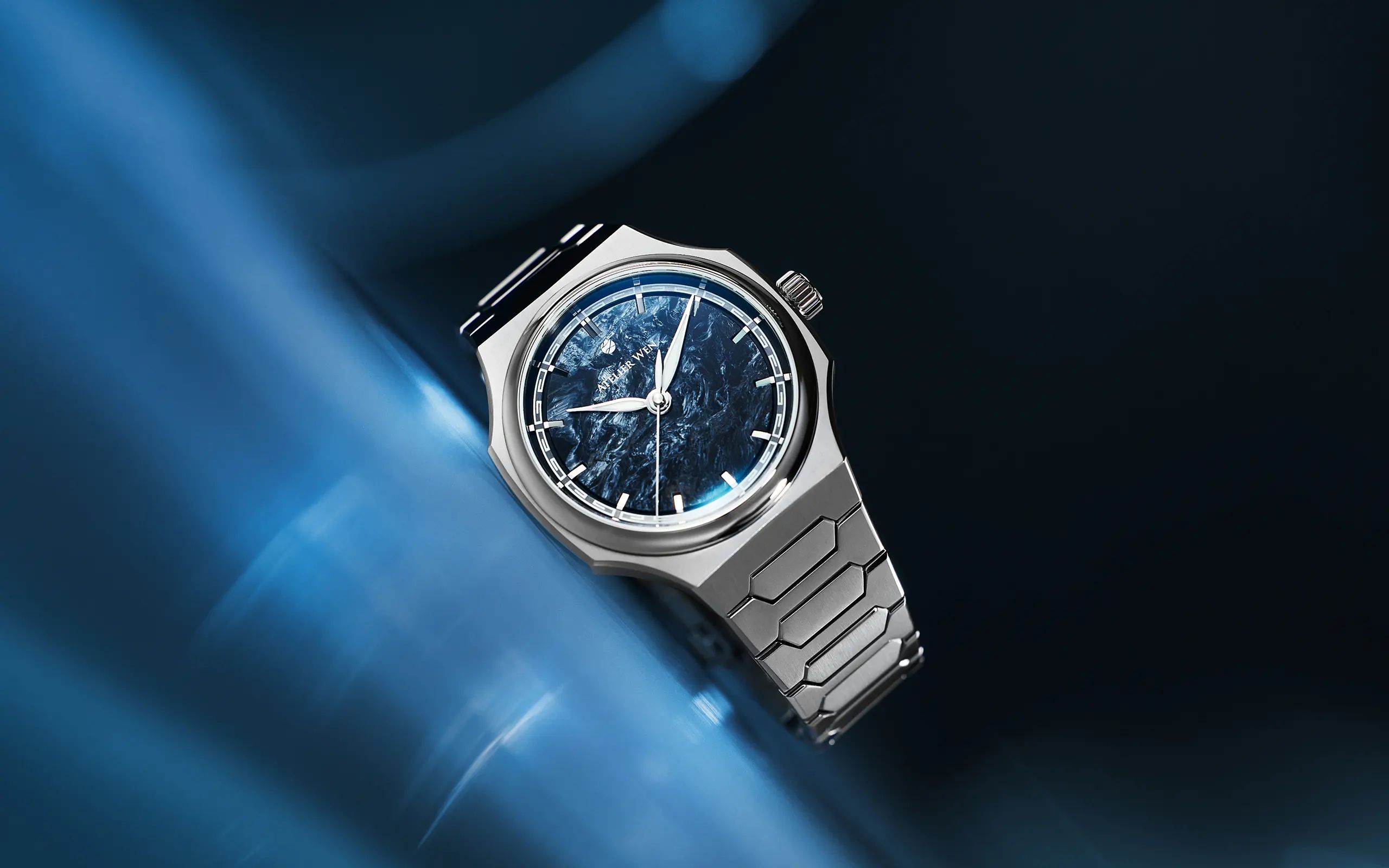
The Millésime is Atelier Wen’s annual limited-edition Perception, built with their collector community in mind.
The 2025 edition, 玄 (Xuán), centres on a natural pietersite stone dial — a Chinese stone of deep blacks, blues, and swirling gold — so brittle that every hour marker hole must be wire-cut by hand in Zhejiang and polished individually in Guangdong.
The 40mm 904L steel case retains the Perception’s 9.4mm profile and iconic bracelet. Inside, the heavily modified Dandong SL1588A beats at 28,800 bph and offers a 41-hour power reserve.
⚙️Watch Worthy
A selection of reviews and first looks from around the web
⏲️End links
A bunch of links that might or might not have something to do with watches. One thing’s for sure - they’re interesting
Do you remember the Faces of Death? I sure do. Oh, the things I’ve seen on the internet as a kid. The fact that it purported to show actual deaths made it an urban legend nonpareil, a meme before we knew to call it a meme. Now, with the (acknowledgedly) fictional meta-adaptation hitting theaters, Sam Adams investigates the real story behind the VHS bloodbath that gave so many ’80s babies nightmares.
The Cattle Baron, a Manhattan steakhouse, may be best remembered for its 1968 print advertisement “of a woman kneeling naked in a Stetson,” whose “body is portioned out with painted lines, each segment labeled as a cut: chuck, rib, loin, rump, soup bone, and so on.” For the latest issue of Cake Zine (titled, perfectly, Steak Zine) Rachel Ossip uncovers the story of the “Cattle Queen,” whose image made her “steakhouse royalty, feminist icon, [and] fungible tourism graphic.”
She wore scrubs, carried dog treats, and had a smile so disarming that an 85-year-old man once walked her to her car in the pouring rain — never suspecting she was about to rob his neighbor. Jennifer Gomez spent four years burglarizing hundreds of Florida homes with surgical precision, exploiting the one thing no alarm system could detect: the unquestioned innocence of a pretty, well-spoken woman in the right neighborhood.
👀Watch this
One video you have to watch today
From the comment section of this video: God damn Channel 5 doing everything major journalism can’t. True words.
What did you think of this newsletterYour feedback will make future issues better |
Thanks for reading,
Vuk
Reply