- It's About Time
- Posts
- The New Omega Constellation Observatory Collection; Breitling Pays Homage To The Concorde; Bulova's Super Seville Mini; Jack Mason's New Diver; Haute-Rive Opens The Incredible 1000-Hour Honoris
The New Omega Constellation Observatory Collection; Breitling Pays Homage To The Concorde; Bulova's Super Seville Mini; Jack Mason's New Diver; Haute-Rive Opens The Incredible 1000-Hour Honoris
A couple of really nice watches today

Vuk Radic
March 26, 2026
Hey friends, welcome back to It’s About Time. I was just talking to someone a month or so ago how I would love to see a reimagining of a pie-pan Constellation. And I really like the look of this one. It has a genuinely cool movement and testing procedure. But that’s quite a price.
HELP RUN THIS NEWSLETTER
If you like this newsletter, and would like to support it, there’s two ways you can do it. First, the completely free one — just share it with your friends. That’s it.
However, if you would like to help me pay for all the services that are needed to run it, you can get a premium subscription, one that gets you a TON of extra content every week.
A paid subscription will get you:
the satisfaction of helping run your favorite watch newsletter
no ads
weekly Find Your Next Watch posts
early access to reviews
Watch School Wednesday posts
a look at watches you haven't seen before
historical deep dives
Facts. Without Hyperbole. In One Daily Tech Briefing

Get the AI & tech news that actually matters and stay ahead of updates with one clear, five-minute newsletter.
Forward Future is read by builders, operators, and leaders from NVIDIA, Microsoft, and Salesforce who want signal over noise and context over headlines.
And you get it all for free, every day.

In this issue
The New Omega Constellation Observatory Collection Is The First Two-Hander Master Chronometer
The Breitling Navitimer Pays Homage To The Best Plane Ever Built — The Concorde
Bulova Renders Their Groovy 1970s-Inspired Super Seville In Just 25mm
Jack Mason Announces a Compressor-Style Diver With A Slightly Different Sales Model
Haute-Rive Opens Up The Absolutely Incredible 1000-Hour Honoris
👂What’s new
1/
The New Omega Constellation Observatory Collection Is The First Two-Hander Master Chronometer

The Constellation name has been through a lot. From the sharp, tool-adjacent chronometers of the 1950s to the claw-lugged quartz era and the diamond-set years that followed, Omega has pulled this line in more directions than most brands attempt in a century. And while I really like the current quirky Constellation lineup, I’ve been wishing that Omega would do more. I actually think that I’ve been wanting this from them, without actually knowing what I wanted. The new Constellation Observatory goes way back — specifically to the pie-pan dial Constellations of the 1950s, with their guilloché edges, dog-leg lugs, and Observatory medallion on the caseback. It also carries a genuinely interesting first: this is the inaugural two-hand watch to earn Master Chronometer certification. And it’s a bigger deal than you might think
The case of the new Constellation Observatory is 39.4mm wide and 12.23mm thick, with a lug-to-lug of 47.2mm. I assume that a lot of that thickness is used up by the two box shaped sapphire crystal on either end and the best design flourish are the dog-leg lugs, a quote of the old Constellations. The collection runs across four materials: Omega's O-MEGASTEEL alloy, and three proprietary gold alloys — Moonshine (yellow), Sedna (rose), and Canopus (white). The top of the range brings all four together in a single platinum-gold reference. Water resistance is modest at 30 meters, and I’m sure that an extra 50 meters could have been squeezed out of them.
The pie-pan dial returns with a beautiful guilloché pattern along the outer edge — stamped on the steel versions. Kite-shaped applied indices are paired with kite-shaped hands, a coherent choice that reinforces the vintage geometry without leaning on nostalgia too hard. The steel versions come in silver opaline with gold markers, blue PVD, green PVD, or a polished black ceramic dial. The gold versions each have matching dials: Moonshine gold gets a yellow gold dial, Sedna gets rose gold, Canopus gets white gold, and the platinum-gold has a PVD platinum coating. No seconds hand anywhere on the dial, which is the whole point of this watch.
The steel references run the calibre 8914, a new movement built on Omega's 89xx architecture with a skeletonised rotor carrying an applied Constellation Observatory medallion. Precious metal versions use the calibre 8915 in two variants — Luxe and Grand Luxe — with the Grand Luxe reserved for the platinum-gold edition and featuring aventurine enamel and white opal details on the medallion. All versions come on shiny alligator leather straps, with the Moonshine gold also available on a matching gold mesh bracelet.
The certification process is genuinely interesting and deserves a paragraph of its own. Traditional chronometer testing, COSC included, uses optical cameras to photograph the seconds hand at set intervals and check whether it's where it should be. Average the deviations over the test period, and you have your result. With no seconds hand, there’s nothing to photograph. Omega's Laboratoire de Précision solves this by listening instead. Every beat of the escapement is captured acoustically across 25 days of testing, in multiple positions, temperatures, and magnetic field exposures. But this method has an interesting advantage over averaging seconds hand positions through hundreds of photographs. It can count every single oscillation, resulting in a complete picture of how the movement actually behaves rather than where it ends up. Master Chronometer already set a high bar — fully assembled watches, 15,000 Gauss magnetic resistance, 0 to +5 seconds per day. The new methodology makes the verification of that tolerance more rigorous than pretty much anything in the industry.
The new Omega Constellation Observatory is available now, with pricing starting at €10,700 for the stainless steel versions and €37,300 for the precious metal versions. The top of the line platinum gold version comes in at €56,900. Let those numbers sink in. See more on the Omega website.
2/

Breitling has a long history of making aviation watches that actual pilots used, and the Navitimer sits at the center of that story. Designed in 1952 for the Aircraft Owners and Pilots Association, it was the first wristwatch with a circular slide rule built for in-flight calculations. This new limited edition honors the 50th anniversary of the first commercial flight of what has to be the greatest passenger plane ever made, the Concorde.
The case remains largely the same, made out of stainless steel, 43mm wide and 13.69mm thick, with a lug-to-lug of 49.07mm. The Navitimer has always been a large watch, there’s no denying it. The platinum bezel operates the bidirectional circular slide rule, and water resistance is 30 meters, enough to survive rain, not a swim.
The dial is new on this model. Breitling went with a deep blue meant to evoke the stratosphere as seen from 60,000 feet. The blue is contrasted with white subdials, and a white and blue bezel. The use of the white over blue is a reference to the nickname that the French gave the plane: L'Oiseau Blanc, or “the White Bird”. The hands are polished and faceted, with subtle use of lume.
Inside is the Breitling Manufacture Calibre B01, a proven movement. Self-winding, COSC-certified, column-wheel chronograph with vertical clutch, 70-hour power reserve, running at 4Hz. It is among the better in-house chronograph movements at this price level. The watch comes on a blue alligator leather strap with a stainless steel folding buckle.
The new Breitling Navitimer B01 Chronograph 43 Tribute To Concorde is limited to 593 pieces, a tribute to the Olympus 593 turbojet engines that powered the Concorde. Price is set at €9,750. See more on the Breitling website.
3/
Bulova Renders Their Groovy 1970s-Inspired Super Seville In Just 25mm

Bulova expands its archive-inspired lineup with the new Super Seville Mini, a watch that translates the bold design language of the 1970s into a more compact format. The original Super Seville leaned into the decade's maximalist tendencies with size and surface to spare. This one pulls back to 25mm, and it just might be one of the better looking options for smaller wrists you can get these days, at this price.
The case is 25mm wide in stainless steel with a coin-edge bezel, and an optional gold-toned case option. The bezel is the strongest visual element here, creating contrast between the smoother case surfaces and the three-link integrated bracelet, especially since it’s not circular but rather follows the squared circle shape of the case. Water resistance is 50 meters.
Three dial options are available: white mother-of-pearl, red mother-of-pearl, or vertically brushed silver. The mother-of-pearl variants shift with light and lean decorative. The brushed silver dial carries a slight vintage tone, especially since it’s paired with the gold tone case. All three versions get polished hands an applied hour markers, with the very cool Bulova logo at 12 o’clock.
The Cal. 5Y26 quartz movement inside replaces the Cal. NM10 with Precisionist Technology found in the larger Super Seville models, which means you lose the smooth-sweep seconds hand and the date window. Which just might be appropriate for the size. The watches come on integrated stainless steel bracelets.
The Bulova Super Seville Mini is available now, priced at $495 for the stainless steel version and $575 for the gold-toned variant. See more on the Bulova website.
4/
Jack Mason Announces a Compressor-Style Diver With A Slightly Different Sales Model
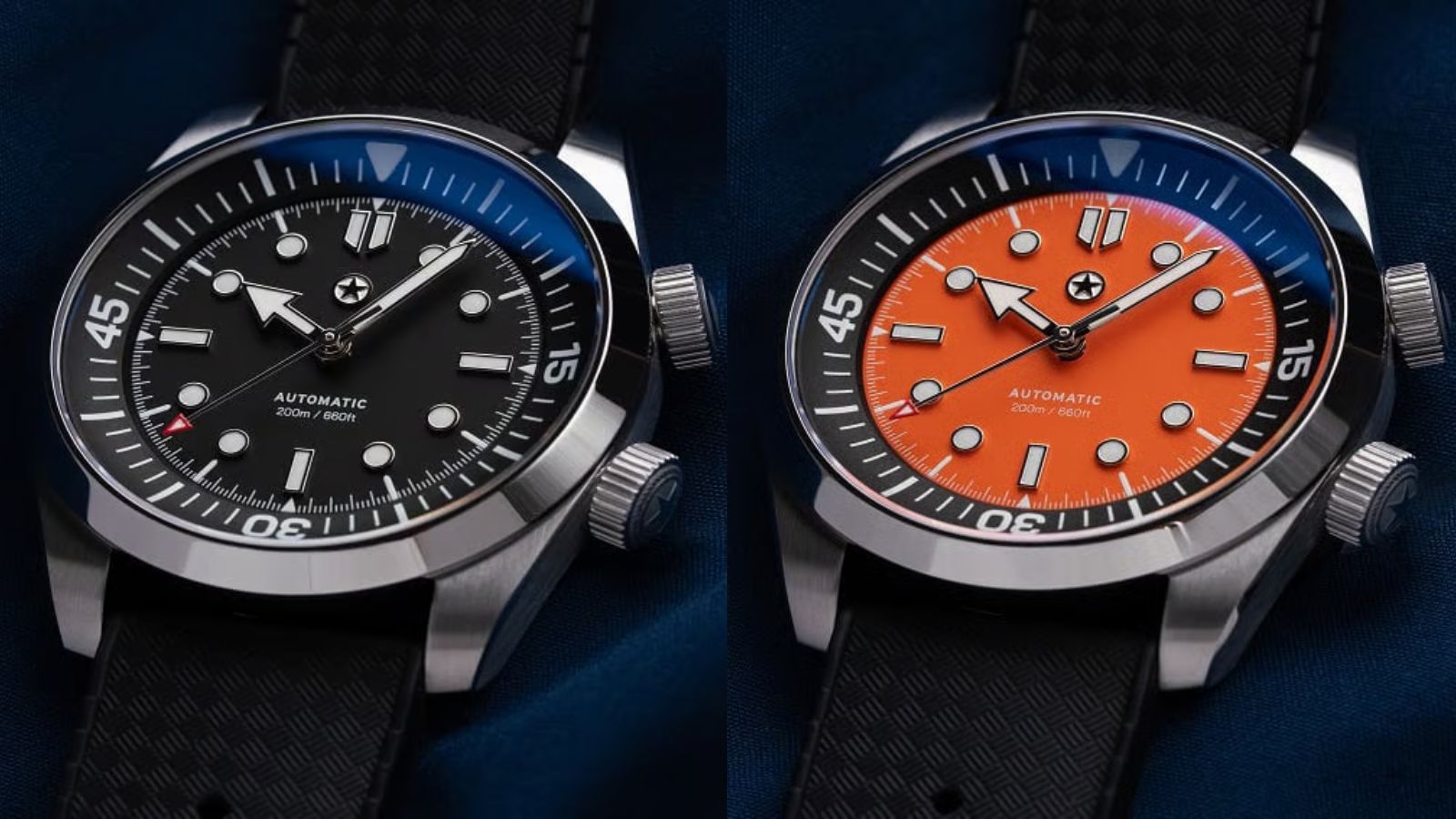
Jack Mason has announced the Palmera Skin Diver, a compressor-inspired dive watch with an internal bezel and Swiss automatic movement. I say announced and not released, because it’s coming out with an interesting sales model that’s a mix between pre-sales and crowd founding, a model that I would like more brands to implement. The watch is a well-proportioned diver with a vintage soul and good looks.
The case measures 39mm wide and 10.8mm thick, with a lug-to-lug of 47mm. Could it have been even smaller? Perhaps. Does it need to be? I’m not sure. The brushed stainless steel is topped with a domed sapphire crystal that pushes itself to the edges and is surrounded by a polished bezel. On the right side is a dual-crown setup, mimicking compressor divers, with the crown at 2 o'clock controlling the internal rotating bezel. This isn’t an actual compressor case, but you still get 200 meters of water resistance.
Two dial options are available at launch: Ash (black) and Ember (orange). You get a bold graduated 60 minute scale on the internal bezel, while the dial centers are kept pretty simple, with applied lumed circular markers and lumed hands, of which the hour one is arrow shaped. There will be a third dial variant as well which will be decided by community vote, but only if reservations reach 200 pieces. But more on that later.
Inside is the La Joux-Perret G101, a Swiss automatic movement running at 28,800 vph with a 68-hour power reserve. It hacks, hand-winds, and is regulated to ±5 seconds per day. Buyers can choose between a three- or seven-link stainless steel bracelet or a Tropic-style FKM rubber strap.
The model that Jack Mason is using for the Palmera, like I said, is a mix between crowd funding and pre-sales. They are calling it “Born and Raised, the Founder Release Program”. In essence, they are taking reservations for the watch and will only go into production if they get 150 reservations. If they get 200, the community will get to chose the color on the third watch. If, however, they don’t reach 150 reservations, the watch will not go into production and all orders will be refunded. If it does go into production, however, delivery is expected within 120 days, which sounds pretty good. However, as I’m writing this, they have 69 reservations and the window closes April 3, so it’s not looking that great. If you get the watches during the founder window, pricing is set at $1,049 on rubber or $1,349 on the bracelet. If they do get the 150 reservations and the watch goes into production, price will go up to $1,349 and $1,649 respectively. See more on the Jack Mason website.
5/
Haute-Rive Opens Up The Absolutely Incredible 1000-Hour Honoris

Haute-Rive is an independent brand launched by Stéphane Von Gunten, formerly the R&D Director at Ulysse Nardin where he filed 30 patents. His debut watch under his own name, the Honoris, was released in 2023 and it was worthy of the the person who directed R&D at one of the more impressive watchmakers we have today. The Honoris came with a 1000-hour power reserve — 41 days. That's not a typo. Now he's released the Honoris Meccanica, exactly what we needed from a watch like this: putting all that mechanism on display.
The case is 42.5mm wide and 11.95mm thick, made from white gold with a rotating bezel used for winding. This is no joke. The mainspring is so long (three meters) and powerful, that a regular crown would just be too much of a hassle to wind. Instead you rotate the bezel to wind, and use a pusher on the side to engage a column wheel that switches the crown between neutral and time-setting modes. I also wonder how the fact that the bezel is no smooth and no longer fluted affects the winding mechanism. You get sapphire crystals top and bottom and even 30 meters of water resistance.
The dial — or lack of one — is where this version diverges from the original. The movement is now fully exposed, organized in a radiating structure around the HR monogram at center. You see the gears, the column wheel and its levers, the keyless works, all of it. Blued hands rotate above the mechanics, and at six o'clock sits a one-minute tourbillon that floats over everything. The balance beats at 2.5Hz, slow by modern standards but consistent with the conservative approach needed to stretch 41 days from a single winding. Interestingly, the one thing you don’t see is the huge barrel. Three versions are available: Rhodium with a rhodium microblasted mainplate and blued hands, Ruthenium with a ruthenium-coated mainplate and blued hands, and Rosso with a ruthenium mainplate, red anodized aluminum ring, rhodium-plated brass hands, and red strap.
The movement is Haute-Rive's in-house calibre, built around one massive barrel — 35mm in diameter, machined directly into the main plate, housing that three-meter mainspring. The outer end of the spring has a slipping bridle to prevent overwinding damage. Power reserve is 1000 hours, as mentioned. Since the majority of the movement is exposed from above, on the back is essentially a closed caseback, with a power reserve indicator that has a red arrow traveling the entire circumference of the caseback. The watch comes on a hand-stitched leather strap with a pin buckle.
The new Haute-Rive Honoris Meccanica is available now, with the Rosso limited to eight pieces and the other expected to produce 10 watches per year. All three have the same price of CHF 158,000. See more on the Haute-Rive website.
⚙️Watch Worthy
A selection of reviews and first looks from around the web
⏲️End links
A bunch of links that might or might not have something to do with watches. One thing’s for sure - they’re interesting
Alaina Demopoulos examines “alpine divorce,” where women are abandoned by male partners on hikes, a trend that gained attention on TikTok. She deepens the analysis by tracing its literary origins and incorporating real-life case studies with expert perspectives. Demopoulos ultimately argues that ego and cultural ideas of masculinity can drive this behavior—with potentially dangerous, even deadly, consequences.
In this gripping essay for The Kenyon Review, N.C. Happe recalls the moments of routine and sometimes horrific violence she saw while spending time on the family farm during summers in Bemidji, Minnesota. She confronts what it means to be guilty, sometimes by association as a witness, sometimes as an unwitting participant. This is a thoughtful look at what we absorb before we have the language to respond to what we’ve experienced in the past.
Camouflage has been part of civilian fashion for decades—but about 15 years ago, traditional patterns like woodland and tiger stripe got eclipsed by a new digital pattern known as MultiCam. For Wired, Avery Trufelman—who hosts the excellent podcast Articles of Interest—tells the story of how MultiCam went from rejected prototype to style (and Special Forces) juggernaut.
👀Watch this
One video you have to watch today
When I lived in New York, everyone had a story about meeting people who lived in the abandoned tunnels under the city. You never could believe these tales. But video is hard to deny.
What did you think of this newsletterYour feedback will make future issues better |
Thanks for reading,
Vuk
Reply