- It's About Time
- Posts
- The Citizen Gets Beautiful Green Washi Paper Dial; Nomos Gives The Club Campus Two New Colors; Holthinrichs Keeps It Cool; The Maghnam Mohareb Is Three Watches In One; Singer's Titanium Caballero
The Citizen Gets Beautiful Green Washi Paper Dial; Nomos Gives The Club Campus Two New Colors; Holthinrichs Keeps It Cool; The Maghnam Mohareb Is Three Watches In One; Singer's Titanium Caballero
Very few things beat a washi paper dial for me

Vuk Radic
March 30, 2026
In partnership with

Hey friends, welcome back to It’s About Time. I’ve always been a fan of untraditional watches. And I think that the Holthinrichs is the perfect amount of quirkiness for me that I could wear just that for the rest of my life.
HELP RUN THIS NEWSLETTER
If you like this newsletter, and would like to support it, there’s two ways you can do it. First, the completely free one — just share it with your friends. That’s it.
However, if you would like to help me pay for all the services that are needed to run it, you can get a premium subscription, one that gets you a TON of extra content every week.
A paid subscription will get you:
the satisfaction of helping run your favorite watch newsletter
no ads
weekly Find Your Next Watch posts
early access to reviews
Watch School Wednesday posts
a look at watches you haven't seen before
historical deep dives

The best HR advice comes from people who’ve been in the trenches.
That’s what this newsletter delivers.
I Hate it Here is your insider’s guide to surviving and thriving in HR, from someone who’s been there. It’s not about theory or buzzwords — it’s about practical, real-world advice for navigating everything from tricky managers to messy policies.
Every newsletter is written by Hebba Youssef — a Chief People Officer who’s seen it all and is here to share what actually works (and what doesn’t). We’re talking real talk, real strategies, and real support — all with a side of humor to keep you sane.
Because HR shouldn’t feel like a thankless job. And you shouldn’t feel alone in it.

In this issue
The Citizen Pays Homage To 50 Years Of Eco Drive With A Beautiful Green Washi Paper Dial
Nomos Keeps To Tradition With Two New Colors For The Club Campus In 36 and 38.5mm
Holthinrichs Keeps On Being Incredibly Cool With The New Small Seconds And GMT LAB Series
The Maghnam Mohareb Is Not Just A Wildly Cool Sculptural Watch, It’s Three Watches In One
Singer Reimagined Releases New Caballero Models, Now Available In Titanium
👂What’s new
1/
The Citizen Pays Homage To 50 Years Of Eco Drive With A Beautiful Green Washi Paper Dial
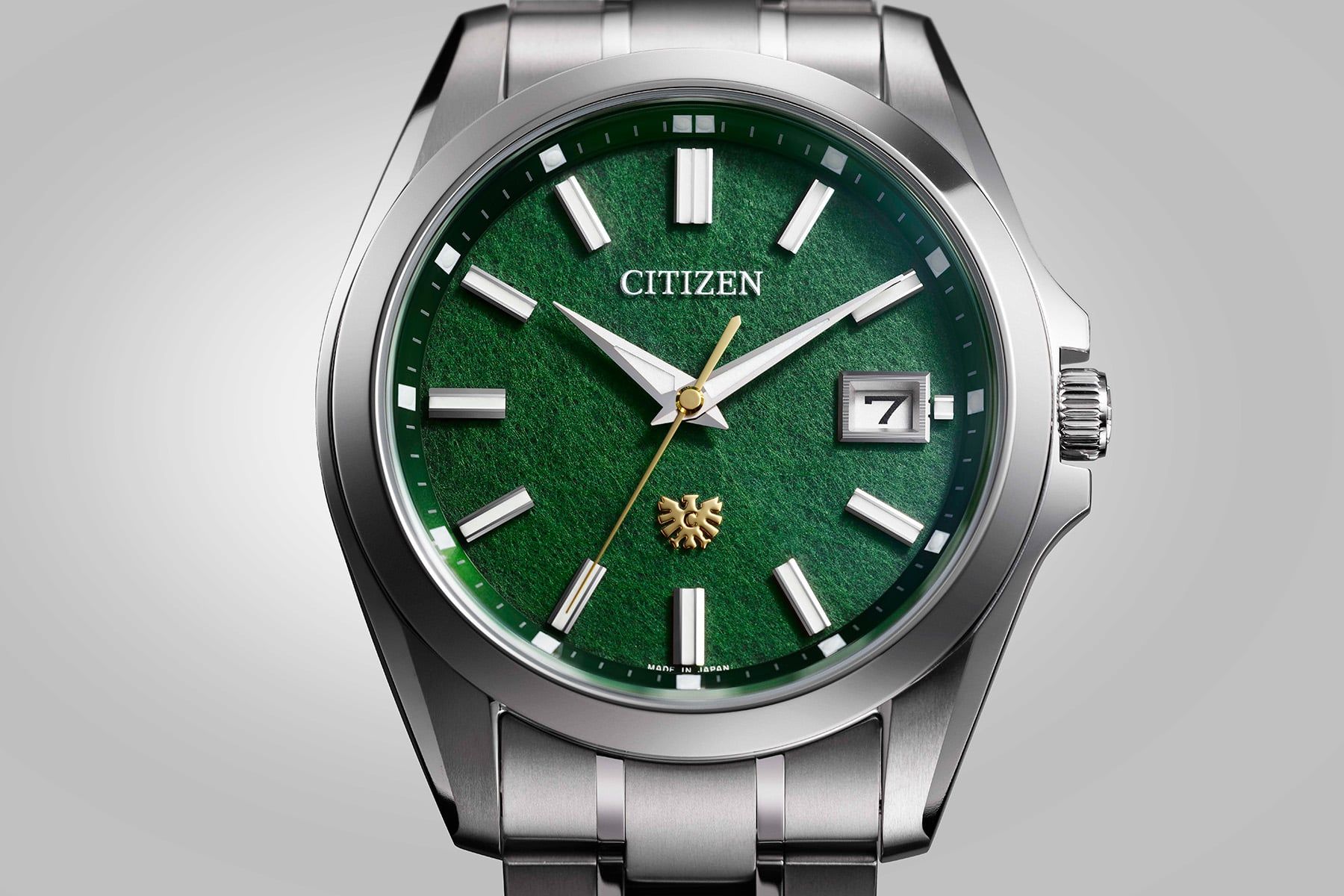
Citizen's relationship with quartz is different from most of the industry. Sure, they’re not the only one to do so, but it seems that Citizen, especially in their upper echelons, has put a strong emphasis on accuracy. That sounds ridiculous to say about a movement technology that’s infinitely more accurate than a mechanical watch, but just consider that Citizen’s Crystron Mega in 1975, just six years after the introduction of quartz technology, achieved three seconds of accuracy per year. A year later, the Crystron Solar Cell put eight tiny solar panels on a dial and became the first commercial light-powered analogue watch. It’s that 1976 moment that this new The Citizen watch is celebrating. This is the new Eco-Drive 50th Anniversary Edition AQ4091-56W from my favorite of the Japanese luxury sub-brands, The Citizen. It’s still a horrible name, but they are really great watches.
The case is 40mm wide and 12.2mm thick, made from Citizen's Super Titanium — surface-hardened to five times the resistance of steel and 40% lighter. The finish is Duratect Platinum, which gives it a silver tone, with polished lugs and bezel and a brushed bracelet that works well against the mirror surfaces. Double domed sapphire crystal with anti-reflective coating is on top, while the solid caseback carries the eagle mark. You get 100 meters of water resistance.
The dial is made out of washi paper, a traditional Japanese material used in lanterns and screens, hand-dyed in chitose midori, a green derived from yellow ibuki kariyasu grass mixed with indigo. Citizen has used washi before in The Citizen line, but the color here is genuinely distinctive: deep and wonderfully matte. Applied silver indices and hour and minute hands carry Natulite lume; the seconds hand is gold, as is the eagle mark applied at 6 o'clock. The date sits at 3 o'clock.
Inside is calibre A060, accurate to ±5 seconds per year — not as extreme as the 2019 Calibre 0100's one second per year, but still pretty cool. Power reserve is 18 months in darkness, with a perpetual calendar that handles month-end corrections and leap years through February 28, 2100. The hour hand adjusts independently for time zones, and there's a proprietary shock-detection function that auto-corrects the hands if bumped. The bracelet is brushed Super Titanium, matching the case finish.
The new The Citizen Eco-Drive 50th Anniversary Edition AQ4091-56W is limited to 650 pieces, which is genuinely limited for a The Citizen, and the watches go on sale in May. Price is set at $3,100. See more on the Citizen website.
2/
Nomos Keeps To Tradition With Two New Colors For The Club Campus In 36 and 38.5mm

Every spring, NOMOS releases new Club Campus colors, and the formula is consistent: two sizes, two dials, a hand-wound movement, and a price that sits just inside what you'd call accessible for a genuine German manufacture watch. Last year's colors sold well. This year brings a rose and an olive, both available in 36mm and 38.5mm.
The case is stainless steel, 36mm wide and 8.1mm thick in the smaller size, or 38.5mm wide and 8.5mm thick in the larger. Both have domed sapphire crystals up front, and you can choose between a solid steel caseback or a sapphire display back if you want to see the movement. Water resistance is 100 meters.
The full rose dial is a warm, dusty pink rather than anything garish. Yellow outlines on the hour markers, light blue numerals on the minute track, and a neon orange seconds hand give it contrast. The olive follows the same logic, with the same orange seconds hand. Both dials multi-layered, which gives them more depth than a flat printed surface and both have the California dial setup with Arabic numerals used on the top of the dial and Roman numerals used on the bottom.
Inside is the DUW 4001, NOMOS's in-house hand-wound caliber. It runs at 21,600 vph, has 17 jewels, and 53 hours of power reserve. The movement is just 2.6mm tall, which is most of what keeps the case this thin. Both watches ship on a vegan velour strap in either beige or anthracite, with an 18mm lug width on the 36mm and 20mm on the 38.5mm.
The new colors of the Club Campus are available now, with the 36mm version priced at CHF 1,420 and the 38.5mm at CHF 1,560. See more on the NOMOS website.
3/
Holthinrichs Keeps On Being Incredibly Cool With The New Small Seconds And GMT LAB Series
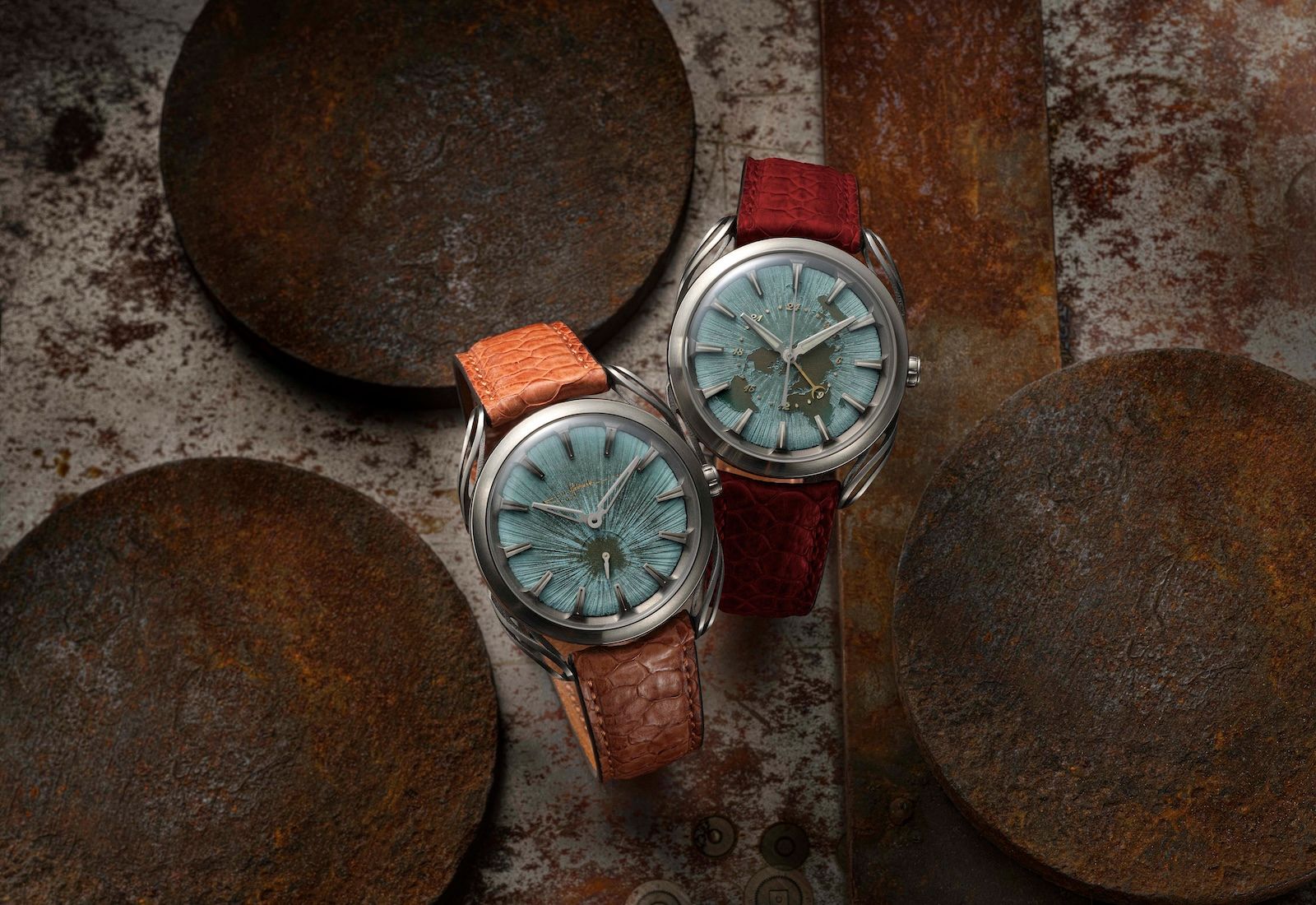
While I still cannot pronounce this brand's name and have to quadruple check the spelling before I commit it to screen, Holthinrichs is easily one of my favorite brands in the game today. I fell deeply in love with the Signature Ornament LAB Series 1.24 made with the Dial Artis last year. And looking at the two new versions of the Signature LAB — a small seconds and a GMT — I just realized that I would be extremely happy wearing a LAB Series watch for the rest of my life. I think this just might have reached my ideal of a watch.
And a lot of my admiration comes from the incredible 3D-printed grade 5 titanium case that Holthinrichs has refined into their signature LAB look. The case is 38.5mm wide and 9.85mm thick, compact on paper but utterly distinctive in person. The lugs are openworked and floating, shaped via selective laser melting into curves that would be impossible to achieve through traditional milling, then left partially raw to show the 3D-printed surface texture alongside the hand-finished areas. A curved caseback, double domed sapphire crystal, and a lug-to-lug of 46mm complete the picture. Holthinrichs calls it Horlogerie Brut and it very much is.
The dials are copper oxide patina, and the brand describes them as the most technically demanding reliefs they've produced. On the small seconds model, deeply carved lines radiate out from the subdial. The GMT version does something else entirely: a globe viewed from the North Pole emerges from the dial, hand-brushed with a micro-brush to pull patina selectively and produce a darker brown contrast against the background. The outermost GMT indicators are Breguet-style, brass-toned, and brushed, matched by the central GMT hand. Both models use openworked hands and floating hour markers set into an inner flange.
Inside, Holthinrichs uses Sellita rather than in-house for obvious reasons: the SW360 in the small seconds, the SW330 in the GMT. Neither movement is anything to get excited about on its own, though both are reliable and thin, which is presumably why they were chosen. What is worth looking at through the caseback is the rotor — patinated, hand-carved, and heat-treated, with a tungsten weight that's been scraped and treated to show blue and purple tones. The watches come on Rooster Leg leather straps, with a signed titanium pin buckle.
The Holthinrichs Signature LAB 1.S Small Seconds is priced at €5,900 excluding VAT, and the Signature LAB 1.GMT at €6,500 excluding VAT. Each is limited to 100 pieces, with first deliveries expected in Q3 2026. See more on the Holthinrichs website.
4/
The Maghnam Mohareb Is Not Just A Wildly Cool Sculptural Watch, It’s Three Watches In One
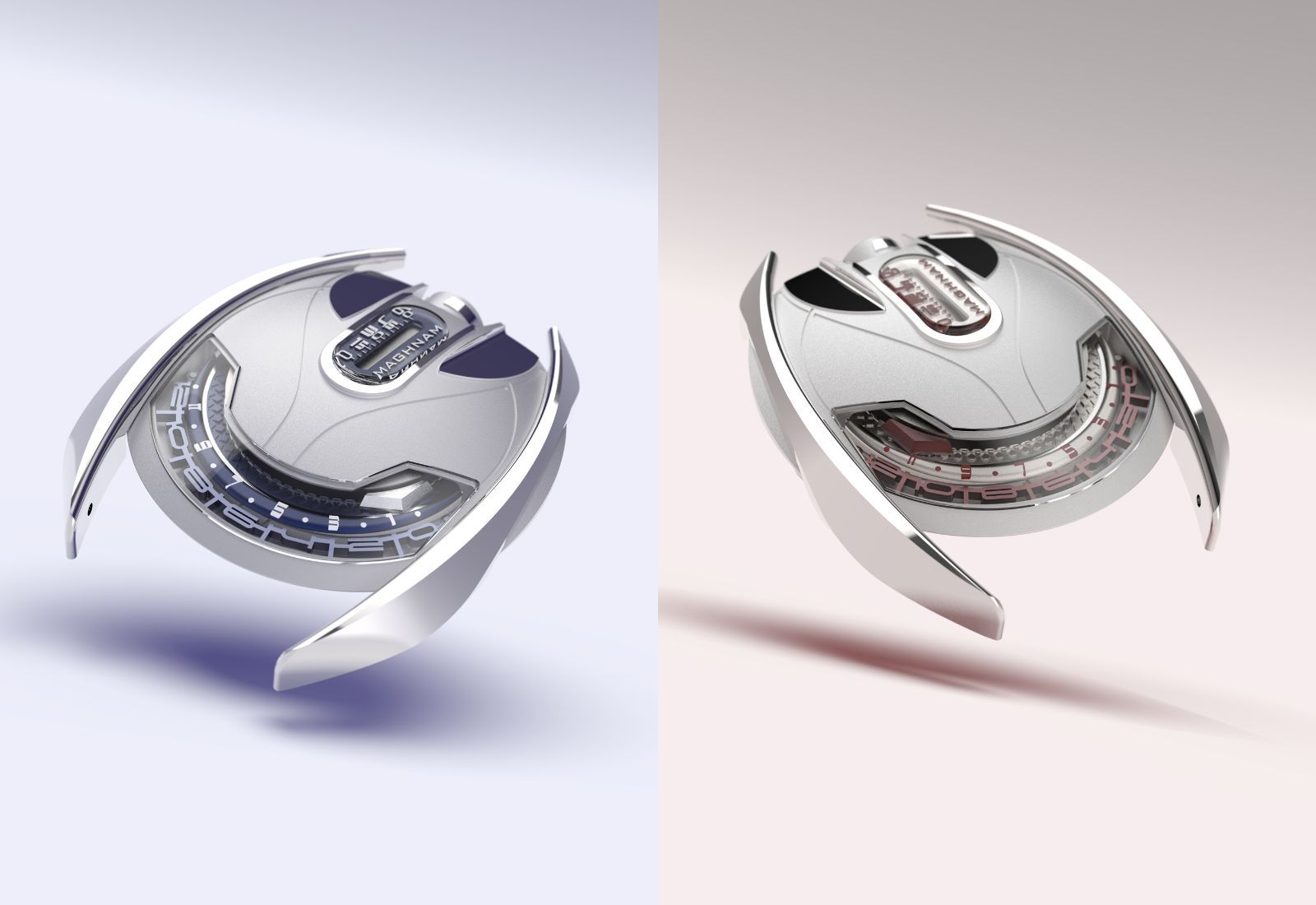
Maghnam is a one-man independent watch brand founded by Sohaib Maghnam, a Palestinian-Jordanian mechanical engineer who trained at the Politecnico di Milano and came to watches through automotive design. The brand launched in 2020 with the Makina and has since built a small catalog around a consistent idea: sculptural cases, each one an experiment rather than a variation on an existing category. The Mohareb — Arabic for fighter or gladiator — is the fourth generation, and its central concept is modularity. The same central case accepts three different outer modules that change the watch's silhouette entirely: Blades (angular, the default), Halo (round), and Wings (oval). You swap them out through a locking mechanism on the caseback in seconds.
The case is 904L stainless steel, 39.5mm wide and 8.6mm at its thickest point, tapering to 3.5mm at the edges. That is genuinely thin for a case this architecturally complex — Maghnam's engineers CNC-machined some walls to under 0.28mm to get there, and the finished watch weighs around 43.5 grams. Water resistance is just 10 meters, which might mean you should avoid splashes all together. The central module is sandblasted, and the three outer cases, the modules, are all polished and it’s an incredibly unique look.
The dial is certainly as untraditional as the case, since the majority of the dial is a metal plate that has cutouts for the bi-retrograde complication. Hours sweep across a 120-degree arc, snap back, and repeat. Minutes run on a vertical linear counter positioned toward the top of the case, which reinforces the helmet shape of the central module. The two colorways are Argent Crimson (silver and red accents) and Deep Blue and the colors are basically delegated to the hour and minute tracks.
The movement is the MCR01-B, built on a Swiss SW210 hand-wound base with a proprietary retrograde module developed by Maghnam. The SW210 is a reliable, well-regarded ébauche, nothing exotic, but a solid foundation for a complication module of this kind. Power reserve is 42 hours. Strap options include alligator, sailcloth, and bespoke configurations.
The Maghnam Mohareb is available now, and it doesn’t seem to be limited. Price is set at CHF 7,200, without taxes. See more on the Maghnam website.
5/
Singer Reimagined Releases New Caballero Models, Now Available In Titanium

If you were to ask what’s one watch from last few years that I would do unspeakable things for, it would easily be the Singer Divetrack, one of the coolest dive watches I’ve ever seen. It’s also knocking at €100,000, so it’s not exactly in the budget right now. I mean, it’s not like any Singers will ever be approachable. After all, they share the name with founder Rob Dickinson’s Porsche restomod company that doesn’t sell cars under seven figures. However, Singer Reimagined did introduce a much simpler version, the Caballero, a time-only watch that is a bit more approachable in price, while still very expensive. Now, we’re getting new versions of the Caballero, now in a titanium case.
The case is 39mm wide and 10.5mm thick, which is genuinely impressive for a movement with four barrels and six days of power reserve. The new case is made out of Grade 5 titanium with micro-sandblasted surfaces, mirror-polished chamfers along the C-shaped case profile, and a mirror-polished bezel. Water resistance is 50 meters. The contrast between the matte body and the polished edges looks fantastic.
There are two dial options: Avio Blue and Cocoa Brown, both in a velvet-touch matte finish. The openwork sections of the dial expose four inset rubies — visible evidence of the four-barrel movement beneath. A toothed golden flange ring runs the perimeter. It's a distinctive look, the exposed rubies and the gold flange, that give it a completely unique dial.
The movement is Singer's Calibre ST5000, a manual-wind calibre developed in-house with four barrels arranged in a 2x2 configuration — two coupled pairs working in parallel — designed to keep torque flat across the entire power reserve. That's 144 hours minimum, 28,800 vph, and accuracy rated at -4/+6 seconds per day. The SR702-3 (Avio Blue) comes on a pearl gray textile strap with gray leather loops; the SR702-5 (Cocoa Brown) gets khaki green textile with Testa di Moro leather loops. Both use a satin-finish steel pin buckle with polished chamfers.
While this is Singer’s simplest watch, it is certainly not simple. The very unique movement and obviously incredible finishing make the price of CHF 18,500 a bit easier to stomach. See more on the Singer website.
⚙️Watch Worthy
A selection of reviews and first looks from around the web
⏲️End links
A bunch of links that might or might not have something to do with watches. One thing’s for sure - they’re interesting
In a world humming with talk of artificial intelligence, this essay begins by reaching backward—to the smoke and clatter of the Industrial Revolution. From Elizabeth Gaskell’s factory floors to Dickens’s haunted London streets, the author asks what these novels can teach us about living through upheaval. If the weavers were yesterday’s white-collar class, who are we now—and how will we adapt when the looms start thinking?
A journalist investigates the supposedly true story of an Olympic runner kidnapped by a Mexican cartel and forced to compete in an inter-cartel sports tournament to survive. After months of reporting, mounting inconsistencies unravel the tale: the "Olympian" never competed, key witnesses are fabricated, and his kidnapping date matches an arrest for fraud. The story was essentially an elaborate con.
He wakes before sunrise to hunt the cheapest possible flights, scrolling through red‑flagged deals on a screen that hints at the fortune behind it yet betrays nothing of his eight‑figure net worth. He drives a sensible car, studies the price of milk with near‑moral seriousness, and winces at a $140 shoe tag as if the sum were a personal insult. Money, he insists, has not changed who he is, but it has quietly reshaped the way he moves through the world: skipping upgrades, avoiding splurges, and measuring every dollar as if the comfort of his life were not already assured.
👀Watch this
One video you have to watch today
My God, I completely missed the fact that Rocket Powered Mohawk is back.
What did you think of this newsletterYour feedback will make future issues better |
Thanks for reading,
Vuk
Reply