- It's About Time
- Posts
- TAG's Minimalist Glassbox; Laco Rounds Out Centenary; Raymond Weil Teams Up With seconde/seconde/; Ollech & Wajs' Funky Vietnam-Era Duo; Panerai's First Bronzo Luminor; JLC Brings Back The 1990s
TAG's Minimalist Glassbox; Laco Rounds Out Centenary; Raymond Weil Teams Up With seconde/seconde/; Ollech & Wajs' Funky Vietnam-Era Duo; Panerai's First Bronzo Luminor; JLC Brings Back The 1990s
Everybody seems to be reaching back into their archives today

Vuk Radic
December 03, 2025
In partnership with

Hey friends, welcome back to It’s About Time. The Ollech & Wajs duo is something that I would buy in an instant, how cool are those.
If you like this newsletter, and would like to support it, there’s two ways you can do it. First, the completely free one — just share it with your friends. That’s it. However, if you would like to help me pay for all the services that are needed to run it, you can get a premium subscription, one that gets you a TON of extra content every week.
A paid subscription will get you:
Turn AI Into Extra Income

You don’t need to be a coder to make AI work for you. Subscribe to Mindstream and get 200+ proven ideas showing how real people are using ChatGPT, Midjourney, and other tools to earn on the side.
From small wins to full-on ventures, this guide helps you turn AI skills into real results, without the overwhelm.
In this issue
TAG Heuer Teams Up With Fragment For A Very Minimalist Take On The Carrera Chronograph Glassbox
Laco Rounds Out 100 Year Celebration With A Very 1950s Dress Watch
Raymond Weil Teams Up With seconde/seconde/ For The Perfect Dress Watch
Ollech & Wajs Recreates Two Very Cool Vietnam-Era Watches, The MK-102 and MV-82
Panerai Brings The Bronzo Case To The Luminor For The First Time With The PAM01678
Jaeger-LeCoultre Brings Back The 1990s With The New Master Control Classic
👂What’s new
1/
TAG Heuer Teams Up With Fragment For A Very Minimalist Take On The Carrera Chronograph Glassbox
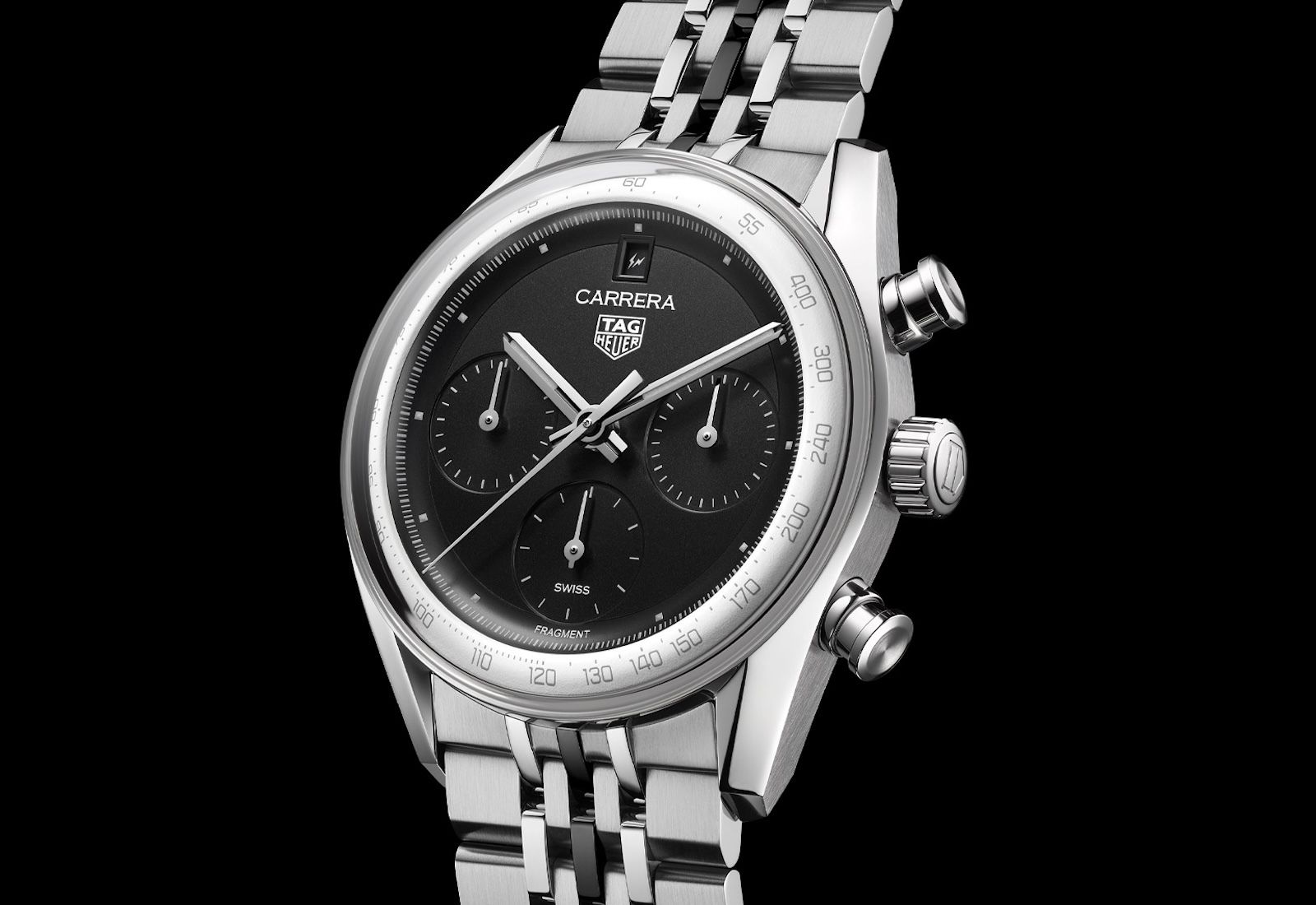
After years of great editions of the Carrera Chronograph, TAG Heuer seems to have perfected it with the relatively new Carrera Chronograph Glassbox. Such a simple change — just pushing the crystal all the way to the edge, with a tachymetre bezel underneath it — created an instant classic. We’ve seen dozens of variants, each cooler than the other, but this latest one gives it a slightly different look. They teamed up with FRGMT, the Fragment design studio founded by the Japanese designer and godfather of streetwear, Hiroshi Fujiwara, for the third time. This time, this is a very minimalist rendition of the sporty chronograph.
On the outside, not much has changed. The case is made out of stainless steel, with classically styled lugs and familiar pushers flanking the crown. It’s overall brushed, with a few nice polished details. The watch measures 39mm wide and 13.86mm thick. While not huge, the Glassbox wears larger due to its immense dial opening on top. That’s thanks to the glassbox crystal construction which extends all the way to the edge of the watch, with the tachymetre scale sitting underneath that crystal and forming a single unit with the dial. It’s an incredibly cool look. Water resistance is 100 meters.
All of the collaboration is visible on the dial, which is now maximally minimized. The internal bezel that holds the tachymeter scale is now white with barely visible silver numerals, and the base dial is done in matte black. The sub-dials are where they should be, but now with no numerals and just baton markers and a sunken position. You still get the running seconds at 6, 30-minute timer at 3 and 12-hour counter at 9 o’clock. But good luck remember which is which at a quick glance. Around the dial is a seconds track, but hour indices are replaced by tiny rectangles of lume. The central hands are rhodium plated and filled with lume. At 12 o’clock is a small framed date window that replaces the 1st and 11th of the month with FRGMT’s logo and FRAGMENT is written below 6 o’clock.
Inside, you’ll find the calibre TH20-00, an automatic column wheel chronograph which has an 80 hour power reserve. Decorations include Côtes de Genève on the bridges and an openworked shield-shaped rotor. The watch comes on a seven-row beads-of-rice bracelet with the central link coated in black PVD.
The new Carrera Chronograph x fragment is a limited edition of 500 numbered pieces and price is set at €9,000. See more on the TAG Heuer website.
2/
Laco Rounds Out 100 Year Celebration With A Very 1950s Dress Watch
In 1925, Frieda Lacher and Ludwig Hummel founded Lacher & Co in Pforzheim to start making watches. Over the years they made great watches with imported movements. Then, in 1933, Hummel left and founded the movement manufacturing company Durowe, supplying Lacher & Co, or LaCo, with locally produced movements. While World War II was a devastating period for Pforzheim, it is also the time that Laco made the watches they are best known for, as they were one of the premier suppliers of pilot’s watches for the German Luftwaffe. They were one of the originators of the Type A and Type B flieger styles. All this means that 2025 was the 100th anniversary of the Laco brand and they did a lot to celebrate. The most notable must have been the Laco Frieda watch, 100 of which were given away to fans, including through this newsletter. But as the year winds down, they have one more celebratory watch — this is the new Laco Edition 100. Over the past years, Laco released five limited special editions, highlighting key chapters of the company’s history, ranging from navy and tactical watches to classic pilot’s watches and a chronograph. Each edition represented a distinct facet of the Laco collection and followed a “count-up” concept: the number of pieces corresponded to the respective year in Laco’s timeline. In this spirit, the Edition 100 completes the series with a run of 100 watches and inspiration from a 1950s vintage watch.
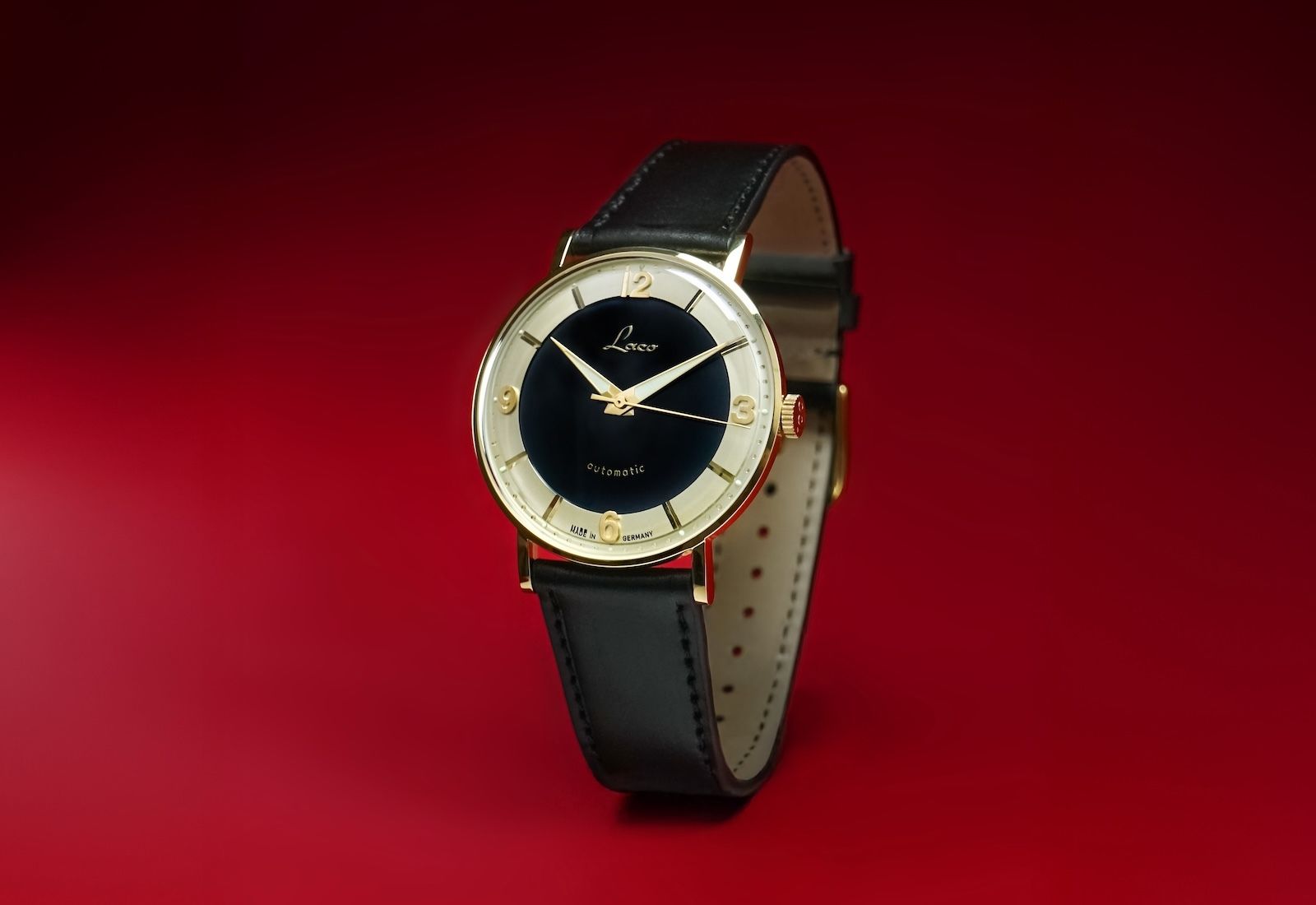
While the 1950s version was certainly much smaller, this new one grows a bit in width, but isn’t huge. The stainless steel case measures 38mm wide and just 9.8mm thick and has a gold-colored IP coating. The lugs are thin, squared off and have a very 50s look. On top is a box-shaped double domed sapphire crystal, and the caseback has the individual number of the watch. Water resistance is a decent 50 meters.
The dial is where the watch is even more retro styled. It has a matte black base with a champagne-colored outer ring, applied gold-colored numerals, recessed indices, and a gold-colored minute track with Superluminova C3 hour dots. The Laco logo is applied, while the hands are polished, dauphine-shaped, and with a gold-colored IP coating. Both the hour and minute hands are filled with C3 Superluminova.
Inside, kind of a surprise. Not because it’s a unique movement, but rather what movement it is at this price point. It’s the Laco 300 movement, which is a slightly modified Sellita SW300-1 that beats at 4Hz and has a 50 hour power reserve. The watch comes on a black Shell Cordovan leather strap with black stitching.
The new Laco Edition 100 is limited to 100 pieces and available now. It’s priced at €1.450, which is a sensational price for a SW300 powered movement. See more on the Laco website.
3/
Raymond Weil Teams Up With seconde/seconde/ For The Perfect Dress Watch
If you don’t know who seconde/seconde/ is, his name is Romaric André and he is a banker-turned-watch-customizer. Most of his customizations are dependent on a pun. Like, for example, his collaboration with Spinnaker which used the Blancpain 50 Fathoms and punned it into 50 Phantoms, making one of the best Halloween watches on record. But as is the case with puns, not all of them can be good, and not all sit well with all people. There have been some that haven’t hit the mark, and then, there are watches like this new collaboration with Raymond Weil on their new Toccata Heritage model that turns upside down all the strict rules of a dress watch that are endlessly debated by purists by making them the focal point of the entire watch. This is the new Raymond Weil Toccata Heritage x seconde/seconde/.
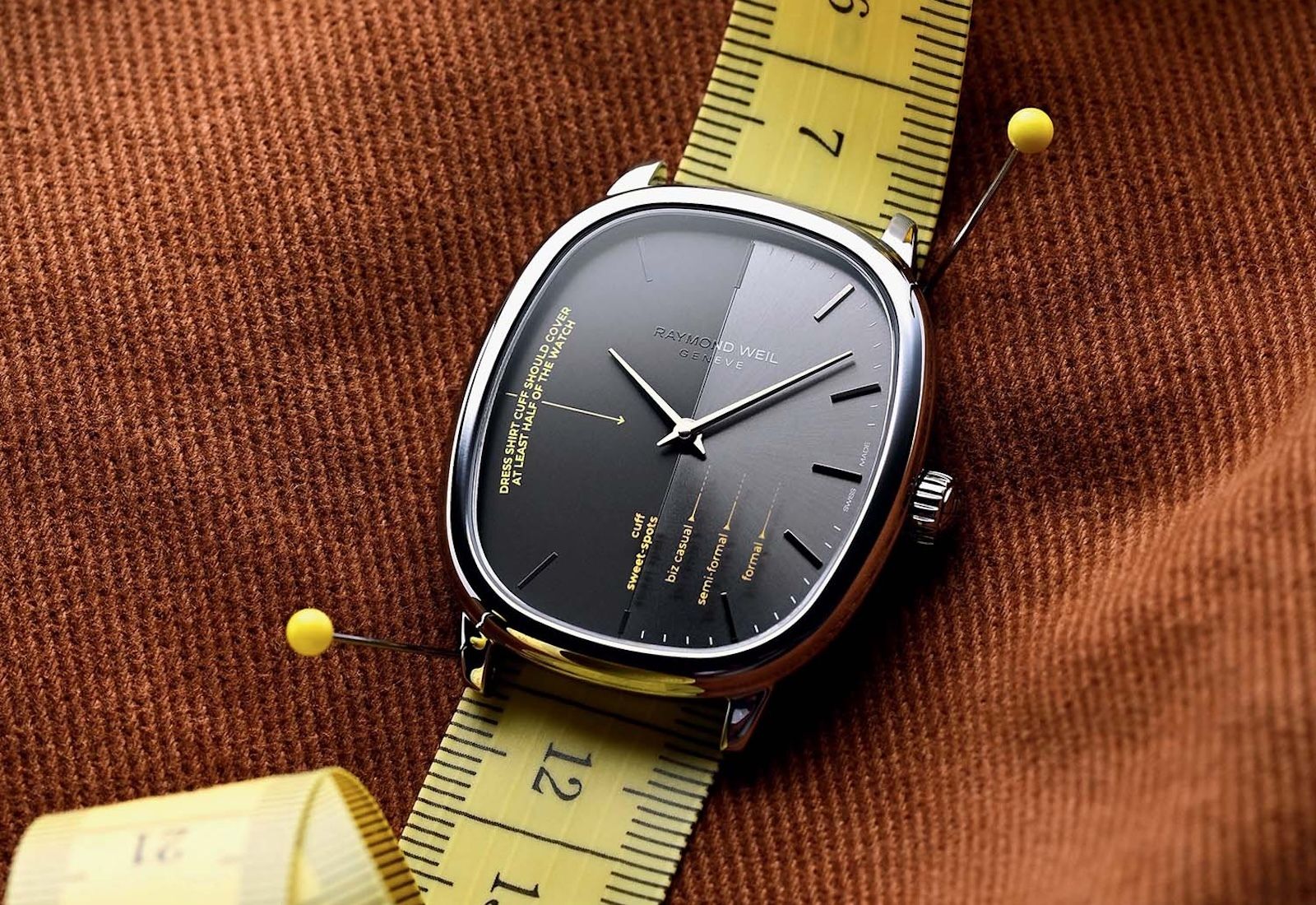
Raymond Weill recently update the Toccata line with the new Heritage which is supposed to emulate the best of dress watches — it has an ellipse shape that measures 33mm wide, 6.95mm thick and has a 38mm lug-to-lug. This version comes in an uncoated polished steel case with a shaped sapphire crystal on top. Even the backside of the watch is used to express the collaboration with seconde/seconde/, which is all about exaggerated dress watch rules. That’s why the closed caseback says in yellow: “Never wind your watch while wearing it. Take it off first, then wind it in a dramatic fashion (ideally in the middle of a conversation)” Funny. Water resistance is 30 meters.
More rules can be found on the dial, poking fun at the purists. They will argue on the internet how much of a dress watch should be seen under a cuff, so seconde/seconde/ splits the dial right down the middle, with one part getting a matte grey finish and the other a sunray brushed finish. The matte grey part reads, in yellow: “Dress Shirt Cuff Should Cover at Least Half of the Watch” with a yellow line with an arrow pointing to the middle of the dial. The sunray part of the dial has four yellow lines that denote potential cuff positions, each labeled with its intended use: the central line that splits the dial reads “cuff sweet-spots”, followed by “biz casual”, “semi-formal” and the “formal” cuff position.
Inside, you’ll find the RW4100, based on the hand-wound Sellita SW210-1. It beats at 4Hz and has a 45 hour power reserve. The watch comes on a black calfskin leather strap with an embossed alligator pattern and a steel pin buckle.
The new Toccata Heritage x seconde/seconde is limited to 50 pieces and I would be surprised if you can still get one. The only thing I could see preventing it from selling out instantly is the price, which is CHF 1,695, about CHF 700 more than the regular version. See more on the Raymond Weil website.
4/
Ollech & Wajs Recreates Two Very Cool Vietnam-Era Watches, The MK-102 and MV-82
Most of the watches made by Ollech & Wajs follow a pretty similar template - they are a skin diver-style case made with heavy vintage inspirations and cool uses of colors. They grasp deep from their history as much is linked to military and professional services. Their watches were worn by scientist Wernher Von Braun and NASA Group 6 astronaut Dr Anthony Llewellyn and In 1965, they became the most widely used ‘unissued’ watch brand by military personnel in the Vietnam conflict, delivering up to 10,000 pieces a year. They also produced special watches for certain US regiments during the Vietnam war. Now, Ollech & Wajs is rooting through their Vietnam archives to recreate some of these amazing watches. These are the M-Series Heritage MV-82 made for the U.S. Army’s Airborne troops and the wildly cool M-Series Heritage MK-102, made for the U.S. Army’s 2nd Infantry Division.
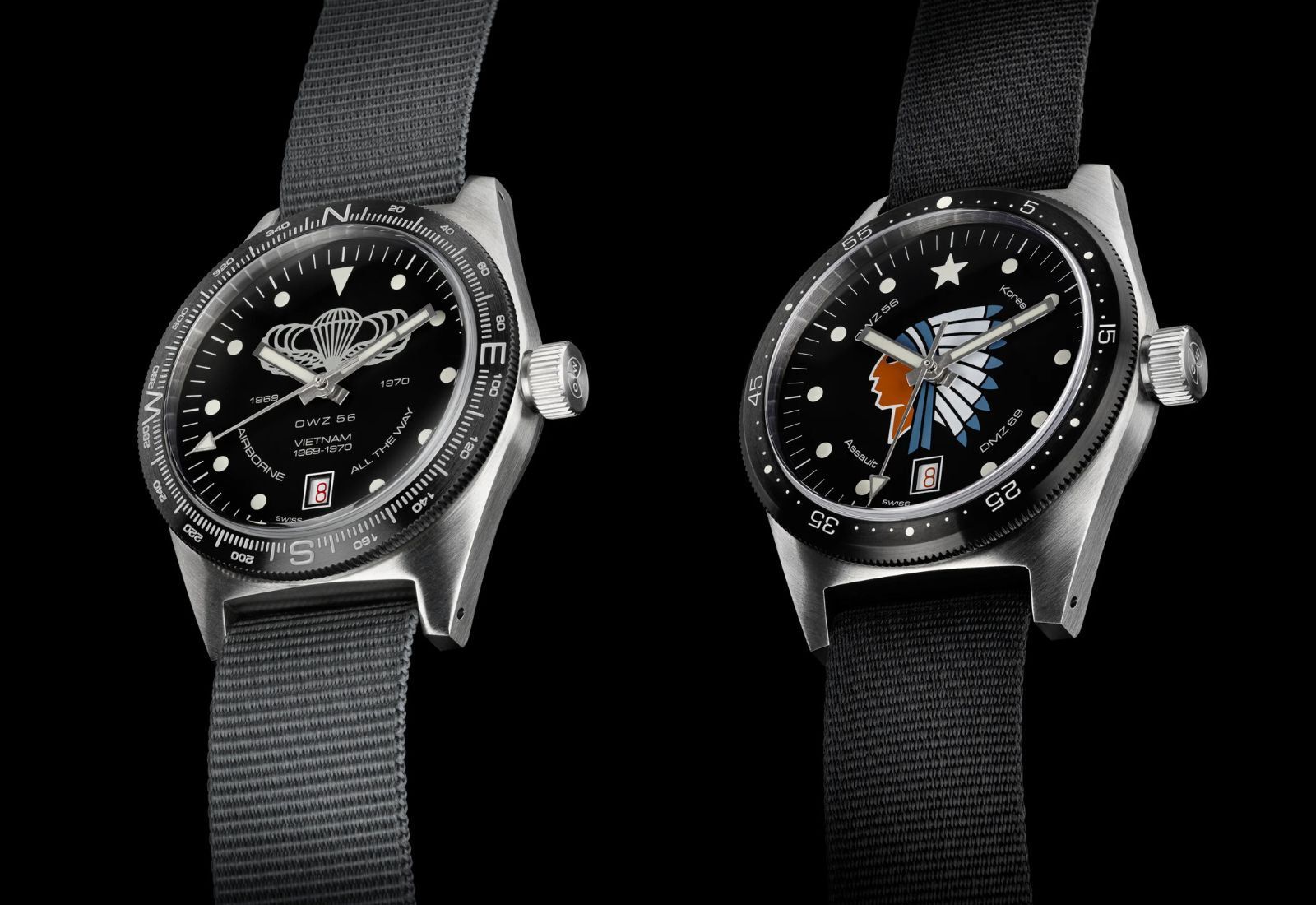
The watches come in a 39.5mm wide and 12.5mm thick case that takes on the brand’s M-type case with very short lugs, brushed finish and an almost skin-diver appearance. On top is a thickened domed sapphire crystal, which helps with the 300 meter water resistance, and around it is a PVD-coated sloping-edged rotating bezel with 12 hour world time markings and a finely serrated edge and two different sets of markings.
Starting with the more conventional of the two, but only slightly more conventional, is the MV-82. This is a watch that was designed for the U.S. Army’s Airborne troops and was given to anyone who passed Airborne School. Since parachutist could be blown off course and lose their gear, the watch has a compass bezel with an angle scale to be useful for orientation. But the most striking part of the dial is the huge Parachutist Badge at the very center and word “Airborne” and “All The Way” which were used by the 82nd Airborne. At 6 o’clock is a date aperture, above which it says Vietnam 1969-1970.
The other watch is the MK-102 which has a bidirectional countdown bezel and a very busy dial, but one with a lot of meaning behind it. The MK-102 was built for the U.S. Army’s 2nd Infantry Division, also known as the “Indianhead” division which has a huge history. Interestingly, they did not see action in Vietnam. Instead, they fought extensively in the Korean war, after which they were based in the demilitarised zone in Korea from 1965 as protection for South Korea from the north. And O&W pushed all of this onto the dial. At the very center is the huge Indianhead logo, surrounded by the words assault, Korea and DMZ69. I love the look of this.
Inside both watches you’ll find the Soprod P024 automatic movement. This is Soprod’s version of the legendary ETA 2824, which means it beats at 28,800 vph and has a 38 hour power reserve. Both watches come on RAF military-grade nylon straps, black for MK-102, grey for MV-82.
The new Ollech & Wajs M-Series Heritage MK-102 and MV-82 are available now, with the first 56 pieces of each being numbered. Price is set at CHF 1,496 for either. See the MK-102 here and the MV-82 here.
5/
Panerai Brings The Bronzo Case To The Luminor For The First Time With The PAM01678
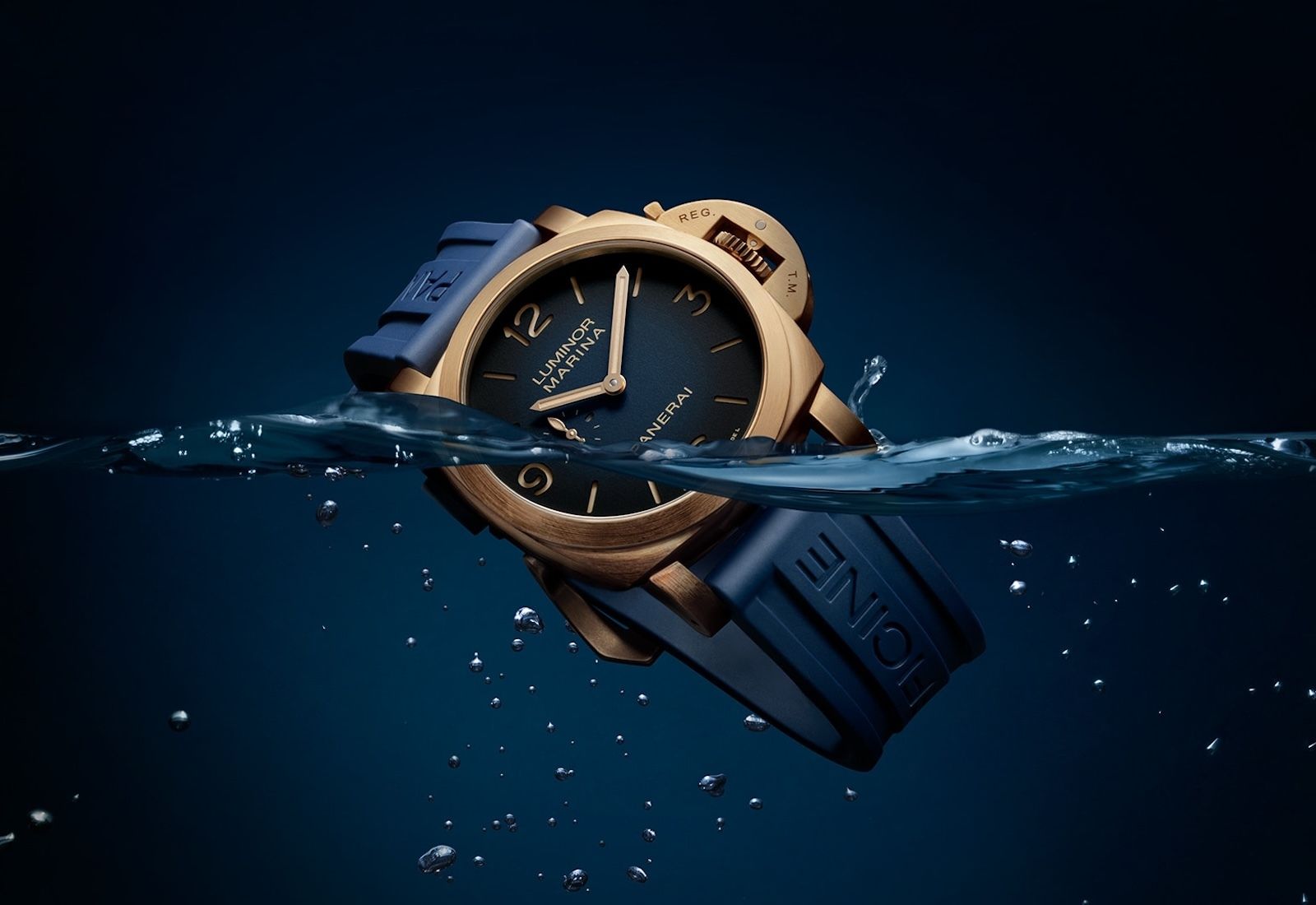
I have long liked Panerai’s use of bronze for their cases, especially when I see a photo of a well aged one. Since Panerai divers already look like dive watches from a bygone era, a weathered one in a Bronzo case looks like it’s been fished out of the depths of the ocean where it fell off a sailors wrist while fighting a Kraken. But what blew my mind is the fact that they never did a Brozno version of their Luminor Marina, their most iconic case. They did a Radiomir. They did a Submersible. But never a Luminor Marina. Until now. This is the new Luminor Marina Bronzo PAM01678 and it looks so good.
Just like previous versions, this PAM01678 uses Panerai’s proprietary bronze alloy, made of pure copper and tin that has been engineered to develop a cool patina. The watch measures 44mm wide and 13.7mm thick, with the iconic crown protector mechanism on the side. Out back you get a titanium caseback with a sapphire crystal. Water resistance is a great 500 meters.
A black dial would work great with a Bronzo case, but why keep it plain. That’s not very Panerai-like. So they give the dial an incredible blue dial that has a gradient from a lighter center to a darker blue on the edges, which works great with the bronze case. You still get the sandwich dial construction with cutouts for the numerals and hour markers that reveal beige Super-LumiNova inside. The hands have a bronze finish, both the central pair and the small seconds at 9 o’clock, all of which are also filled with beige lume.
Inside, you’ll find the P.980 automatic movement that beats at 4Hz and has a 72 hour power reserve. The watch comes on a blue calfskin leather strap with beige stitching, closed with a brushed bronze trapezoidal buckle, and you get an additional blue rubber strap.
The new Panerai Luminor Marina Bronzo PAM01678 should be on sale already, and it’s part of the regular collection. Price is set at a pretty significant €17,000. See more on the Panerai website.
6/
Jaeger-LeCoultre Brings Back The 1990s With The New Master Control Classic
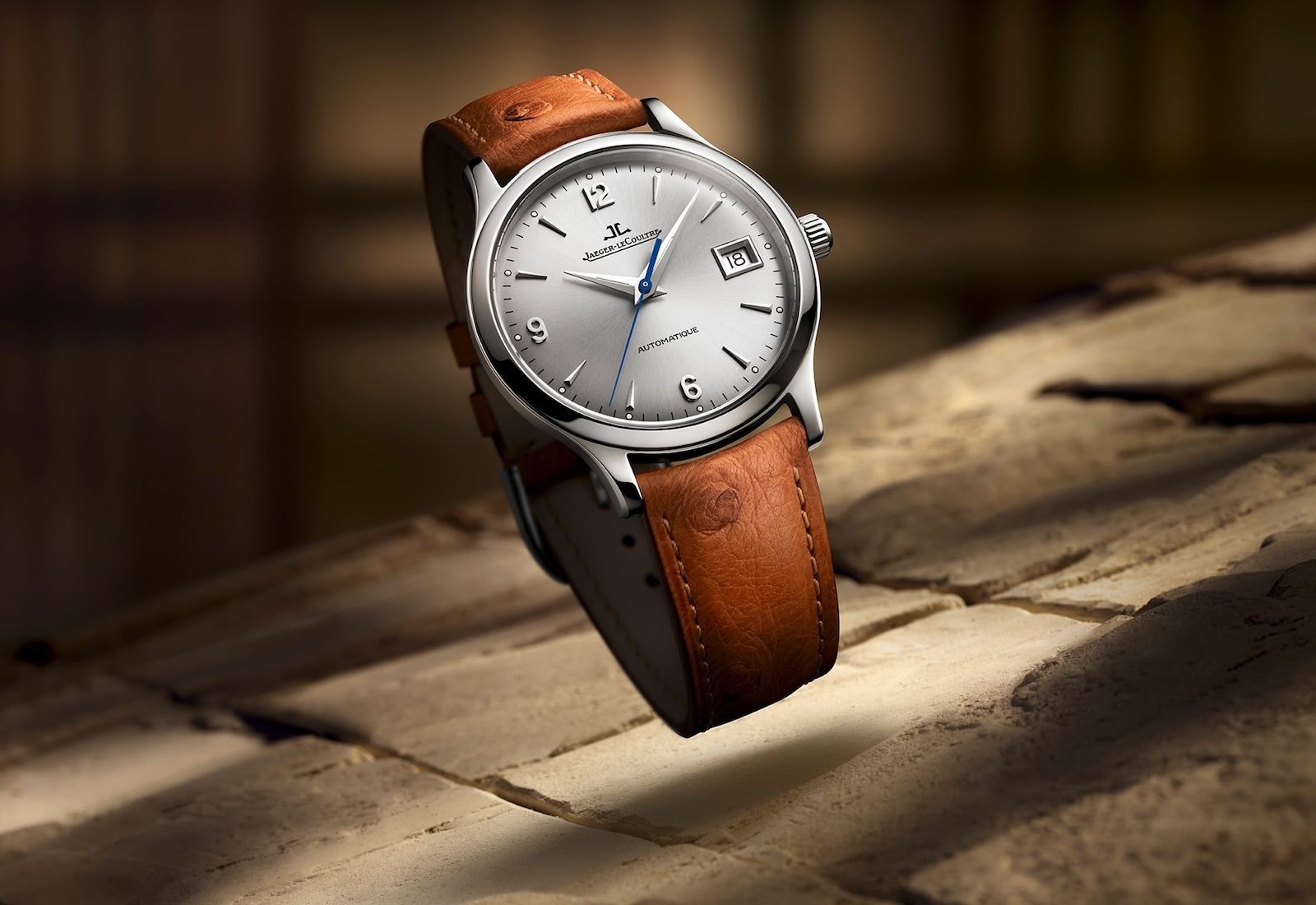
I fell in love with Jaeger-LeCoultre in the late 1990s and early 2000s. In retrospect, it seemed that JLC at the time was a much more diverse company that experimented with shapes, sizes and movements, while modern JLC focuses on a lot of Reverso models. I might be imagining it. But even JLC acknowledges that they made some pretty rad models in the 90s. They’re doing it with the release of the new Jaeger-LeCoultre Master Control Classic, a modern reinterpretation of a heritage model – the 1995 Master Control.
The way that Jaeger-LeCoultre approached this is the perfect way to upgrade an icon — with incremental changes. The ‘95 version was objectively a small watch, so they increased the size, but don’t feat. While the old version measured 34mm wide, this new one comes in a stainless steel case that measures 36mm wide and a svelte 8.15mm thick. On top is a domed sapphire crystal with a proportional plain and fixed bezel, while the caseback features a vintage-inspired Master Control medallion. The case features polished and satin-brushed surfaces. Water resistance is very decent at 50 meters.
The dial, on the other hand, is very close to the original. That means that it has a silver sunray brushed base with applied and sharp triangular hour markers with lumed dots at their bases. The hands are faceted and dauphine-shaped, while the central seconds hand is blued. At 3 o’clock is a framed date window.
But while the look of the watch draws on the 90s, the insides are modern. it’s the in-house Caliber 899. The most impressive thing about this movement is the fact that it’s an automatic wound with a centrally mounted rotor. Really impressive for a 7.8mm thick watch. It recently got a power reserve upgrade to 70 hours, while beating at 4Hz. The watch comes on a brown ostrich leather strap, which is the exact strap that my dad has on his early 2000s Reverso, so it’s absolute perfection.
Unfortunately, the new Jaeger-LeCoultre Master Control Classic is limited to 500 pieces. The watch is available now and priced at €8,950. See more on the Jaeger-LeCoultre website.
FOR WATCH CLUB MEMBERS Watch School Wednesday: A Practical Guide To The Materials That Make Up Our Escapements
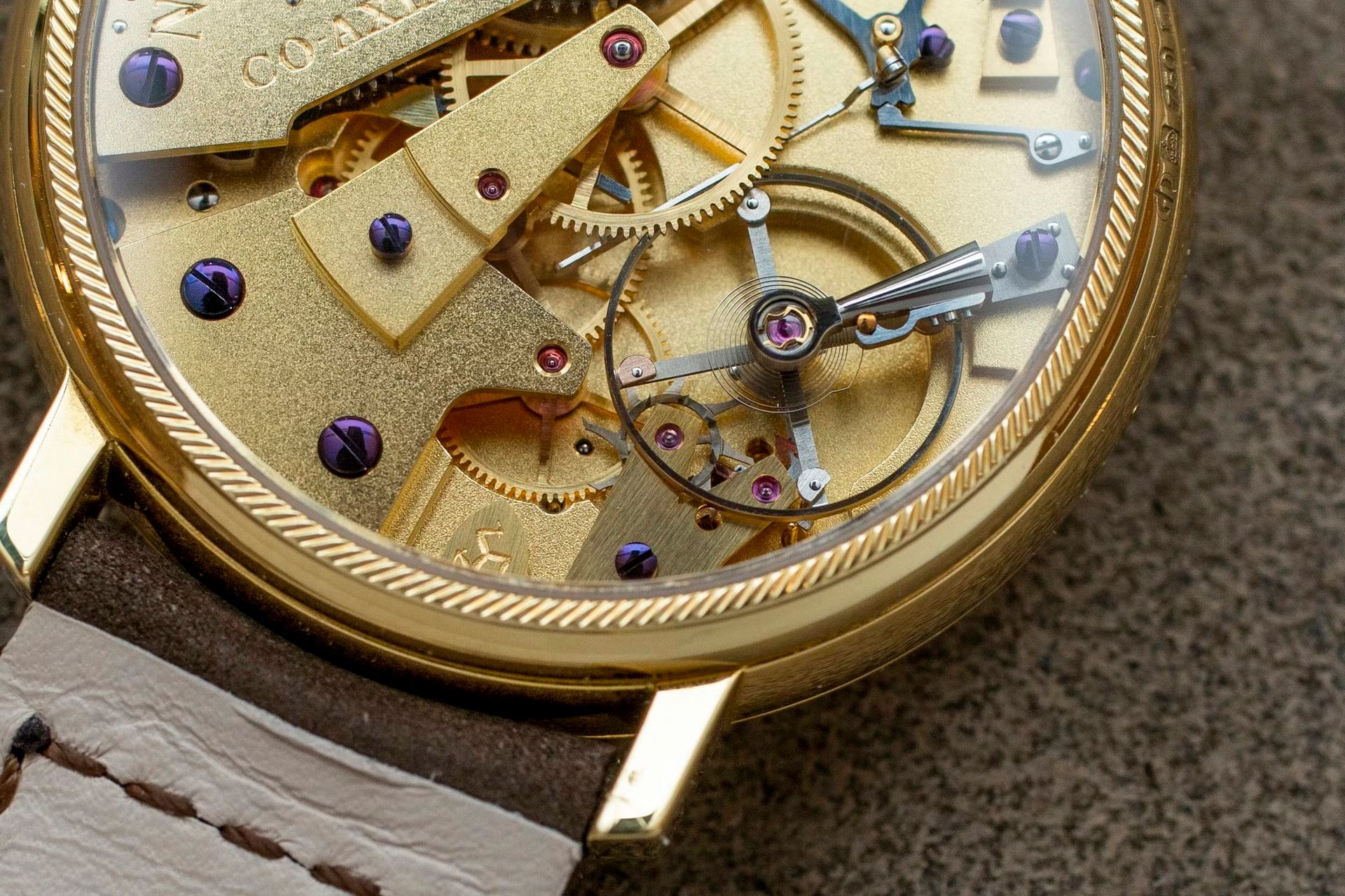
Escapement materials as the frontline of innovation in mechanical watchmaking. Read it here.
⚙️Watch Worthy
A selection of reviews and first looks from around the web
⏲️End links
A bunch of links that might or might not have something to do with watches. One thing’s for sure - they’re interesting
Chandler Fritz confesses his first journalistic mistake 11,000 words into his account of the Prestonwood Baptist Church’s multi-million-dollar Christmas pageant in Dallas: “I got comfortable.” The second mistake comes moments later, when he becomes part of the story, donning his “biblicals” and waving candles at zebras during what a media director calls “the largest scale and most technologically advanced show that goes on, certainly during Christmas, maybe ever.” I loved Fritz’s “The Man in the New Boots,” about his decision to ride a bull. This is a different animal entirely: a sprawling, detailed portrayal of an epic event, featuring a sound team from Slayer tours, a llama in heat, a history of Baptists in Texas, and ultimately—finally!—a consideration of goodness beyond faith’s limit.
Another editor might’ve titled M.P. Kennedy’s essay “Thirteen Ways of Looking at a Hamm’s Beer Ad.” Fortunately, better minds prevailed. Inside a pizzeria in southern California, a decades-old lightbox repeatedly scrolls through a series of natural images beside a defunct brewery’s logo and a slogan: “Born in the land of sky blue waters.” Kennedy’s critique of advertisements as kitsch and “imaginal pollution” isn’t a new take, but that’s hardly the pleasure of his expansive, playful essay. The real pleasure is watching Kennedy’s mind make its savvy, nimble moves—seeing his own wheels turn as the idyllic scene endlessly winds its way through the box.
Hans Fallada’s Every Man Dies Alone turns a slim Gestapo file into a sprawling portrait of ordinary Berliners facing their smallest and greatest moral tests under Nazism. In the Quangels’ doomed postcard campaign, and in the petty fears and muted refusals around them, the novel maps how private decency persists—and sometimes falters—inside a machinery built to make cowardice feel like survival.
👀Watch this
One video you have to watch today
I’ve seen this video years ago, but I don’t think I ever shared it here. It’s fascinating how much work goes into something that nobody ever thinks about.
What did you think of this newsletterYour feedback will make future issues better |
Thanks for reading,
Vuk
Reply