- It's About Time
- Posts
- TAG Heuer Expands Their Formula 1 Solargraph Lineup With Pastel Colors And Watches And Wonders Coverage Continues With New Watches From Nomos, Chopard, Chanel and Czapek
TAG Heuer Expands Their Formula 1 Solargraph Lineup With Pastel Colors And Watches And Wonders Coverage Continues With New Watches From Nomos, Chopard, Chanel and Czapek
What do we think about pastel Formula 1 models?

Vuk Radic
April 22, 2026
Coverage of Watches and Wonders is brought to you by

Hey friends, welcome back to It’s About Time. Watches and Wonders coverage is slightly winding down but there’s still some cool stuff to be covered. Check this space on Friday to see my thoughts on the entire show.
HELP RUN THIS NEWSLETTER
If you like this newsletter, and would like to support it, there’s two ways you can do it. First, the completely free one — just share it with your friends. That’s it.
However, if you would like to help me pay for all the services that are needed to run it, you can get a premium subscription, one that gets you a TON of extra content every week.
A paid subscription will get you:
the satisfaction of helping run your favorite watch newsletter
no ads
weekly Find Your Next Watch posts
early access to reviews
Watch School Wednesday posts
a look at watches you haven't seen before
historical deep dives
In this issue
TAG Heuer Expands Their Formula 1 Solargraph Lineup With Pastel Colors
Nomos Keeps Its Cool With Two Updated Models At Watches And Wonders
Chopard Doubles Down On The Alpine Eagle And A Bit Of Racing Pedigree
Chanel Brings Back The 42mm J12; Plus Four New References In Two Different Directions
Czapek Brings The Antarctique Into Titanium With Three Cosmic Blue Watches
👂What’s new
1/
TAG Heuer Expands Their Formula 1 Solargraph Lineup With Pastel Colors

The Formula 1 Solargraph is barely a year old, but I kind of already forgot a bit about it. OK, to be honest, I wasn’t exactly a huge fan of the return of one of the most iconic watches of the 80s and 90s. I love the design, the plastic case, the quartz movement, but I couldn’t get over the price. I was expecting something higher than a Moonswatch, but certainly not something that’s higher than other steel TAG Heuer Solargraphs. Anyways, the general reception musth have been good enough to warrant a new colorway, and that’s what we’re getting here, this time in five pastel colors split across two very different executions.
The case carries over unchanged from last year — 38mm wide and 9.9mm thick, with a lug-to-lug of 45.2mm. Three of the five models use TAG Heuer's Polylight bio-polyamide case (a.k.a. plastic, but durable plastic) in pastel blue, beige, and pink, each matched to a rubber strap and bidirectional-rotating Polylight bezel of the same color. The other two are sandblasted stainless steel with Polylight bezels in pastel green and lavender blue. All five have screw-down crowns and casebacks for 100 meters of water resistance.
The three Polylight versions get opaline dials in their respective case colors, with the same layout as the original — Mercedes-style lume hand, TAG logo-shaped markers at 6, 9, and 12, small date window. Each gets a contrasting accent color worked into the dial that gives it just enough visual tension to avoid looking flat. The steel versions go a different direction: both feature pastel-toned dials set with eight VS-grade diamonds where the circular markers would be, which is certainly a choice. Not sure I would make that choice, but it is a choice.
Inside all five is the TH50-00 Solargraph movement, developed with La Joux-Perret, which charges via natural or artificial light and stores up to 10 months of power reserve in darkness. Worth flagging: the specs here have changed since the original launch. The 2025 model needed two minutes of light for a day's charge and 20 hours to reach full capacity; this version is listed as one minute for a day's charge and 40 hours to full.
The TAG Heuer Formula 1 Solargraph Pastel Collection is available now in limited production. Standard dial (Polylight) models are priced at €1,950. Diamond dial (steel) models are priced at €2,800. See more on the TAG Heuer website.
2/
Nomos Keeps Its Cool With Two Updated Models At Watches And Wonders
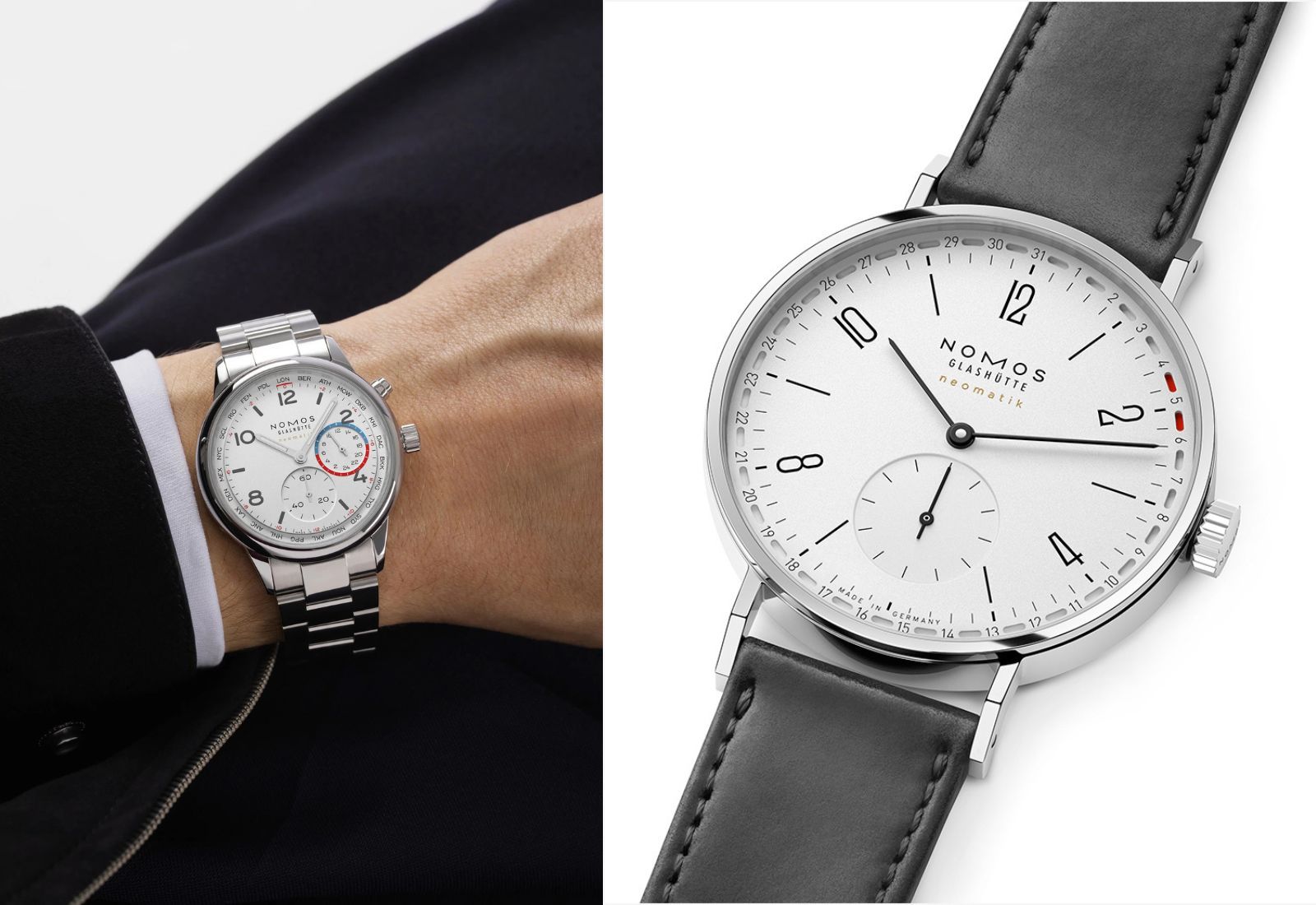
Watches & Wonders is when the industry makes its biggest swing of the year. Well, for the majority of the industry. NOMOS decided on a different approach, with a few select updates to the things that work best for them. These are the new Club Sport Neomatik Worldtimer and the new Tangente 38.
The Club Sport Neomatik Worldtimer was a hit when it debuted at last year's show, and it's easy to see why: slim, practical, priced fairly for what it does. In fact, this was the first time I got to handle one, and… wow, what a watch. The click-to-switch-timezones is one of the most satisfying things in the world. For 2026, NOMOS adds a radiant white version to the permanent collection alongside the existing blue and silver sunburst references. The case stays exactly as it was — 40.5mm wide, 9.9mm thick, stainless steel — with the screw-down crown and its red warning ring, and 100 meters of water resistance. The complication operates through a pusher at 2 o'clock that advances both the city ring and the central hour hand simultaneously to set local time. Home time sits on a slightly recessed 24-hour sub-dial at 3 o'clock with day/night indication via a red and blue ring.
The new dial is matte silver-plated white, and it might be the best-looking of the three permanent options (my heart lies with the limited editions). The white sub-dial for home time and the white city ring below it all hold together with restrained doses of red and grey, and the grey Arabic numerals and pencil-shaped hands are treated with blue-emission Super-LumiNova. The 24 IATA airport codes on the city ring include some obscurities, so you'll pick up some geography whether you want to or not. Small seconds sit at 6 o'clock with a rhodium-plated hand. The NOMOS calibre DUW 3202 powers everything: 4.8mm thick, in-house escapement and hairspring, 42-hour power reserve. It comes on a three-link stainless steel bracelet with satin-brushed outer links at €4,260, or on a grey textile strap at €4,080. More on the NOMOS website.
The second release is the Tangente Update, a watch NOMOS introduced in 2018 in a 40.5mm case, defined by its patented peripheral ring date — all 31 days displayed simultaneously around the dial's edge, with two red markers framing the current date. That complication is back in a new 38.5mm version that's also 7.4mm thick, which makes it properly slim. The case is still Bauhaus-angular with clean lines and squared-off lugs, but the reduced size softens the whole thing considerably. For the first time, the Tangente Update is also offered in 18k gold, with a "doré" tone-on-tone variant and a blued-hands variant both available. The steel version gets black hands.
The dial is silver-plated with printed Arabic numerals, baton markers, and a recessed small seconds at 6 o'clock. Clear and easy to read, nothing competing with the date ring for attention. The movement is the in-house calibre DUW 6101, an automatic Neomatik that's just 3.6mm thick, with bidirectional winding, a quick-set date that adjusts in both directions, and the Swing System escapement regulated in six positions. The Tangente Neomatik 38 Update starts at €3,680 for the steel version and €12,400 for gold, on a leather strap. See more on the NOMOS website.
3/
Chopard Doubles Down On The Alpine Eagle And A Bit Of Racing Pedigree

Chopard keeps returning to the same well — the Alpine Eagle — and keeps finding something new to pull out of it. This year there are two new references, plus a Mille Miglia chronograph that might be the most visually interesting thing the brand has shown in years. I’ve covered some Chopard releases from Watches and Wonders this year, but I completely overlooked the Alpine Eagle. Big mistake. Let’s fix it.
The bigger news on the Eagle front is the Alpine Eagle 41 XPS, which takes the extra-thin direction the brand started in 2023 and pushes it further. The case is 41mm wide and just 8mm thick — made from Lucent Steel, Chopard's in-house alloy that's harder than standard steel and has a bright, slightly precious-metal quality to it. The new dial color is called "Mountain Glow," a champagne tone meant to evoke alpine light on fresh snow, with the brand's characteristic radiating eagle-iris pattern across the surface. White gold hands and Roman numerals, small seconds at 6 o'clock, all coated in Super-LumiNova. Inside, the L.U.C calibre 96.40-L: 3.3mm thin, off-center 22k gold micro-rotor, twin stacked barrels, 65-hour power reserve, Poinçon de Genève finishing. The bracelet was reworked, with tapered links at the lugs and thinner ones at the clasp, plus a comfort-fit extension built into the folding clasp. It retails for CHF 25,600 and joins the permanent collection.
The second Alpine Eagle story is a new dial color — Rhone Blue — across the standard 41mm and 36mm references. The shade comes from the Rhône River as it exits the glacier in Valais. The 41mm runs the 01.01-C calibre with a 60-hour power reserve and includes a date at 4:30; the 36mm uses the 09.01-C with 42 hours and skips the date. Both are COSC-certified. Pricing is CHF 12,400 for the 36mm and CHF 15,400 for the 41mm.
Then there's the Mille Miglia Classic Chronograph. Same 40.5mm Lucent Steel case as the 2023 edition, but this time it's been DLC-coated and then put through a tribofinishing process in which ceramic media is vibrated against the surface to soften edges and create a worn, patinated look. It looks like a piece of steel that's been through something, which is exactly the point for a watch tied to a 1,000-mile road race. The dial is salmon colored, bright, circular-brushed, paired with black sub-dial rings and a black peripheral tachymetre scale with salmon-toned graduations. Three-register tricompax layout, vintage Arabic numerals, glass-box sapphire crystal for that extra depth. The movement is an ETA A322-11, COSC-certified, 28,800vph, with a 54-hour power reserve. It comes on a perforated rally-style calfskin strap with an aged-finish pin buckle to match the case. Limited to 100 pieces, price around EUR 11,500. See more on the Chopard website.
4/
Chanel Brings Back The 42mm J12; Plus Four New References In Two Different Directions
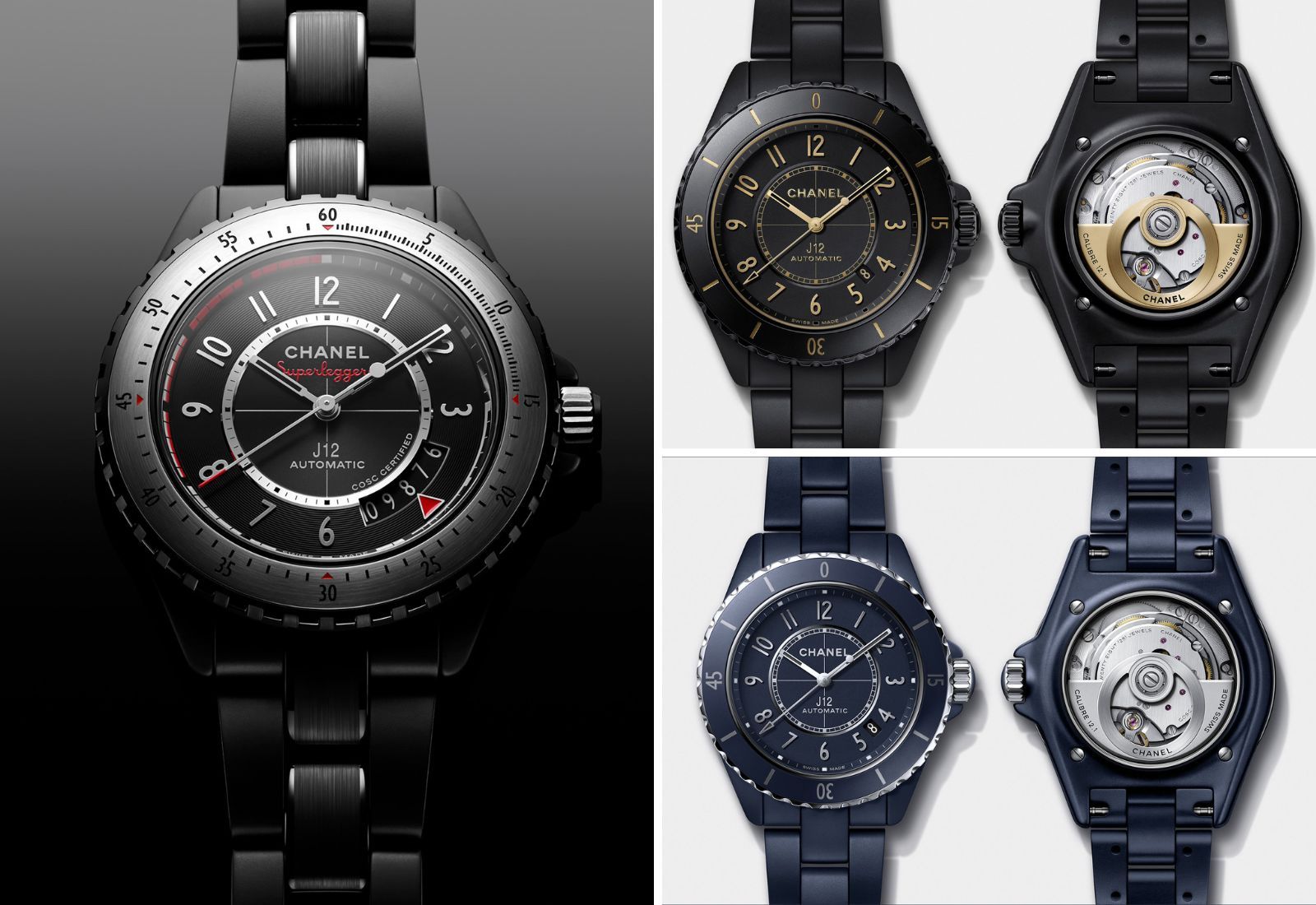
The Chanel J12 has always had a strange place in watch culture — designed in 2000 for men, immediately adopted by women, and then gradually abandoned by men after some commercial missteps in the early 2010s. For over a decade, Chanel quietly retreated from the men's market and leaned into what was working. The result was a brand whose most iconic watch had, somewhat ironically, drifted away from the person it was originally designed for. Watches & Wonders 2026 looks like Chanel's attempt to correct that, and they're coming in with four references across two very different directions.
The most visually interesting of the bunch are the two new unisex models in matte dark blue ceramic — available in 38mm and 33mm. This shade of blue isn't brand new; Chanel introduced it in a pair of limited editions last year after five years of development to land on what their director of watchmaking described as something between black and blue. It's now moving into the permanent lineup. Both cases mix matte ceramic with steel, with the 38mm coming in at 12.6mm thick and the 33mm at 12.94mm thick, each with a unidirectional rotating bezel, screw-down crown with ceramic cabochon, and 200 meters of water resistance. Silver applied Arabic numerals, a printed railway track, and lume-tipped hands read clearly against the matte blue dial. The 38mm adds a date at 4:30. Movement duties go to proprietary Kenissi calibres — the 12.1 in the 38mm with 70 hours of power reserve, the 12.2 in the 33mm with 50 hours — both COSC-certified and visible through an exhibition caseback. Pricing hasn't been confirmed yet.
Then there are the two 42mm men's models, and this is where it gets more interesting. The J12 Golden Black is a limited edition that goes back to something Chanel hasn't done since a 2008 Audemars Piguet collaboration — black ceramic and yellow gold. It's not as extravagant as that collab was; the yellow gold here is PVD on the rotor and hour markers rather than solid case gold, but the combination still works. Matte black ceramic, pale gold accents, unidirectional bezel, 200 meters water resistance, Kenissi calibre 12.1 at 4Hz with 70 hours of power reserve. It's priced at $12,150. The J12 SUPERLEGGERA is the non-limited option at $13,750, and despite the name — which translates to "super light" — it isn't especially light. Where the original SUPERLEGGERA mixed ceramic with aluminum for weight savings, this one mixes ceramic and stee. It's a three-hand watch with a timing bezel, an asymmetric open date window that will divide opinion, and the same Kenissi 12.1 inside.
5/
Czapek Brings The Antarctique Into Titanium With Three Cosmic Blue Watches

The Antarctique launched in 2020 as Czapek's integrated bracelet sports watch and has since become the brand's calling card — a flat tonneau case, off-center micro-rotor, glass-box sapphire crystal, C-shaped bracelet links. It's a recognizable look, and it works. For Watches & Wonders, Czapek is releasing three titanium versions of the collection: the Dark Sector, the Révélation, and the Tourbillon, all sharing a Cosmic Blue dial. Titanium Antarctique isn't new, we saw the titanium Dark Sector in 2023. What's new is the color, the breadth, and for the first time, the choice between fully brushed or brushed-and-polished bracelet links.
The case geometry is unchanged across all three: the same flat tonneau, polished bezel, rounded crown guards. New is the material. Titanium lightens the watch considerably and gives it a cooler, more muted look that sits better with the Cosmic Blue dials than steel. The Dark Sector is available in both 40.5mm and 38.5mm wide cases, 10.6mm thick each, as is the Révélation. The Tourbillon comes only in 40.5mm. All three get a glass-box sapphire crystal and an integrated bracelet.
The Dark Sector's velvety blue dial is one of my favorite things Czapek does, even though it’s super simple. Two concentric rows of applied elements circle the dial, segmented at each hour. It's clever and understated. The only splash of color is the red marker at noon and the matching red tip on the central seconds hand. Lume is minimal, limited to the tips of the hour and minute hands. The Révélation goes the opposite direction: it's built around calibre SXH7, which reverses the escapement to show it on the dial side along with a visible stop-seconds system. The small seconds is at 4:30, surrounded by a Cosmic Blue ring that matches the peripheral minute track. The Tourbillon has the most going on — calibre 9 with a dial-side flying tourbillon, with the gear train and barrel visible above a hand-guilloché Singularité pattern. In titanium with the blue dial behind all that movement, the depth it creates is considerable.
The Dark Sector and Révélation both run on Czapek's in-house SXH5 and SXH7 respectively, the off-centered recycled platinum micro-rotor doing its job from beneath five openworked finger bridges, 60-hour power reserve, variable-inertia balance beating at 4 Hz. The Tourbillon gets the calibre 9, a purpose-built movement for that dial-side display. All three come on titanium integrated bracelets, now available for the first time in either fully brushed or brushed-and-polished combinations.
The Antarctique Titanium Dark Sector is priced at CHF 32,000; the Révélation at CHF 42,000; the Tourbillon at CHF 67,000. All three are limited editions: 25, 50 and 25 per year, respectively. See more on the Czapek website.
📢 Closing message
Inflection — The Rarest Metal on Your Wrist: 100 Watches a Year, No Exceptions
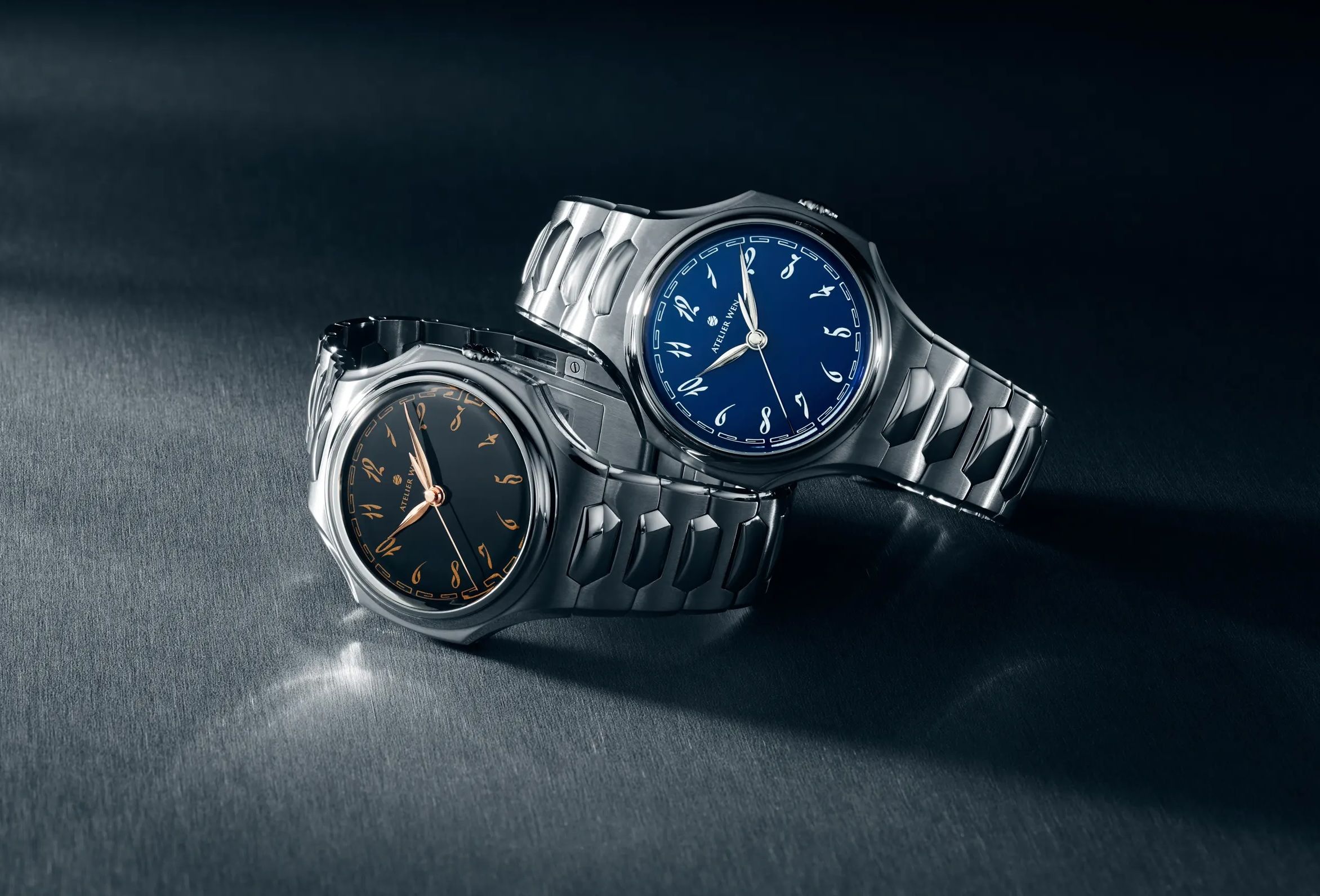
If the Perception was Atelier Wen’s opening statement, the Inflection is the brand’s full-throated manifesto — a watch that pushes independent horology into uncharted territory.
The 40mm case and every bracelet link are crafted from 99.9% pure tantalum, a dense, bluish-grey metal that is corrosion-resistant and extraordinarily difficult to machine, chosen because it reflects the brand’s refusal to take the easy path. The case design embodies the Taoist principle of yīn and yáng through a harmony of concave and convex surfaces.
Grand feu enamel dials by Kong Lingjun come in three variants: 幽 (Yōu) — a hand-hammered pale green to deep viridian gradient (30 pieces); 墨 (Mò) — pitch black obsidian; and 渊 (Yuān) — midnight blue.
The movement is a highly customised Girard-Perregaux GP03300 with bridges inspired by wind motifs in classical Chinese paintings, ruthenium plating, 28,800 bph, and a 48-hour power reserve. Total annual production is capped at 100 pieces across all variants, allocated by application only.
⚙️Watch Worthy
A selection of reviews and first looks from around the web
⏲️End links
A bunch of links that might or might not have something to do with watches. One thing’s for sure - they’re interesting
Even if you’ve never enjoyed Noah Hawley’s television work—Fargo, Legion, Alien: Earth—this chronicle of his time at Jeff Bezos’s annual gathering known as Campfire demonstrates that he knows how to instill a creeping sense of dread. Here are dozens of people, most of them prodigiously accomplished in their fields, invited to spend a few days listening to other prodigiously accomplished people. All that brainpower and ambition, and yet most of them seemed flummoxed, if not outright discomfited, by their own presence. Was this TED by way of Bohemian Grove? Yaddo for the stratospherically successful? Or was it simply, as Hawley makes clear, a playground for a man who has effectively isolated himself from life as most people experience it?
We’ve all gotten a bump on the head. Fewer of us have fallen out of a moving minibus and directly onto our heads. Fewer of us still are doctors who have experienced such an event, and the fewest of all are also, in addition to the other three things, very funny writers. Thankfully, that sub-sub-sub-sub category contains Adam Boggon, whose Pangyrus essay about crashing made my dreary afternoon much more enjoyable.
The hunt and the hunt saboteur have a long history in the UK, one that continued even after the ban on fox hunting in 2004. With the ban riddled with loopholes, saboteurs have remained necessary to help protect British foxes. They are a dedicated and eclectic bunch, now embracing new technology such as drones to catch hunters who push the limits of the law. With the UK government moving towards a complete ban on trail hunting, this tumultuous relationship may finally be drawing to a close—although I suspect some unfinished business may linger for years to come.
👀Watch this
One video you have to watch today
Love Iron Snail videos and I’ve been on the lookout for new boots. So, maybe these?
What did you think of this newsletterYour feedback will make future issues better |
Thanks for reading,
Vuk
Reply