- It's About Time
- Posts
- Second Day Of Watches And Wonders 2026 Coverage And We Have Novelties From Tudor; TAG Heuer; Vacheron Constantin; Panerai; Parmigiani; Ulysse Nardin; And A Stray Breitling
Second Day Of Watches And Wonders 2026 Coverage And We Have Novelties From Tudor; TAG Heuer; Vacheron Constantin; Panerai; Parmigiani; Ulysse Nardin; And A Stray Breitling
The Ulysse Nardin is easily in the top five watches I've seen all show

Vuk Radic
April 16, 2026
Coverage of Watches and Wonders is brought to you by

Hey friends, welcome back to It’s About Time. You know how I like to apologize for late issues? Well, have you ever seen one that’s a full day late? The tempo here in Geneva is crushing. I’ve had 28 meetings in 2 days, and after the meetings are done, you have to hit up all the events and parties to see everyone you didn’t get to see during the day. Which leads to you just lying down for a second to rest your back and waking up at 5 in the morning realizing that you haven’t written Wednesday’s issue. So here’s Wednesday, with a slight delay, and expect the Thursday edition later tonight! Hope you like them.
HELP RUN THIS NEWSLETTER
If you like this newsletter, and would like to support it, there’s two ways you can do it. First, the completely free one — just share it with your friends. That’s it.
However, if you would like to help me pay for all the services that are needed to run it, you can get a premium subscription, one that gets you a TON of extra content every week.
A paid subscription will get you:
the satisfaction of helping run your favorite watch newsletter
no ads
weekly Find Your Next Watch posts
early access to reviews
Watch School Wednesday posts
a look at watches you haven't seen before
historical deep dives
In this issue
Tudor Turns 100 With a New Flagship, Three Black Bays, and a Royal Refresh
TAG Heuer Fixes the Monaco and Reinvents the Chronograph in One Shot
Vacheron Constantin Essentially Revives The Overseas Everests, And Releases A Fantastic Ultrathin
One Of These Panerais Will Run For A Full Month, And The Other Two Are Just Cool
Parmigiani Creates The Most Elegant Monopusher Chronograph Of All Time With The Mystérieux
Breitling Pays Hommage To Artemis II With A Blue Meteorite Dial Cosmonaute
Twenty-Five Years Of The Freak Leads To This, The Ulysse Nardin Super Freak
👂What’s new
1/
Tudor Turns 100 With a New Flagship, Three Black Bays, and a Royal Refresh

Tudor turns 100 this year, and the brand has arrived at Watches & Wonders with a lot — five releases, a new flagship, a ceramic bracelet, manufacture movements across an entire collection. Whether any of it genuinely moves the needle depends on how you feel about Tudor to begin with. The Monarch is the most ambitious thing the brand has done in years, and it's worth your attention. The rest is mostly refinement.
The Monarch is a name resurrected from a mostly forgotten chapter of Tudor's history. It's a 39mm steel dress-sport watch, 11.9mm thick, with a lug-to-lug just over 46mm, sharp faceted angles, and a strong contrast between satin and polished surfaces. The dial is a champagne colored finish with a vertical brushed texture, blackened faceted Snowflake hands, and a blackened applied California-style layout with Roman numerals at the top and Arabic at the bottom. Small seconds sits at 6 o'clock. Inside is the new calibre MT5662-2U, built with Kenissi, and it's the best-decorated movement Tudor has ever shipped — perlage on the mainplate, Côtes de Genève on the bridges, an 18ct gold rotor inlay — all visible through the open caseback. METAS Master Chronometer certified, 65-hour power reserve, silicon balance spring. It wears on a two-link H-shaped bracelet with a T-Fit clasp. Price is set at €5,400.
The Black Bay 58 gets a black-and-gold treatment this year. The 39mm case comes in at 11.7mm thick, polished and satin-brushed, with a black anodised aluminium bezel insert and gilt markings with sharper knurling. The matte black dial carries gilt accents on the indices, peripheral track, and inscriptions — the iconic 1969 Snowflake hour hand is there, and the central seconds now ends in a round lollipop rather than the rhomboid shape, recalling Tudor's early dive watches. Under the domed sapphire crystal and dial is the calibre MT5400-U, COSC and METAS Master Chronometer certified, 65-hour power reserve, 4Hz. Three bracelet options: rivet-style, five-link steel, and rubber. CHF 4,350 on the riveted bracelet, CHF 4,250 on the five-link, CHF 4,050 on rubber.
The Black Bay 54, introduced in 2023 at 37mm to revive the proportions of Tudor's original 1954 diver, gets a blue variant to sit alongside the existing all-black reference. Same case: 37mm wide, 11.2mm thick, 46mm lug-to-lug, satin finished with polished accents. The blue anodised aluminium bezel insert comes without minute graduation, which is a reference to the 1954 reference 7922. The dial is slightly domed, rendered in blue with a white printed minute track, snowflake hours, sword-shaped minutes hand, and the lollipop seconds. The MT5400 inside is COSC-certified, 70-hour power reserve, stop-seconds. Available on the riveted three-link bracelet at CHF 3,850 or on rubber at CHF 3,650.
The Black Bay Ceramic gets a ceramic bracelet for the first time. The 41mm matte-black ceramic case has been around since 2021, and the novelty is basically the bracelet. The bezel and crown remain in black-PVD steel, and the movement is the calibre MT5602-U, METAS Master Chronometer certified, 70-hour power reserve, silicon hairspring, 0/+5 seconds per day accuracy. The new three-link ceramic bracelet with double folding clasp completes the all-black picture. CHF 6,300, up from CHF 5,000 for the ceramic case on hybrid leather/rubber.
The Royal collection also gets a full refresh across three sizes: 30mm, 36mm, and 40mm, in steel or steel-and-yellow-gold, with new dial options including a clean applied stick marker design that links back to the Oyster Prince era. All three sizes now run Kenissi-built manufacture calibres — the MT5201, MT5412, and MT5633 respectively — all with silicon hairsprings, all chronometer-certified. The 40mm is the most capable, rated to -2/+4 seconds per day with a 70-hour power reserve. Steel versions start at CHF 2,650 for the 30mm. See all the new models on the Tudor website.
2/
TAG Heuer Fixes the Monaco and Reinvents the Chronograph in One Shot

TAG Heuer showed up to Watches & Wonders 2026 with two Monaco releases that couldn't be more different in what they're trying to say. One closes a chapter that's been open for over a decade. The other opens one that the entire industry will be watching.
The classic McQueen-style Monaco has been running on an outsourced Sellita SW300 with a Dubois-Depraz chronograph module since its 2015 revival. It was a fine movement, but at the price they were charging, it was a harder sell. That ends here. The new Monaco Chronograph finally gets a proper in-house movement, the Calibre TH20-11, derived from TAG Heuer's TH20 platform but reconfigured specifically for the Monaco, with the left-hand crown position now engineered into the movement rather than dictated by a module. It runs at 28,800vph, uses a vertical clutch and column wheel, and delivers 80 hours of power reserve. The case is 39.4mm wide and 13.8mm thick — a millimeter slimmer than the outgoing version — in grade 5 titanium, with sharper edges and a sapphire crystal closer to a true square.
The blue dial preserves everything that made the reference 1133B iconic: horizontal applied indices, squared subdials, that specific shade of blue. The subdial layout has been inverted to suit the new movement, with chronograph minutes now at 3 o'clock and running seconds at 9. There's a small date window at 6 o'clock. Three versions are available — blue, green (British racing colours), and a two-tone titanium and 18k rose gold with a black dial. The blue and green are €9,300; the gold-cased version is €13,000. To put that in context: previous Monaco titanium editions powered by the Sellita-based Calibre 11 were priced higher, which is kind of wild. This is an arguably better watch for less money.
The Evergraph is a different kind of announcement. TAG Heuer and Vaucher Manufacture Fleurier spent five years developing the Calibre TH80-00, and the result is a chronograph that replaces the traditional architecture of levers, springs, and column wheels with compliant mechanisms — monolithic flexible structures that bend microscopically to trigger start, stop, and reset functions rather than sliding or pivoting. Because there are no contact surfaces or articulated joints, friction and wear are effectively eliminated. The pusher feel is the same on the first press as it will be on the ten-thousandth.
The case is 40mm square, in either natural grade 5 titanium or black DLC-coated titanium, with the left-hand crown and elongated pushers faithful to the 1969 reference 1133. A square sapphire caseback mirrors the movement geometry. The dial is largely transparent, exposing the inverted construction — barrel, gear train, and balance wheel all visible from the front — with running seconds at 9 and chronograph minutes at 3, framed by two arched bridges. The natural titanium version pairs the exposed movement with blue opaline counters; the DLC version goes all black. The Calibre TH80-00 runs at 5Hz (36,000vph), holds 70 hours of power reserve, and is COSC-certified. Both versions are priced at €25,000, available now, not limited. See the TAG Heuer releases on their website.
3/
Vacheron Constantin Essentially Revives The Overseas Everests, And Releases A Fantastic Ultrathin

The Overseas Everest Dual Time is one of my favorite watches, full stop. So when Vacheron announced the Cardinal Points — a regular-production successor built on the same bones, now in four colorways — my reaction was immediate and uncomplicated. The fact that it's less exclusive than the Everest editions will sting for anyone who owns one of those, but it just exponentially increased my chances of ever owning such a fantastic watch.
The Cardinal Points comes in a titanium case at 41mm wide and 12mm thick, with the familiar Overseas asymmetry courtesy of the screw-down crown at three and pusher at four, both flanked by crown guards. The four dials are tied to compass directions: white for North, brown for South, green for West, blue for East. Each pairs a grained main dial with a circularly brushed seconds track, polished applied markers, and orange accents on the second timezone and AM/PM indicators. The Calibre 5110 DT/3 runs at 4Hz with 60 hours of power reserve, and the watch ships with two rubber straps — one orange pyramid-textured, one woven textile matched to the dial. At $41,000, it's grail territory for most, but compared to what comes next, it's practically a bargain.
The Overseas Self-Winding Ultra-Thin 2500V is the more significant release. Vacheron is the last of the Holy Trinity to retire the JLC-derived Calibre 1120 architecture, and the new Calibre 2550 is its replacement — seven years in development, 2.4mm thin, built around a platinum micro-rotor, a suspended double barrel, and a single-level five-wheel gear train delivering 80 hours of power reserve. For context, the AP Royal Oak Jumbo's Calibre 7121 offers 55 hours, and the Patek’s Calibre 26-330 SC gives 35–45. The watch is 39.5mm wide and 7.35mm thick in a platinum case, with a salmon lacquered dial, sunburst centre, white gold applied markers, and blue Super-LumiNova hands. No seconds hand, no date, 50 meters of water resistance. Limited to 255 pieces at CHF 98,000.
The Historiques American 1921 is the most straightforward of the three: new dial textures and blue accents on an existing platform. The cushion case with its rotated dial and crown at twelve o'clock is unchanged — still available in 36.5mm and 40mm pink gold, at 7.41mm and 8.06mm thick respectively. The new grained silver dial brings a matte background with vivid blue Arabic numerals and blued 18k gold hands, with a snailed running seconds subdial between two and four o'clock. The manual-winding Calibre 4400AS is offset 45 degrees from its axis, measures 2.8mm thick, and delivers 65 hours of power reserve. A blue gradient calfskin strap with pink gold pin buckle completes both versions. The 36.5mm is CHF 32,300; the 40mm, CHF 39,200. See the new releases on the Vacheron Constantin website.
4/
One Of These Panerais Will Run For A Full Month, And The Other Two Are Just Cool

Panerai has been obsessed with power reserve since the 1950s. Panerai has also been getting a lot of flack lately for dubious claims about their movements. But, when you let the watchmakers from Panerai loose, instead of making them listen to the accountants, you get some pretty interesting watches. Like, for example, the Luminor 31 Giorni PAM01631, which will get you a full month of power reserve. I very much like what Panerai came out with this year.
Panerai's headline release is the Luminor 31 Giorni PAM01631, and the name tells you everything: 31 days of power reserve from a manual-wind movement. The Caliber P.2031/S achieves this through four mainspring barrels totaling 3.3 meters of mainspring, with a Torque Limiter that carves out an optimal 31-day window from a potential 36-day reserve. Winding is done entirely via the crown with 128 rotations. The 44mm case is Goldtech, Panerai's proprietary 18k rose gold alloy with copper, platinum, and silver added for durability and color retention, and it comes with a display caseback and 100 meters of water resistance. The skeletonized dial sits above a grid lattice backdrop, with a large arc-shaped power reserve indicator occupying the lower right and Panerai's polarized date disc at 3 o'clock — nearly invisible until the polarized aperture window reveals the current date. I love that. Limited to 200 pieces, priced at CHF 79.900.
The other two releases share more DNA with Panerai's past. The Luminor PAM01731 and Luminor Destro PAM01732 are both inspired by the Ref. 6152/1, the 47mm stainless steel tool watch made for Italy's Marina Militare frogmen in the 1960s. Both have been brought down to 44mm, run on the in-house hand-wound Caliber P.6000 — a single-barrel movement with three days of power reserve running at 3Hz — and display only hours and minutes, just like the original. Water resistance is 300 meters. The PAM01731 has a tobacco-colored sandwich dial with beige Super-LumiNova glowing through cut-out numerals and a small seconds counter at 9 o'clock. The PAM01732 is the Destro — crown guard on the left side of the case, conceived so that combat divers could wear the watch on their right wrist while operating instruments with their left — and carries a matte blue sandwich dial with no seconds counter, a deliberate callback to the stripped-down functionality of the original. Both come on brown vintage calfskin with an extra rubber strap included. Both are priced at €8,900 and available in April 2026. See the Watches and Wonder releases on the Panerai website.
5/
Parmigiani Creates The Most Elegant Monopusher Chronograph Of All Time With The Mystérieux
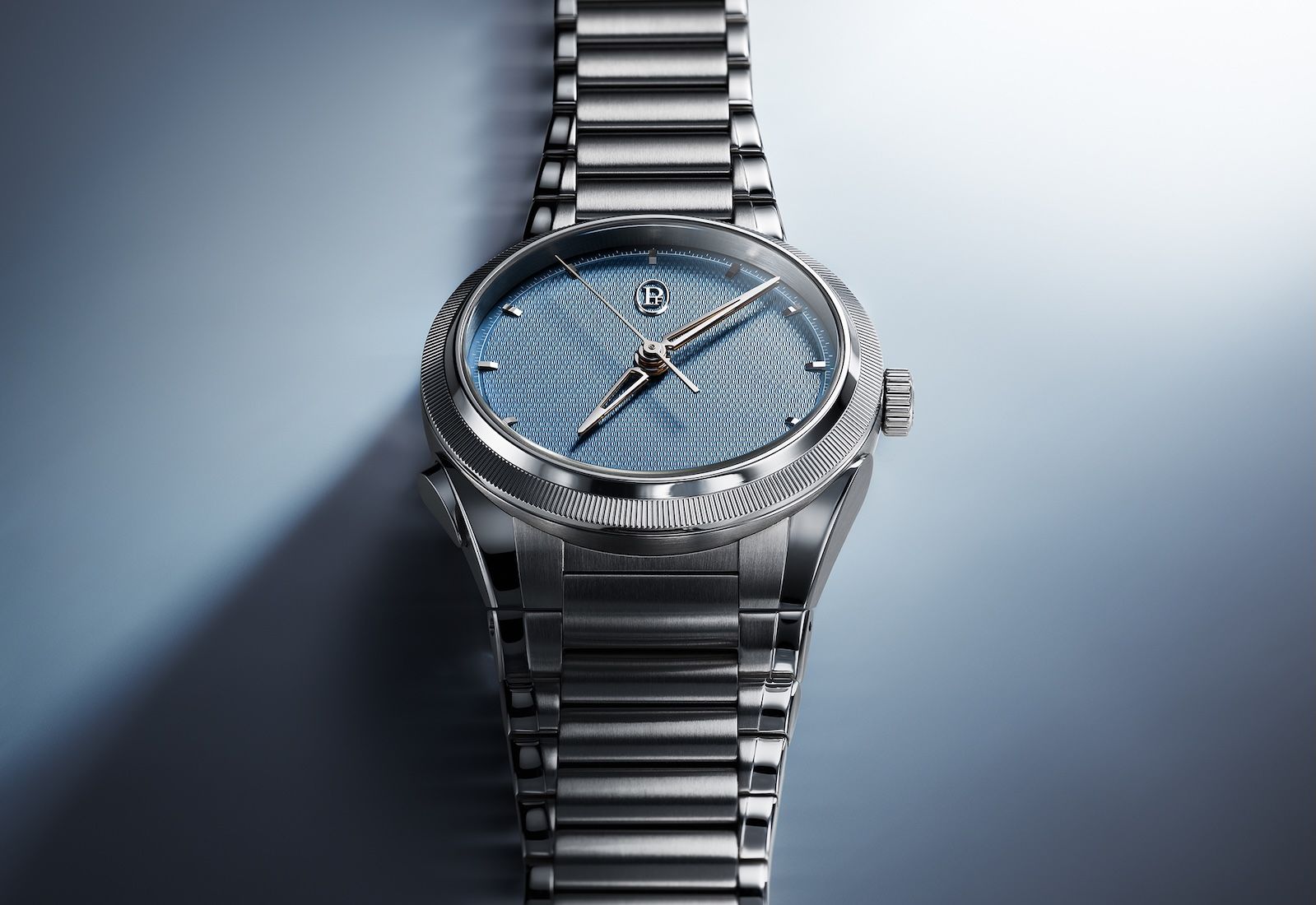
Parmigiani has been building toward this for a few years now. The GMT Rattrapante in 2022 introduced the idea of a hidden complication — a watch that looks simpler than it is until you ask it to reveal itself. The Minute Rattrapante followed in 2023 with the same logic applied to elapsed time. Both were clever, both looked wonderful, and both pointed to something bigger coming down the line. This is it: a full monopusher chronograph where the timing function is so well hidden you can’t help but smile when you see it activated live.
The case is the familiar Tonda PF template — 40mm wide, 13mm thick, stainless steel with a knurled platinum bezel. Water resistance is 100 meters, and it ships on an integrated steel bracelet. None of that is new or particularly surprising. What is surprising is how normal the watch looks. There's a teardrop-shaped pusher at 7:30, but that's the only external tell. If you can spot it, because it’s so well integrated. Nothing about the case signals chronograph — because the dial beneath it certainly doesn't.
The dial in this reference is Mineral Blue, with grain d'orge guilloché texture, applied gold indices, and openworked delta hands. At rest, it's a three-hand Tonda. Press the pusher once, and the rhodium-plated trio flyback instantly to become chronograph hands while rose gold hour and minute hands emerge from beneath them to continue keeping time. A second press stops the elapsed hands; a third resets and hides them. The rhodium seconds hand handles both functions. It's a genuinely elegant solution.
The movement is the PF053 calibre, developed from scratch for this specific watch — there was nothing in the brand's archive that could do what this needed to do. At 362 components, it's a column-wheel integrated chronograph measuring 32.4mm across and 6.8mm thick, beating at 28,800vph with a 60-hour power reserve. The 22k rose gold rotor has sandblasted and polished surfaces, and the openworked bridges on the caseback show off the hand-bevelled anglage. Bracelet is integrated steel with brushed central links.
The Tonda PF Chronograph Mystérieux is priced at CHF 36,900. See more on the Parmigiani website.
6/
Breitling Pays Hommage To Artemis II With A Blue Meteorite Dial Cosmonaute

Breitling isn’t exhibiting at Watches and Wonders, so this is a bit of a stray post here, but I did see this watch exhibited at the Breitling Boutique at Place des Bergues and thought it was timely enough to be mentioned as soon as possible. Not just because of the recency of the Artemis II mission and the interest in their watches, but also because this is a limited edition.
The Cosmonaute has a true claim to being the first Swiss wristwatch designed for space — Scott Carpenter asked Breitling for a 24-hour dial in 1962 so he could tell day from night in orbit, and then wore it on Mercury 7. Sixty-three years later, the Artemis II crew used one to track mission elapsed time on a loop around the moon. Mission commander Reid Wiseman even said so himself on Instagram, calling the 24-hour display "extremely helpful." That is quite an endorsement.
The case is 41mm wide and 13mm thick, stainless steel, with a lug-to-lug of 47mm and a 22mm lug width. The black circular slide rule bezel is new for this edition. Water resistance is 30 meters — enough for splashdown optics, not for diving.
The dial is the major update on this edition over the standard. release. Breitling calls it "galaxy blue" meteorite, and all three subdials share the same material, a meteorite in a wonderful dark blue shade, paired with white hour markers and indices, red chronograph seconds hand and accents. It is a lot going on, which is what the Navitimer has always been.
Inside is the Breitling Manufacture calibre B02, hand-wound, beating at 28,800 vph with a power reserve of around 66 hours. COSC certified. The Artemis II connection appears on the caseback: the mission logo centered in the sapphire display window, "Artemis II" and "One of 450" engraved on the surrounding steel ring. The watch comes on blue alligator strap with a stainless steel folding buckle.
The Breitling Navitimer B02 Chronograph 41 Cosmonaute Artemis II is priced at $11,900 and limited to 450 pieces. See more on the Breitling website.
7/
Twenty-Five Years Of The Freak Leads To This, The Ulysse Nardin Super Freak

Without a single doubt, Ulysse Nardin had the most effective booth at Watches and Wonders. I won’t say they had the best booth, because it certainly cause many nightmares here in Geneva, but it was certainly the most effective. The entrance to their booth, which was laboratory themed, featured a huge — probably 2 meter tall — robotic face, mounted on an industrial robotic arm, staring at you, blinking every so often. It is incredibly unnerving, sitting at the very worst part of the uncanny valley. I mean, I’ll show it to you, but be warned. If you haven’t recognized the face yet, it’s that of Ludwig Oechslin, one of the five greatest watchmakers alive today and I’m not sure if that makes the robotic face better or worse. What is cool is basically the entire booth is dedicated to Oechslin and his work, as he is the person that came up with and designed the Ulysse Nardin Freak. And now, the brand has launched its most advanced version of the Freak, the Super Freak.
The white gold case comes in at 44mm wide, a marginal step down from the 45mm Freak S, and 16.54mm thick overall, though the geometry does a decent job of disguising that. There is no crown, as has always been the case with the Freak: time is set by rotating the bezel, winding done through the caseback. The bezel-locking system has been redesigned to be more integrated than on previous generations. Water resistance is 30 meters.
Seven distinct planes of depth replace what a dial would normally do, and the movement fills every one of them. The hour disc is made from Nanosital, a transparent polycrystalline material that has a bluish hue to it. It floats above the movement architecture, letting light pass through to the components below. If you've never seen a Freak in person, none of this prepares you — the watch is genuinely strange to look at, in a way that photographs don't fully capture. Everything is moving, nothing looks like a watch and it takes time getting used to. The hour disc completes one full rotation every twelve hours; the central bridge, carrying the regulation system, rotates once per hour as the minute indicator. The new addition is a seconds display, driven by a compact gimbal system that solves the considerable problem of transmitting energy to an off-centre display on a movement that is itself constantly in motion.
The calibre is the new UN-252, a 511-component movement four years in development. Two flying tourbillons, each inclined at ten degrees, rotate in opposite directions on a shared bridge that doubles as the minute indicator. A differential just 5mm in diameter averages their outputs. The gimbal that connects the differential to the seconds display measures 4.8mm and has 11 components. Winding is handled by the Grinder system, which uses ultra-thin oscillating blades rather than a central rotor, giving it unusually good efficiency from minimal wrist movement — power reserve is approximately three days. Silicon throughout: balance wheels, hairsprings, and DIAMonSIL escapements. The Super Freak is worn on a grey rubber strap.
The Ulysse Nardin Super Freak is a limited edition of 50. Price is set at CHF 320,000. See more on the Ulysse Nardin website.
📢 Closing message
Perception — The Watch That Brought Chinese Guilloché to the World

Atelier Wen was founded on a single conviction: that Chinese artisanship deserved a seat at the highest table of watchmaking. No watch makes that argument more powerfully than the Perception.
It features a 40mm 904L stainless steel case with 47mm lug-to-lug and a remarkably slim 9.4mm profile. Its centrepiece is a hand-turned guilloché dial in an écailles de poisson (fish scale) pattern by Cheng Yu Cai, China’s foremost master guilloché craftsman, taking approximately 8 hours per dial to produce. The four-layer dial construction is inspired by sǔn mǎo, the ancient Chinese mortise-and-tenon joinery principle. Inside beats a customised Dandong SL1588A automatic, 28,800 bph, 41-hour power reserve. The bracelet features individually chamfered hexagonal links evoking Chinese pagoda windows, with a patent-pending telescopic on-the-fly micro-adjustment clasp.
Originally launched in three dial colours: 缥 (Piāo), 霞 (Xiá), and 影 (Yǐng). Learn more about Perception at the Atelier Wen website.
⚙️Watch Worthy
A selection of reviews and first looks from around the web
⏲️End links
A bunch of links that might or might not have something to do with watches. One thing’s for sure - they’re interesting
If you’re looking for wholesome, genuine community, complete with funky team names and colorful, coordinated outfits, look no further than competitive jigsaw puzzling. In this piece for The Guardian, author Leila Jordan goes from puzzle enthusiast to competitor, pitting herself against 800+ participants vying for glory at the USA Jigsaw Nationals in Atlanta, Georgia.
Dozens of campers died in a Texas flood last summer. Was it an act of God or the result of a catastrophic failure by the adults entrusted with hundreds of little girls’ lives? Kerry Howley spends time with people on both sides of the painful divide in the Mystic community, examining how faith, tradition, and mythology can buoy people during tragedy, or betray them.
A new book, Geoff Bennett’s Black Out Loud: The Revolutionary History of Black Comedy From Vaudeville to ’90s Sitcoms, frames the history of Black comedy in the U.S. as one of ceaseless progress. But Kam Collins argues in his Atlantic review that the book, while praiseworthy, mistakenly equates “progress” with broad mainstream acceptance, which dulls comedy’s sharpest edges in favor of palatability. It’s a provocative rebuttal and a strong counterargument: Black comedy’s revolutionary potential is strongest when it ignores the other eyes upon it—or, as Collins puts it, “Black comedy that primarily serves Black audiences”
👀Watch this
One video you have to watch today
Porsche released one of their more controversial cars in decades, but I don’t doubt it will make them billions.
What did you think of this newsletterYour feedback will make future issues better |
Thanks for reading,
Vuk
Reply