- It's About Time
- Posts
- IAT REVEIW: The Atelier Wen Inflection and the Exhausting, Beautiful Labor of Watchmaking
IAT REVEIW: The Atelier Wen Inflection and the Exhausting, Beautiful Labor of Watchmaking
China, Switzerland, and a Very Heavy Argument

Vuk Radic
April 24, 2026 • Estimated Reading Time: 6 minutes
There's a particular kind of object that breaks your brain by simply existing. Not because it's complicated, or because it does something magical, but because it violates every reasonable expectation you've formed through years of experience. The first time I held a solid gold watch, I nearly dropped it. My hand expected a weight consistent with its size, which is to say the weight of a watch, and instead received something more like a bar of lead with a dial. The brain rejects it. It insists on rechecking, rolling it in the palm, tipping it side to side. Eventually it accepts the evidence. The thing is real. The thing is just very heavy.

Nothing in my watch experience prepared me for tantalum.
Pick up the Inflection and your hand will lie to you. Not in a mysterious way, your hand will simply be wrong about what it's holding and it will take a moment to correct itself. Tantalum does this. It has a density of 16.7 g/cm³, denser than gold by a margin you can feel, and until you've held something made from it, your brain has no reference point to work from. It keeps reaching for a comparison and coming up empty. This is the first thing the Inflection tells you about itself, before you've looked at the dial, before you've flipped it over to see the movement. It's serious. Very serious.
Robin Tallendier and Wilfried Buiron started Atelier Wen with a very specific argument to make. Two French men who fell in love with Chinese watchmaking, who saw that the industry producing the movements inside half the watches in Switzerland was capable of far more than anyone in the West was crediting it for. The Perception was their proof of concept. The collaborations with Revolution, with Wristcheck, with seconde/seconde/ were their evidence that this was a good idea. The Dandong SL-1588 was their movement, modified and regulated and pushed until it performed at a standard that embarrassed watches costing twice as much. The entire Atelier Wen project, from day one, was about a single proposition: Chinese watchmaking deserves to be taken seriously on its own terms.
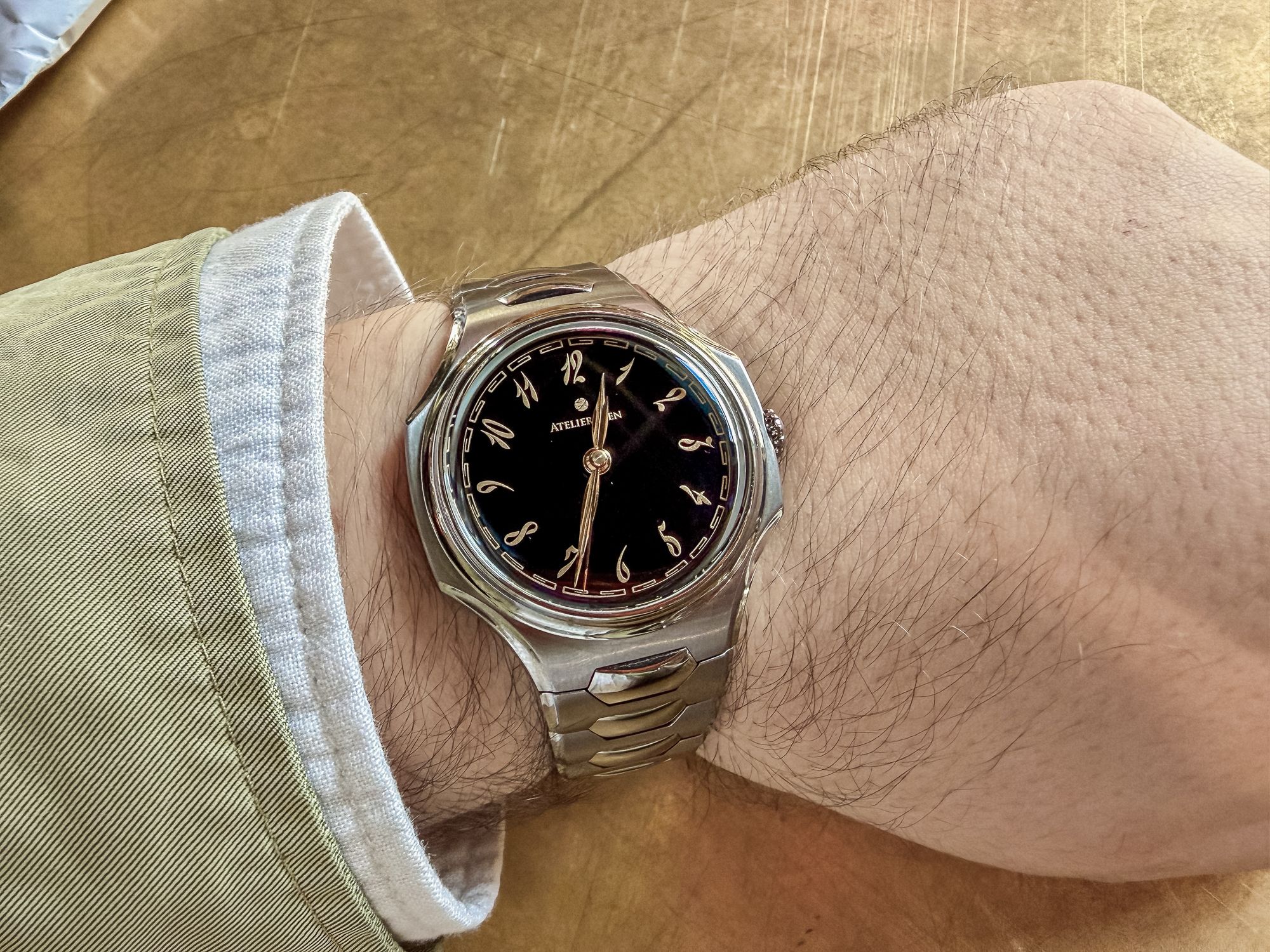
The Inflection has a Swiss Girard-Perregaux movement inside it.
The story almost writes itself as a betrayal narrative, and the story would be wrong. Atelier Wen has earned the right to be interrogated on the movement precisely because they made the argument so convincingly in the first place. What the Inflection represents is not a betrayal of that argument. It's something more complicated and, ultimately, more honest: the recognition that making the best watch they are capable of making, at this moment, with these materials, required going to Switzerland for the movement. But that doesn’t mean it won’t change in the very near future. The case and bracelet are tantalum, machined in China. The enamel dials are fired by the workshop of Kong Lingjun, one of China's great enamelers. The movement is a GP calibre, reworked by Atelier Wen into something you wouldn't mistake for anything else on the market. This is what ambition actually looks like when it stops caring about the narrative and starts caring about the object. I find it admirable. Your mileage may vary.

Now, about tantalum.
You've probably never thought about tantalum, which is fair. Almost nobody has. It lives on the periodic table between tungsten and rhenium, element 73, discovered in 1802 by a Swedish chemist named Anders Gustaf Ekeberg, who named it after Tantalus of Greek mythology — the king condemned to stand in a pool of water beneath branches heavy with fruit, forever just out of reach of everything he wanted. The name was chosen because tantalum, despite being immersed in acid, stubbornly refuses to react. It absorbs nothing. It surrenders nothing. It just sits there, inert and impervious, absolutely certain of itself.
As a material for watchmaking it is extraordinary and nearly impossible to work with. Its density is close to platinum, but that’s not the most interesting thing about it. It is extraordinarily hard to machine. It is even harder to polish, because the very hardness that makes it corrosion-proof also makes it resistant to everything else, including the tools trying to shape it. I’ve heard someone describe it as play doh made out of diamonds. It’s incredibly tough, so it can break bits, but once a bit bites down, it turns into a putty, making it difficult to precisely form into correct shapes. Most watchmakers who have experimented with tantalum use it for small components only — a rotor weight here, a crown there. A handful of high-end brands have made tantalum cases, but they remain rare even at the stratospheric end of the market. Full tantalum bracelets are essentially unheard of.

There is also something poetic about naming a watch made from Tantalus's element and then making it available only by application, at $29,800, in an edition of 100 pieces. The king forever reaching for the thing just out of his grasp.
The case measures 40mm wide and 10mm thick, with a 45mm lug-to-lug, and on paper those numbers suggest something perfectly reasonable. Put it on the wrist and it confuses you immediately. The profile is lush and organic, all curves and flowing transitions, and it is the precise opposite of the Perception in this regard. Where the Perception was sharp-shouldered and architectural, the Inflection moves. The whole thing catches light in a way that only deep, brushed tantalum can: a blue-grey that isn't quite blue, isn't quite grey, isn't quite silver, sitting somewhere in a colour neighbourhood that doesn't have a proper name in any language I speak. Vertically brushed surfaces run along the flanks. Polished accents catch the light at exactly the right moments. The concave bezel curves inward in a move that should feel obvious but somehow keeps reading as a small revelation. None of this prepares you for what happens when you pick it up.
It is not the weight of gold. It is a different weight, denser, a weight that communicates something specific about the object it belongs to. When the full bracelet version sits on your wrist you are not wearing a watch that happens to be heavy. You are wearing something that just might be bending gravity. It doesn't let you forget it's there. After an hour, you stop trying to forget and start appreciating it instead.

The bracelet itself is worth separate attention. Making a full tantalum bracelet is not something you do because it's easy. You do it because you are committed to the premise in a way that is almost unreasonable, and you want the entire object to have the same density, the same colour, the same quality of light from every surface. The clasp closes with a solidity that reinforces everything else about the watch. When you look down at your wrist what you see is unified, coherent, complete. It’s just so cool.
I had the Mò and the Yuān in hand. The Mò is obsidian grand feu enamel, which means the dial is not merely black — it is black in the way a lake is black at night, with depth that seems to extend beyond the physical surface of the dial. Gilt Arabic numerals and 5N gold-plated hands glow against it with a warmth that is genuinely surprising. The Yuān is blue grand feu with white Arabic numerals and rhodium-plated hands, and it is one of the most beautiful watch dials I've encountered outside a Patek exhibition. Both were made by the workshop of Kong Lingjun, one of China's most celebrated enamelers, the same workshop that produced the dials on the Ancestra. Grand feu enamel — the real thing, fired repeatedly at temperatures above 800°C until it fuses completely to the metal — is not something you rush or produce at volume. The labour intensity is significant, and the rejection rate is high. That these dials ended up on a watch engineered from one of the most difficult materials on earth says everything about what Atelier Wen is trying to communicate, which is that there is no ceiling here. There is no moment at which they will decide they've pushed far enough.

The You variant, the one I didn't have in hand, is arguably the most important piece in the collection and the one least likely to be seen in the wild. The dial is hand-hammered silver with a gradient translucent enamel layered over it in multiple shades of green, and the effect in photographs looks like light moving through shallow water over hammered copper. The hammering creates a topography under the enamel that gives the colour depth and variation, so no two dials are identical. The leaf-shaped hands — frosted mid-plane, deeply concave polished side planes — catch light at extreme angles on all three versions and flicker as the wrist moves in a way that rewards attention.
Back to the movement. The GP03300 is not used here in its standard configuration. Atelier Wen took the base calibre and rebuilt what you see: the bridges are ruthenium-plated and finished with polished bevels and laser-etched wave patterns, a combination of techniques that is laborious and looks genuinely spectacular under a loupe. The rotor is fully custom, a tungsten weight on five skeletonized spokes in rose gold, and through the sapphire caseback it looks like a finished object in its own right rather than an afterthought. It beats at 4Hz and delivers 48 hours of power reserve. The argument that a Chinese brand should only use Chinese movements is, on reflection, not a very interesting argument. Patek doesn't make their own steel. Rolex doesn't mine their own gold. Atelier Wen found the best movement engine for a watch of this ambition, modified it until it was theirs, and moved on.
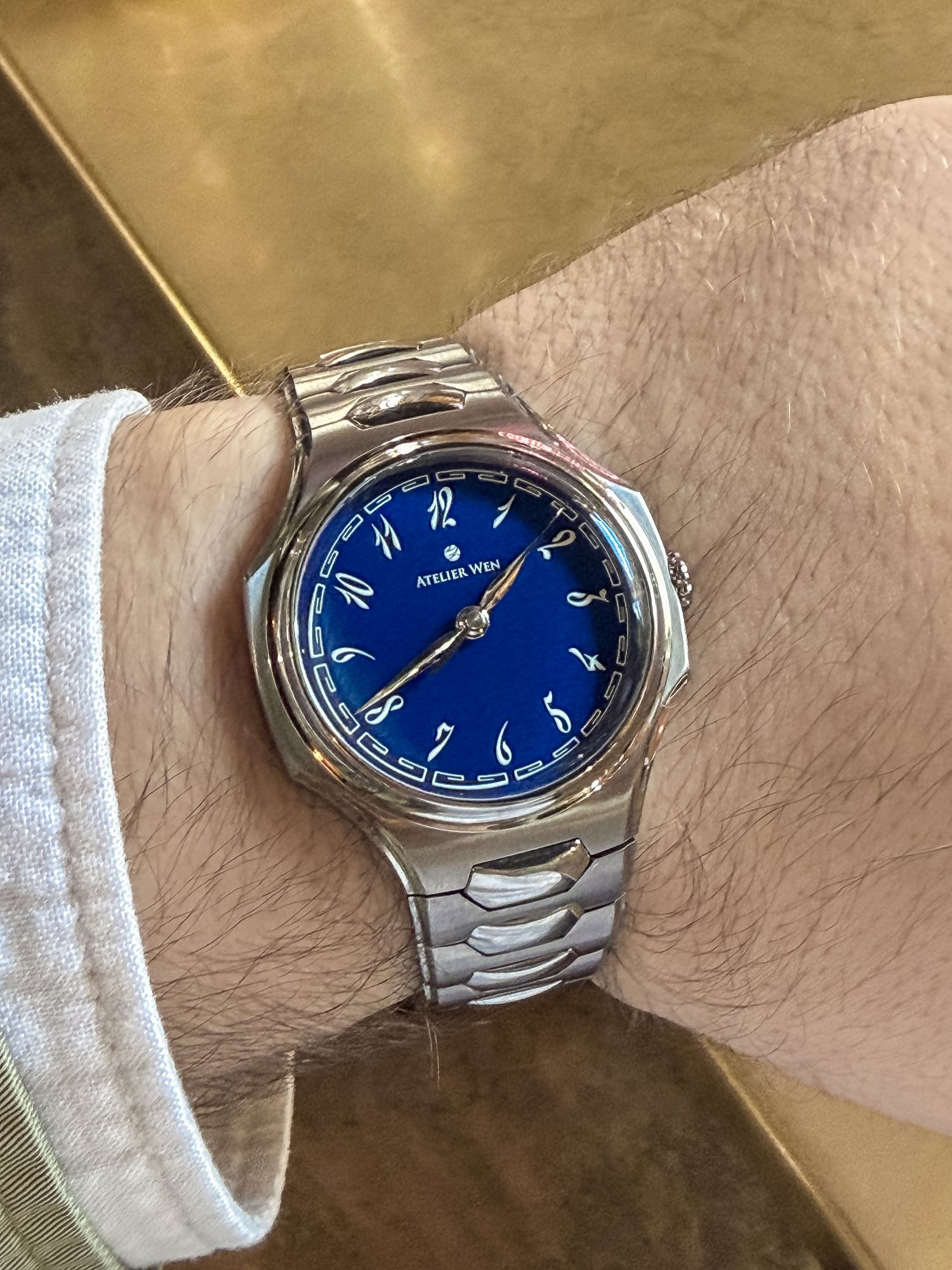
The crown is smooth to operate, positive in its positions, and exactly the right size for the case. Water resistance is 100 meters. The rubber strap option, FKM, with a tantalum buckle, costs $19,800, which is to say it costs less than the bracelet version by ten thousand dollars but still more than almost anything else Atelier Wen has ever made. The full bracelet version is $29,800. Both without tax. Allocation is by application, vetted internally by the brand.
There's a version of this story where two French guys who spent years championing Chinese watchmaking made a $30,000 watch with a Swiss movement and people called it a sellout. That story would be wrong. The Inflection is the most serious thing Atelier Wen has ever made, and seriousness sometimes means setting aside the argument you started with to pursue the thing itself. Tantalus would understand.
More at atelierwen.com.
-Vuk
What did you think of this newsletterYour feedback will make future issues better |
Reply