- It's About Time
- Posts
- Hamilton Digs Up Rare Military Inspiration For The 36mm Khaki Field; Watches And Wonders Coverage Is Almost Over With Watches From Oris, Favre Leuba, Laurent Ferrier And Moser
Hamilton Digs Up Rare Military Inspiration For The 36mm Khaki Field; Watches And Wonders Coverage Is Almost Over With Watches From Oris, Favre Leuba, Laurent Ferrier And Moser
Oris is really making interesting watches these days

Vuk Radic
April 23, 2026
Coverage of Watches and Wonders is brought to you by

Hey friends, welcome back to It’s About Time. It’s kind of expected that I cover all the major releases from Watches and Wonders up front, so we kind of see a bunch of watches that aren’t exactly awe-inspiring on the first few days. Where things get interesting is towards the end of the reporting, when I can feature stuff like the very cool Laurent Ferrier. That’s fantastic.
HELP RUN THIS NEWSLETTER
If you like this newsletter, and would like to support it, there’s two ways you can do it. First, the completely free one — just share it with your friends. That’s it.
However, if you would like to help me pay for all the services that are needed to run it, you can get a premium subscription, one that gets you a TON of extra content every week.
A paid subscription will get you:
the satisfaction of helping run your favorite watch newsletter
no ads
weekly Find Your Next Watch posts
early access to reviews
Watch School Wednesday posts
a look at watches you haven't seen before
historical deep dives
In this issue
Hamilton Digs Up A Rare Military Reference Inspiration For The 36mm Khaki Field Mechanical
Oris Moves The Calibre 113 Into The Artelier With A White Or Green Dial
Favre Leuba Returns To Its 1966 Roots With A Compact, Faithful Harpoon Revival
Laurent Ferrier Adds A Traveler Complication To The Sport Series With A New Manufacture Calibre
H. Moser & Cie. Strips The Endeavour Minute Repeater Tourbillon Down To Its Bones
👂What’s new
1/
Hamilton Digs Up A Rare Military Reference Inspiration For The 36mm Khaki Field Mechanical

The Khaki Field Mechanical has long been one of Hamilton's most approachable watches — a simple hand-wound field watch that has existed in various sizes over the years. Most people know the 42mm and 38mm versions. What fewer people know is that Hamilton also made military navigator watches in the 1970s, including the FAPD 5101, that come in a smaller size. One that would be very interesting these days, as more and more watches size down. The new Khaki Field Mechanical 36mm and its US-exclusive sibling, the Khaki Field Mechanical 250, which marks the 250th anniversary of the United States of America.
The stainless steel case measures 36mm wide and 10.2mm thick, with an 18mm lug width and a matte sandblasted finish that is very much in keeping with the tool-watch brief. But Hamilton then takes things way vintage and even more toolish — you get fixed bars on the lugs and on top is an acrylic box-shaped crystal, just like you would get in the 70s, only this one comes with a hard coating and anti-fingerprint treatment. The acrylic has a completely different look than sapphire, one that’s softer and more vintage-like.
The dial is very familiar. It has a matte black base, white markings, a 24-hour inner track. Hands and dial markings use Super-LumiNova Grade X2. No date, no complications, no distractions. The US edition gets slightly different packaging and an additional calf leather strap alongside the textile NATO, but both versions share the same dial. Not necessarily dial related, the watches have an internal dust cover that was common on military issued Hamilton watches to make them more durable.
Inside is the H-50 hand-wound movement, which offers a very generous 80-hour power reserve and a Nivachron balance spring for magnetic resistance. Both versions come on a textile NATO with pin buckle.
The standard Khaki Field Mechanical 36mm, reference H69399930, is priced at €675 and produced exclusively in 2026. The US-only Khaki Field Mechanical 250, reference H89399930, is limited to 1,776 pieces — a nod to the year of American independence — and will be priced around $700. See more on the Hamilton website.
2/
Oris Moves The Calibre 113 Into The Artelier With A White Or Green Dial

I was so enamored with the new Oris Star (as well as the Artelier Complication) that I saw at Watches and Wonders that I completely forgot to tell you about the new lineup of Calibre 113 watches. Oris introduced the movement last September in the Big Crown — a big, colorful, complication-forward watch that was the kind of thing you want but don't actually need. Then came the Year of the Fire Horse limited edition in January, all red dials and gold details and 88 pieces for the Chinese market. Now the movement gets a third home, and arguably the most appropriate one: the Artelier. A dress watch with 10 days of power reserve and a full business calendar is a pretty unusual proposition, but I want one.
The case is the same stainless steel package we've seen before — 43mm wide, 13.1mm thick, with a lug-to-lug of 50mm. That's not a small watch, and there's no way around it. On top is a domed sapphire crystal, doubled on both surfaces, and the screwed exhibition caseback shows off the movement. Water resistance is 50 meters, which is just fine for a watch with this many complications. All calendar functions adjust through a single crown, which is always appreciated.
The dial is the main attraction. White or green, both with applied indices, small seconds at 9, date window at 6, day aperture at 12. Running around the perimeter is the 52-week calendar, pointed to with a central hand. The non-linear power reserve sits at 3, becoming progressively more accurate as the mainspring runs down. The layout is busy but organized, and neither version looks cluttered.
Inside is Oris Calibre 113, hand-wound, 34mm across, beating at 21,600 vph with 38 jewels and a 240-hour power reserve from a single barrel. Ten days without winding. Love that. The business calendar covers date, day, week of the year, and month, all adjusted through that single crown. The white dial version pairs with either a dark brown cordovan leather strap or a multi-link steel bracelet; while the green dial version comes on just the brown leather strap.
The Oris Artelier Calibre 113 is priced at CHF 6,350 regardless of strap choice, and is available now on the Oris website.
3/
Favre Leuba Returns To Its 1966 Roots With A Compact, Faithful Harpoon Revival

Favre Leuba has been around since 1737, survived the quartz crisis twice, and spent the last couple of years on a third revival under CEO Patrik Hoffmann that's been steadily adding watches across its Chief, Sea Sky, and Deep Raider collections. This year saw the brand's first Watches & Wonders appearance, and they've chosen to mark it with something that looks backward: the Harpoon Revival, a 60th anniversary tribute to the original 1966 Harpoon.
The case is faithful to the original's compact dimensions — 37mm wide, 10mm thick, made from steel with a polished finish. The closed caseback reproduces the brand's hourglass emblem in a medallion with period-correct typography, which is a nice touch. No bracelet here, unlike the original three-link steel version. Favre Leuba opted for a black leather strap with a tool-free interchangeable system and a steel pin buckle. Water resistance is 50 meters.
The dial is grey with a contemporary sunray-brushed finish, and keeps the horizontal bar markers at 12, 6, and 9 o'clock that defined the original. Rhodium-plated rectangular indices with tapered ends catch the light against those bars, and the framed date window sits at 3 o'clock. One departure from the original: the minutes flange now uses simple baton markers instead of luminescent plots. The hands have green glwoing Super-LumiNova inserts, and at 6 is the "Harpoon" text in the original's stylized typography.
Inside is the La Joux-Perret G100 automatic, which Favre Leuba labels as a "contemporary" solution — appropriate given the Harpoon's everyday tool watch positioning. It beats at 28,800bph with a 68-hour power reserve.
The Favre Leuba Harpoon Revival is priced at CHF 1,800, without tax. See more on the Favre Leuba website.
4/
Laurent Ferrier Adds A Traveler Complication To The Sport Series With A New Manufacture Calibre

While my favorite travel watch of Watches and Wonders was certainly the Nomos Club Sport Neomatik Worldtimer, there was one that kind of flew under the radar, mostly because the travel integration was so well done. Laurent Ferrier has been building out the Sport family since the Grand Sport Tourbillon set the aesthetic template a few years ago. The Sport Auto followed, grounding that same flowing titanium case and integrated bracelet in everyday wearability. Now comes the Sport Traveller, which takes that same formula and adds a dual time complication.
The case is grade 5 titanium, 42mm wide and 13.3mm thick. That's slightly beefier than the Sport Auto's 41.5mm, though the same sculpted tonneau shape keeps the visual character consistent — softened bezel, satin-brushed sides, mirror-polished flanks, and that signature spherical screw-down crown. The construction is what Ferrier calls an evolution of their Square case concept, which means the geometry is rounder in person than the specs suggest. Water resistance is 100 meters.
The anthracite opaline dial is organized around a crosshair layout, with the minute track and small seconds scale printed in powder grey. Two apertures sit opposite each other at 3 and 9 o'clock — home time on the left, a date on the right — and both are cut into the dial with a characteristic chamfered edge, almost as if the dial is flowing down to the opening. Small seconds at 6 o'clock gets a snailed texture. The Assegai-shaped hands and applied teardrop hour markers are white gold, indicating the local time, and the lume fill is light green SuperLumiNova.
The traveler function works via two pushers on the left side of the case: the one at 10 o'clock advances the local hour hand forward, the one at 8 o'clock moves it back, and both work while the movement is running. Inside is the new manufacture calibre LF275.01, a 240-component automatic with a 950 platinum micro-rotor, running at 28,800 vibrations per hour with a 72-hour power reserve. Previous Ferrier traveler complications used the natural escapement of the LF230.02; this one swaps to a Swiss lever. Bridges feature horizontal satin brushing with a ruthenium treatment, and the micro-rotor bridge gets hand-finishing with mirror polish and refined internal angles. The watch comes on an integrated three-link titanium bracelet with a titanium deployant clasp.
The Laurent Ferrier Sport Traveller is priced at CHF 61,000, without tax. See more on the Laurent Ferrier website.
5/
H. Moser & Cie. Strips The Endeavour Minute Repeater Tourbillon Down To Its Bones

The Endeavour Minute Repeater Cylindrical Tourbillon Skeleton is the kind of watch that makes you wonder what Moser is even doing in the same conversation as everyone else. The brand has a long history with this complication stack, having debuted the Endeavour Concept Minute Repeater Tourbillon back in 2019. The chiming mechanism between nine and 11 o'clock and the flying tourbillon at six was already a bold layout. Now they've taken the whole architecture apart, stripped away the bridges, and showed you how good they are at making watches.
The case is titanium, 40mm wide and 14.4mm thick, with a hollowed-out middle section. Moser doesn’t use titanium just to save on weight. Titanium is rigid and low-damping, so it retains vibrational energy rather than absorbing it, giving the repeater a fuller, longer chime. The sliding bolt that fires the mechanism runs on a Teflon rail and is integrated directly into the mainplate to keep the whole thing as compact as possible. On top is a heavily domed sapphire crystal and on the right side is an oversized conical crown. The brand doesn’t give us a water resistance, but I doubt this will take more than a very light rain.
The dial, such as it is, is mostly empty space and machinery. A small domed sub-dial at two o'clock does the actual timekeeping, rendered in Moser's signature fumé in Funky Blue, darkening to near-black at the edges. It has Roman numerals, a railway track, and leaf-shaped hands, which contrast sharply with the mechanical chaos below. The brand logo is traced in transparent lacquer, barely visible. Everything else you're looking at is the movement.
Inside is the HMC 909 calibre, a manual-winding movement measuring 33mm across and 9.6mm thick, with 415 components, 35 jewels, and a 90-hour power reserve at 21,600vph. The minute repeater's gongs are curved to avoid interfering with the flying tourbillon, which puts them on the same plane — tuning round gongs is already difficult; tuning curved ones is considerably more so. The cylindrical hairspring, borrowed from 18th-century marine chronometer tradition, improves isochronism and reduces friction. Moser's sister company, Precision Engineering AG, shapes each one by hand. The bridges and mainplate that remain are finished with Moser's double-stripe decoration. The watch comes on a grey nubuck leather strap closed with a titanium pin buckle.
The Endeavour Minute Repeater Cylindrical Tourbillon Skeleton is priced at CHF 330,000 excluding tax. See more on the H. Moser & Cie. website.
📢 Closing message
Inflection — The Rarest Metal on Your Wrist: 100 Watches a Year, No Exceptions
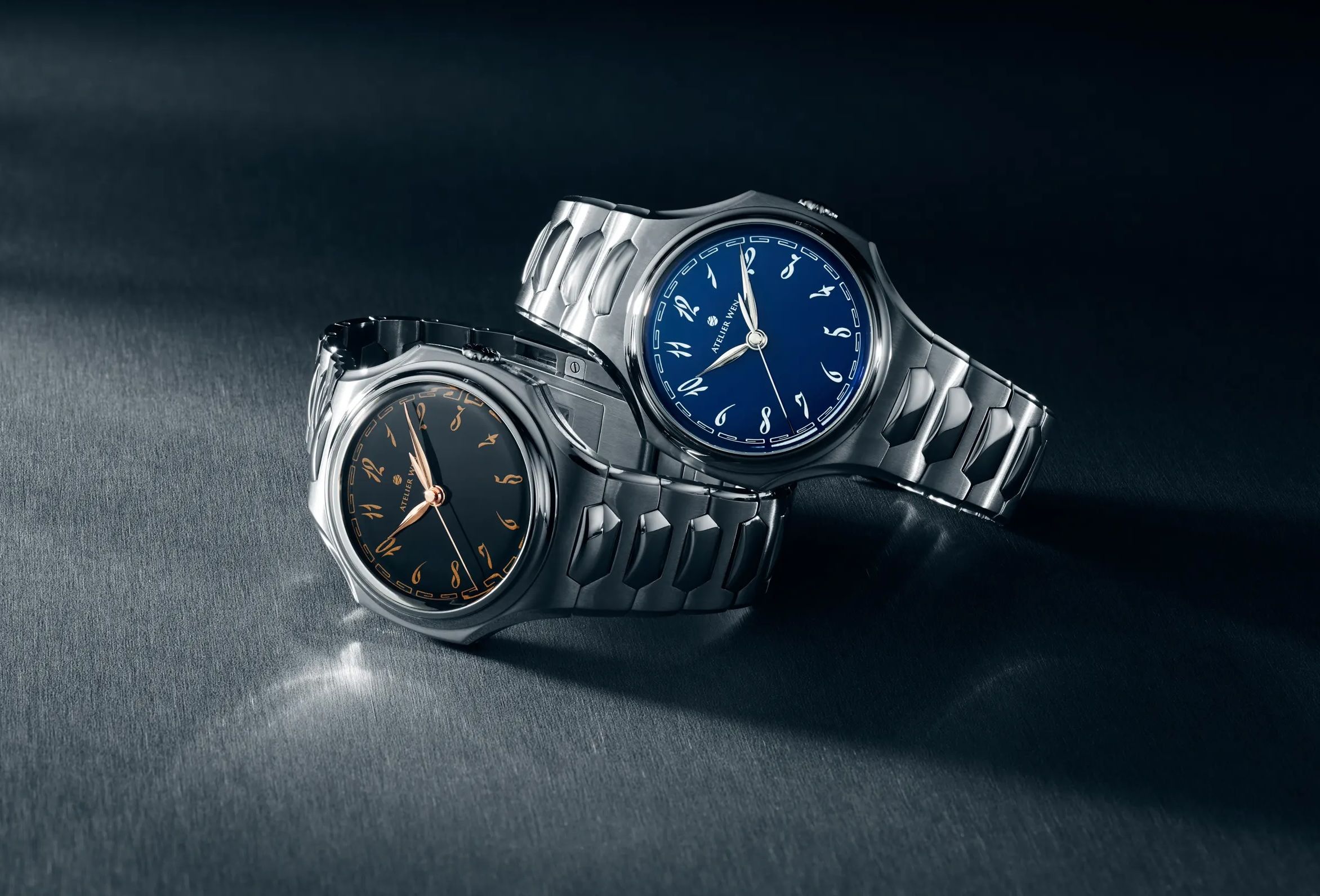
If the Perception was Atelier Wen’s opening statement, the Inflection is the brand’s full-throated manifesto — a watch that pushes independent horology into uncharted territory.
The 40mm case and every bracelet link are crafted from 99.9% pure tantalum, a dense, bluish-grey metal that is corrosion-resistant and extraordinarily difficult to machine, chosen because it reflects the brand’s refusal to take the easy path. The case design embodies the Taoist principle of yīn and yáng through a harmony of concave and convex surfaces.
Grand feu enamel dials by Kong Lingjun come in three variants: 幽 (Yōu) — a hand-hammered pale green to deep viridian gradient (30 pieces); 墨 (Mò) — pitch black obsidian; and 渊 (Yuān) — midnight blue.
The movement is a highly customised Girard-Perregaux GP03300 with bridges inspired by wind motifs in classical Chinese paintings, ruthenium plating, 28,800 bph, and a 48-hour power reserve. Total annual production is capped at 100 pieces across all variants, allocated by application only.
⚙️Watch Worthy
A selection of reviews and first looks from around the web
⏲️End links
A bunch of links that might or might not have something to do with watches. One thing’s for sure - they’re interesting
Elena Saavedra Buckley recounts her two-week stay in the Mars Desert Research Station, a nonprofit research facility in Utah whose residents pay a few thousand dollars to immerse themselves in a simulated Martian colony. There, she puts a few of the “Big Questions” to her fellow researchers: “Why go in the first place? Were we really so sure it would be a good idea? What would be the worst consequence of not going?” I’m not interested in going to Mars, but I’m fascinated by the varied human perspectives, flawed and earnest, that shape the idea. Buckley’s dispatch is humane and richly observed; it’s also the best way to explore the minds of would-be Martian colonizers and explorers.
Millions of Americans are taking GLP-1 drugs like Ozempic and Zepbound for more than weight loss. As Julia Belluz reports in this interactive New York Times story, people are finding unexpected relief from a variety of diseases and conditions, including traumatic brain injuries, long Covid, arthritis, addiction, and irritable bowel syndrome. But these surprising results outpace science’s ability to explain them. With roughly one in eight Americans now having taken these drugs, a vast and unregulated medical experiment is already underway—fueled by Reddit threads, fitness influencers, and telemedicine companies—while the US medical system scrambles to keep up.
That concrete box off the freeway wasn’t designed for storage so much as capture—of markets, workers, and, now, people detained by immigration agents. It’s a disappearing machine. We need to see it clearly.
👀Watch this
One video you have to watch today
This is going to be such a good movie. Just a note, Mel Brooks is 99 years old.
What did you think of this newsletterYour feedback will make future issues better |
Thanks for reading,
Vuk
Reply