- It's About Time
- Posts
- First Day Of Watches And Wonders 2026 Coverage And We Have Novelties From Rolex; IWC; Cartier; Grand Seiko; Lange; Armin Strom; And A Very Cool Moser Colab
First Day Of Watches And Wonders 2026 Coverage And We Have Novelties From Rolex; IWC; Cartier; Grand Seiko; Lange; Armin Strom; And A Very Cool Moser Colab
It's only been 24 hours and I'm already completely beat by this show

Vuk Radic
April 14, 2026
Coverage of Watches and Wonders is brought to you by

Hey friends, welcome back to It’s About Time. These first-day posts from Watches and Wonders now traditionally come super late, but i don’t think I ever sent a letter this late. But we crushed 14 meetings with brands today, and it’s all a bit of a blur. I hope you still enjoy it and tomorrow will be better. Oh, and by the way, I managed to also bang out a review of the Sternglas Hamburg Chrono Silver, and they gave me a discount code. A first for me, but would love to pass it on if you’re planing on getting one!
HELP RUN THIS NEWSLETTER
If you like this newsletter, and would like to support it, there’s two ways you can do it. First, the completely free one — just share it with your friends. That’s it.
However, if you would like to help me pay for all the services that are needed to run it, you can get a premium subscription, one that gets you a TON of extra content every week.
A paid subscription will get you:
the satisfaction of helping run your favorite watch newsletter
no ads
weekly Find Your Next Watch posts
early access to reviews
Watch School Wednesday posts
a look at watches you haven't seen before
historical deep dives
In this issue
Rolex at Watches & Wonders 2026: A New Gold Alloy, A New Yacht-Master, A Very Cool Daytona
IWC at W&W 2026: Space Stations, Glowing Ceramic, And A Perpetual Calendar That Goes Both Ways
Cartier Brings Back the Roadster, Plays With Volcanic Stone, and Goes Full Surrealist With the Crash
Grand Seiko Fixes Its Diver To A Better Size, Releases An Elegant Dress Watch And Gem Studded Beast
Armin Strom's New Minute Repeater Resonance Finally Comes In The Right Size
Moser Releases The Funniest Duo Of Watches At W&W, Styled After The Iconic Rebook Pump Sneakers
👂What’s new
1/
Rolex at Watches & Wonders 2026: A New Gold Alloy, A New Yacht-Master, A Very Cool Daytona

Here we are, Watches and Wonders 2026 has kicked off and Rolex always takes the crown with their releases on opening day. I’m not saying they’re the best releases at the fair, far from it. But they do generate the most buzz. You should have seen the crowd at their booth at opening. Crazy times. I’ve seen all the releases and I can tell you a few things while still remaining cryptic: that one watch you deeply hate from this release, it will grow on you, I promise. The one that confuses you will likely confuse you with its existence for years to come. And the one that you’re not even thinking of as being important is the coolest of the releases.
The centrepiece of the Oyster Perpetual lineup this year is the new ref. 134303 — a two-tone 41mm in Yellow Rolesor, marking 100 years of the Oyster case. Rolex has kept it restrained: same Oystersteel case and bracelet as the mainline OP, gold bezel and crown, green accents on the lettering and minute track, and "100 years" replacing "Swiss Made" at six o'clock. Inside is the calibre 3230 automatic, running at 28,800vph with a 70-hour power reserve and the full suite of Rolex shock and escapement tech. Water resistance is 100 meters. It's priced at €9,400.
The OP36 (ref. 126000) goes in a completely different direction. The new Jubilee dial is a lacquered repeat pattern of the Rolex name in ten different colours — each applied separately, which is a serious amount. Rolex applied this same pattern on tote bags that flooded Palexpo on the first day. It comes in three cases — 31mm, 36mm and 41mm, priced at $6,300, $6,750 and $7,050 respectively.
Then there are the OP28 and OP34, which now come 18k yellow gold and Everose gold rather than Oystersteel, with natural stone hour markers at three, six, and nine — heliotrope on the green dial, dumortierite on the blue. Movement is the calibre 2232 with a 55-hour power reserve. Prices are $30,000 for the 28mm and $34,000 for the 34mm.
The Datejust 41 (ref. 126334) pairs White Rolesor — Oystersteel and white gold — with an ombré green lacquer dial and the classic fluted bezel. Calibre 3235 inside, the same 28,800vph movement with a 70-hour power reserve, Chronergy escapement, Parachrom hairspring, 100 meters water resistance. The fume effect is more subdued than most gradient dials, which is a great look. Priced at $11,650. This will be quite a hit for the brand
The Yacht-Master II is the big update. The redesign addresses almost everything that made it awkward. The countdown scale has moved from the dial centre to the flange, operated via pushers either side of the crown. The bezel is a new bi-directional 60-minute Cerachrom unit. Submariner-style indices complete the picture. At 44mm wide and 13.9mm thick, it's still a large watch, but it looks like it knows what it is now. Calibre 4162 inside, 72-hour power reserve. Available in Oystersteel (ref. 126680, €19,850) and yellow gold (ref. 126688, €56,700), both with 100 meters water resistance.
The Day-Date 40 introduces Jubilee Gold, Rolex's new proprietary yellow gold alloy, joining Everose, Oystersteel and RLX titanium in the house metals lineup. The case is 40mm wide and 12mm thick, and this first version pairs it with a pale green aventurine stone dial set with ten baguette-cut diamond markers in matching Jubilee Gold settings. Calibre 3255 inside, 70-hour power reserve.
Last, we have the Daytona (ref. 126502). The 40mm case is Rolesium, Oystersteel with platinum accents, with an anthracite Cerachrom bezel edged in platinum and a tachymetric scale. The caseback is open, making this only the third exhibition-back Daytona. But the dial is even ore interesting — grand feu white enamel, with 18k white gold markers and hands. This will be pretty special down the line. Calibre 4131 automatic chronograph inside, 72-hour power reserve, 100 meters water resistance. See all of these novelties on the Rolex website, and let me know what you think. Don’t hold back.
2/
IWC at W&W 2026: Space Stations, Glowing Ceramic, And A Perpetual Calendar That Goes Both Ways

IWC showed up to Geneva with six watches worth talking about, and they cover a lot of ground — from a purpose-built space watch to a perpetual calendar you can actually set backwards, to a Big Pilot that glows in the dark in its entirety. Here's the full rundown.
The most technically ambitious of the bunch is the Pilot's Watch Venturer Vertical Drive (CHF 24,000). Built with VAST, the company developing the next generation of commercial space stations, and it's the first IWC engineered specifically for use in space. There’s no crown. Instead, you get a rocker switch on the left to select the function and a rotating Ceratanium bezel that does the winding, time-setting, and GMT adjustment, because astronauts wear thick gloves. The 44.3mm white ceramic case is 16.7mm thick, the matte black dial has no applied markers whatsoever, and the new calibre 32722 delivers 120 hours of power reserve with a GMT function integrated into the base movement. A light blue seconds hand is the only color in the whole watch. Not limited, which is a genuine surprise.
The Big Pilot's Watch Perpetual Calendar Ceralume ($76,300) is the other extreme. IWC teased luminous ceramic as a concept two years ago. Now it's in production, and they've gone as far with it as possible. The case glows. The perpetual calendar displays glow. The rotor medallion glows. The strap glows. In the dark, the whole thing is a blue beam around your wrist. The 46.5mm, 15.9mm-thick case runs on calibre 52616 — Kurt Klaus's perpetual calendar, crown-adjustable, accurate to one day every 577.5 years on the moon phase. Achieving an even distribution of Super-LumiNova through ceramic required a new ball-milling manufacturing process. Limited to 250 pieces.
Then there's the Big Pilot's Watch Perpetual Calendar ProSet, which gets IWC’s mechanism that allows bidirectional crown adjustment on a perpetual calendar — overshoot a date and you simply turn back, rather than cycling forward through weeks. The moon phase has been recalculated to one day's deviation every 1,040 years. It comes in three references: 42mm steel (IW329601), 42mm pink gold (IW329602), and 43mm white ceramic with a gradient blue dial (IW339601).
The Le Petit Prince Anniversary Editions mark 20 years of IWC's collaboration with the Saint-Exupéry estate across five watches, 36 to 43mm, split between three-handers and chronographs. All share a deep blue sunray dial and gold-plated hands. The 36mm Pilot's Watch Automatic (IW458802) might be the most intriguing — no date, clean dial, 120-hour power reserve from the 32102 calibre, gold hands on blue. The two chronographs at 41mm and 43mm use the in-house 69385 column-wheel movement with a 46-hour power reserve.
Back to something more restrained: the Ingenieur Perpetual Calendar 41 Titanium (CHF 41,000) follows last year's steel version with a full grade 5 titanium construction — case, bezel, crown guard, and integrated bracelet. The proportions remain the same at 41.6mm wide and 13.2mm thick. The matte grey grid dial matches the titanium without becoming dull, the three recessed calendar subdials doing enough to break it up. Calibre 82600 inside: Klaus's perpetual calendar again, Pellaton winding, 60-hour power reserve, all adjustments via the crown.
And finally, the Ingenieur Automatic 42 in green ceramic ($23,800) — forest green zirconium oxide case with 18k rose gold crown and bezel screws. At 42mm wide and 11.5mm thick it's on the larger side, but dark ceramic appears smaller than steel and weighs less. The brushed surfaces have an almost textile quality to them that the steel versions simply don't, and the rose gold minute track, dial text, and date wheel numerals tie the whole thing together without tipping into loud. The in-house 82110 with Pellaton winding and a 60-hour power reserve does the work. For a ceramic integrated-bracelet sports watch with an in-house movement, $23,800 is a reasonable ask. See all the novelties on the IWC website.
3/
Cartier Brings Back the Roadster, Plays With Volcanic Stone, and Goes Full Surrealist With the Crash

It’s almost impossible to put into words how impressive the Cartier booth at Watches and Wonders is. I tried taking a few pictures of it, but it’s incredibly difficult to capture its scale. They built a whole city in Palexpo, spilling over. two sides of a broad walkway. If pushed came to shove, I’m pretty sure that their booth could be used as comfortable housing for two dozen families to live in luxury. It’s that awe-inspiring. And yet, for such an impressive booth, one might expect just as impressive a lineup of releases. But after a pretty big year last year, this year, Cartier seems to have taken a step back to make incremental improvements to watches we’ve seen before, while also keeping it a bit interesting with a couple of unexpected revivals.
The Roadster is back. Cartier discontinued it in 2012, which inadvertently made it a minor collector's favorite, and now it returns with the same tonneau silhouette and automotive DNA largely intact. The flowing lugs are still there, as are the concentric rings on the chapter ring, the chemin de fer track, the incredibly cool crystal and the Roman numerals with the hidden signature at VII. What's changed: the four recessed lug screws have migrated to the bezel in a rivet format, the crown is more integrated and less theatrical than the original, and the bracelet has been redesigned with shorter, more ergonomic links featuring polished central links contrasted against brushed outers. The QuickSwitch system is included, and each watch ships with an alligator strap as well.
Two sizes are available: large at 47mm x 38mm, 10.06mm thick, and medium at 42.5mm x 34.9mm, 9.7mm thick. Both water-resistant to 100 meters. The L models run on Cartier's calibre 1847 MC with a 42-hour power reserve; the M models use the slimmer calibre 1899 MC with 38 to 40 hours. Material options span solid yellow gold, two-tone yellow gold and steel, and steel in blue or white dial configurations. The medium Cartier Roadster in steel (ref. CRWSRD0019) is priced at €7,600, while the two large steel Cartier Roadsters (ref. CRWSRD002 in white and CRWSRD001 in blue) will retail for €8,300. Still no word on the prices for the two-tone and full gold versions
New for the Santos-Dumont is a proper bracelet. Cartier has fitted the LM-size Santos-Dumont with a flexible mesh bracelet drawn from the Maison's own 1920s archive work — 15 rows, 394 individual links, each 1.15mm thick, machined and assembled at the manufacture. The case measures 43.5mm x 31.4mm, 7.3mm thick, in either 18ct yellow gold or 950 platinum. Three references are available: yellow gold with an obsidian dial, yellow gold with a silvered sunray dial, and platinum with a silvered sunray dial. All three run on the calibre 430 MC, Cartier's hand-wound in-house movement. Water resistance is rated to 30 meters, which is fine for this. I couldn’t find pricing while writing this.
For its tenth anniversary, the Privé collection brings back three shapes at once. The Tortue Chronographe Monopoussoir, the Tank Normale, and the Crash Squelette — all in platinum, all with ruby-tipped crowns. The Tortue and Tank are familiar territory for Privé followers. The Tortue's monopusher chronograph runs on calibre 1928 MC; the Tank Normale on calibre 070, both manually wound, both with subtle burgundy dial printing as the main update this year. The news is the Crash Squelette. Cartier built an entirely new movement — the calibre 1967 MC — designed specifically for the Crash's awkward dimensions. Its 142 components conform to the watch's warped L-shaped case, the bridges carry hand-hammered finishing at two hours of labor per piece, and the crown now sits in the crook of the L pointing downward. The Crash's elongated Roman numerals have become structural elements of the movement itself. Limited to 150 pieces. No pricing disclosed. See all of these novelties at the Cartier website.
4/
Grand Seiko Fixes Its Diver To A Better Size, Releases An Elegant Dress Watch And Gem Studded Beast
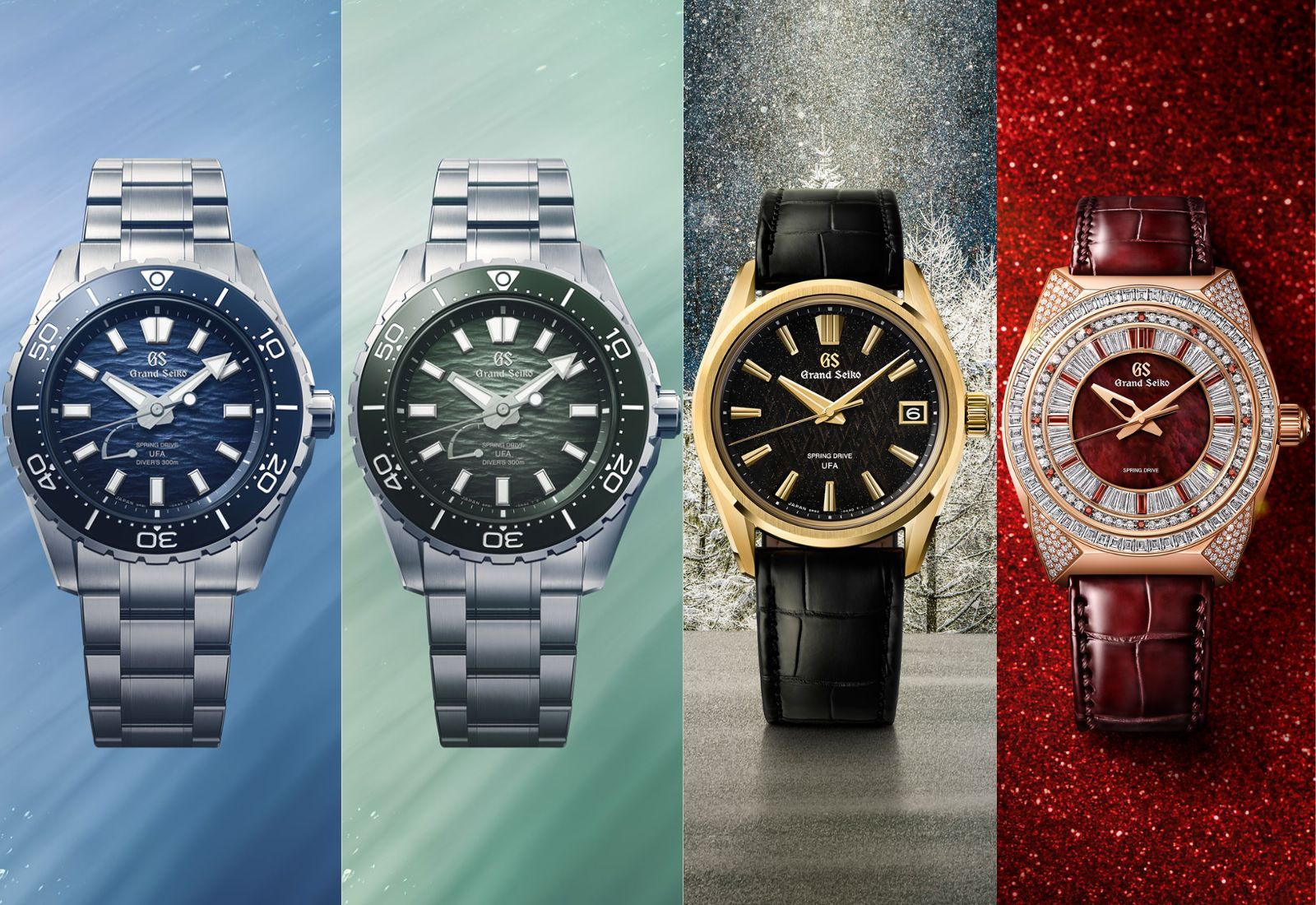
Grand Seiko came to Watches & Wonders 2026 with three releases that span just about the full breadth of what the brand does — from a long-overdue fix to a persistent problem, to a dress watch in gold, to a jewellery watch that costs more than most people's apartments.
The most interesting is the Spring Drive UFA Ushio 300 Diver, in gradient blue (SLGB023) and gradient green (SLGB025). Grand Seiko has been making dive watches since 2008, and the consistent complaint has always been size — the previous Ushio divers ran 43.8mm wide and 13.8mm thick, capable underwater but awkward everywhere else. The new pair fixes that: 40.8mm wide, 12.9mm thick, made out of High-Intensity titanium. Those are pretty good dimensions, especially considering it keeps the 300 meters of water resistance and shrinks down substantially from the previous version. You get a screw-down crown, a 120-click unidirectional bezel with a ceramic insert. The lume is limited to the bezel triangle, which is the one thing you'd want more of. Rectangular, faceted hour markers replace the small round dots of earlier models, and there’s no date. The movement is the calibre 9RB1 — Spring Drive UFA, accurate to ±20 seconds per year, with a 72-hour power reserve. The new bracelet finally has a proper micro-adjustable clasp. Both are €12,500 from June 2026; the blue goes to all retailers, the green to Master Shops and boutiques only. See the blue one here and the green one here.
Next is the Spring Drive UFA Ice Forest SLGB006 — a 37mm dress watch in 18k yellow gold running the same calibre 9RB2 from last year's Ice Forest debut. Case is 11.4mm thick, 100-meter water resistance, box sapphire crystal. The dial is a jet-black gradient with an embossed pattern of ice-covered larch branches, gold faceted indices, and a date at 3 o'clock. Three-day power reserve, on a black alligator strap, with a yellow gold clasp. Limited to 80 pieces, boutique-only, and available from June 2026, the watch is priced at €44,700. See it here.
The third watch is the Masterpiece Collection SBGD228 "Red Lion" — the fourth in Grand Seiko's annual jewellery Lion series. This one has 250 hand-applied diamonds and Mozambique garnets on an 18k white gold case, with red mother-of-pearl at the center. The garnets shift from deep red to orange in different light; they're set as hour markers and separated by tapering white diamonds. Inside is the calibre 9R01 — the 8-day Spring Drive made exclusively at the Micro Artist Studio, accurate to within 10 seconds per month. Eight pieces, $273,000. More of this beast, here.
5/
Lange Brings A Glowing Tourbillon Perpetual Calendar And Super Slim Annual Calendar To Watches & Wonders
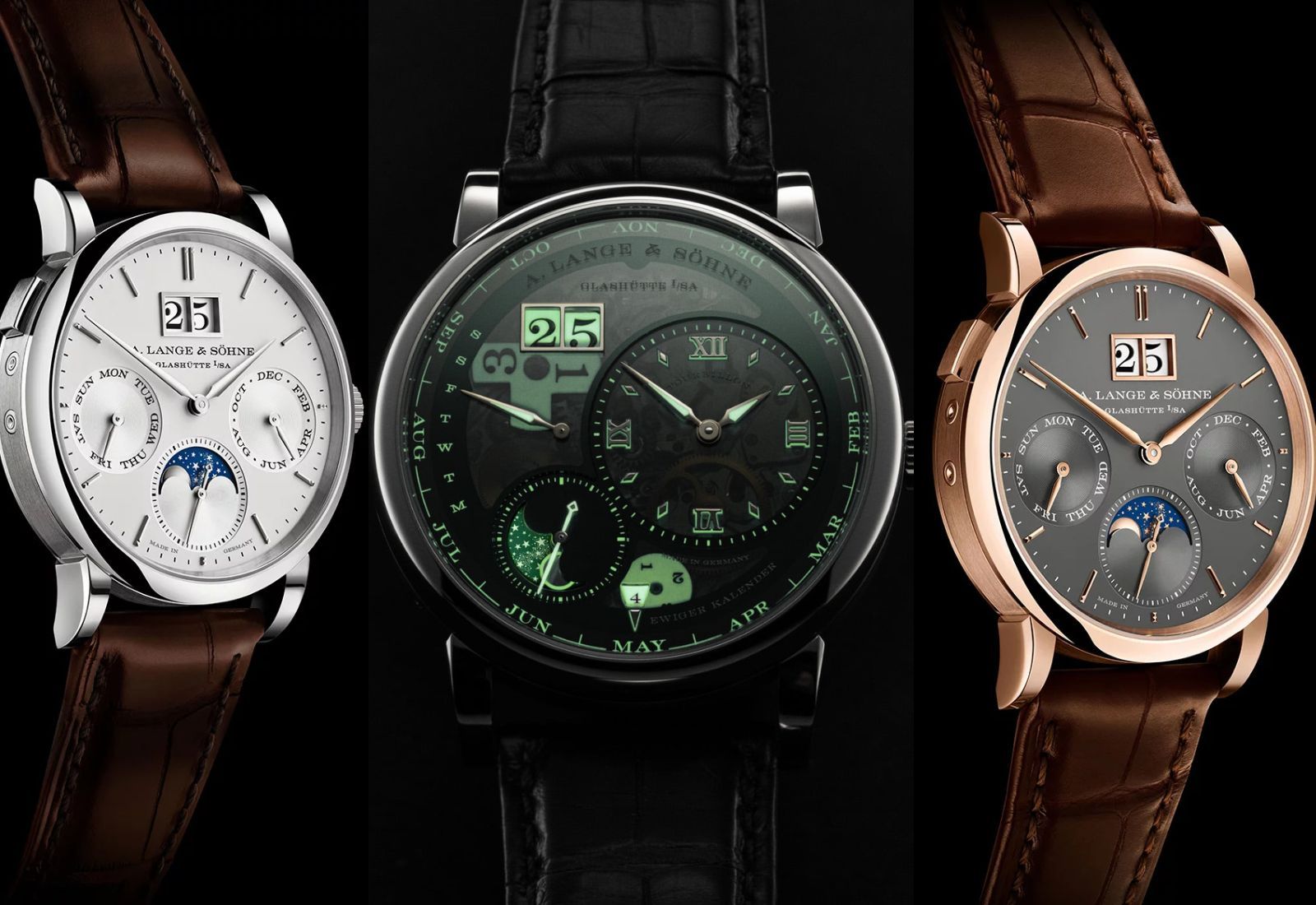
Some brands show up to Geneva with a calendar full of press appointments and watches that exist mainly to fill a booth. Lange shows up with two releases and makes everyone else look like they're trying too hard. That's just what they do. This year it's a 50-piece tourbillon perpetual calendar that glows green in the dark and a 36mm annual calendar so slim I thought I was mistyping it several times. Both of them are exactly what you'd expect from Glashütte, which is to say, better than almost anything else in the room.
The headliner is the Lange 1 Tourbillon Perpetual Calendar Lumen, the first time the brand has applied its Lumen technology to this particular complication. The concept dates back to the 2010 Zeitwerk Luminous: a dark-tinted semi-transparent sapphire dial that blocks visible light while letting UV through to charge luminescent material hidden underneath. Applied to the Lange 1 Tourbillon Perpetual Calendar, it turns a watch you already know into something completely different after sunset. The oversized date numerals glow green, the moon phase has luminescent stars, and the retrograde weekday hand, small seconds, and hour and minute hands all join in. During the day, the sapphire reveals a dense cross-section of the new calibre — large plates with perlage, straight-grained levers, chamfered edges, and a tourbillon cock and intermediate wheel cock hand-engraved with stars and a shooting star. The platinum case holds the same dimensions as its predecessor — 41.9mm wide, now 13mm thick.
Inside is a new movement, the calibre L225.1, a step up from the L082.1 it replaces: 685 parts versus roughly 500, 74 jewels versus roughly 62. It runs at 21,600vph, uses an 18k white gold rotor with a platinum centrifugal mass, and delivers a 50-hour power reserve. The one-minute tourbillon is secured by a diamond endstone in a screwed gold chaton. Perpetual calendar indications switch instantaneously and won't need correction until March 1, 2100. The moon phase requires adjustment once every 122.6 years. The watch is limited to 50 pieces. Price on request, which at this level means you already know it's not a conversation you want to have in public.
The second release is more understated and, in some ways, more impressive for it. The Saxonia Annual Calendar is a 36mm watch — two and a half millimeters smaller than the previous reference — that packs an annual calendar with moon phase into a case just 9.8mm thick. That's the profile of a straightforward three-hander. The movement responsible, calibre L207.1, is 30.4mm wide and 5.7mm thick, self-winding, with a 60-hour power reserve, 491 parts, and 56 jewels. It winds via a unidirectional central rotor with a 950 platinum centrifugal mass. The dial, either argenté for the white gold or grey for the pink gold, keeps things clean, with azuragé finishing inside the day, month, and small seconds sub-dials and the signature outsize date at 12. A single rapid-correction pusher at 10 o'clock advances all calendar indications at once; individual correctors are hidden on the case for finer adjustments. Two references, both available now, both around €65,000. See more on the Lange website.
6/
Armin Strom's New Minute Repeater Resonance Finally Comes In The Right Size
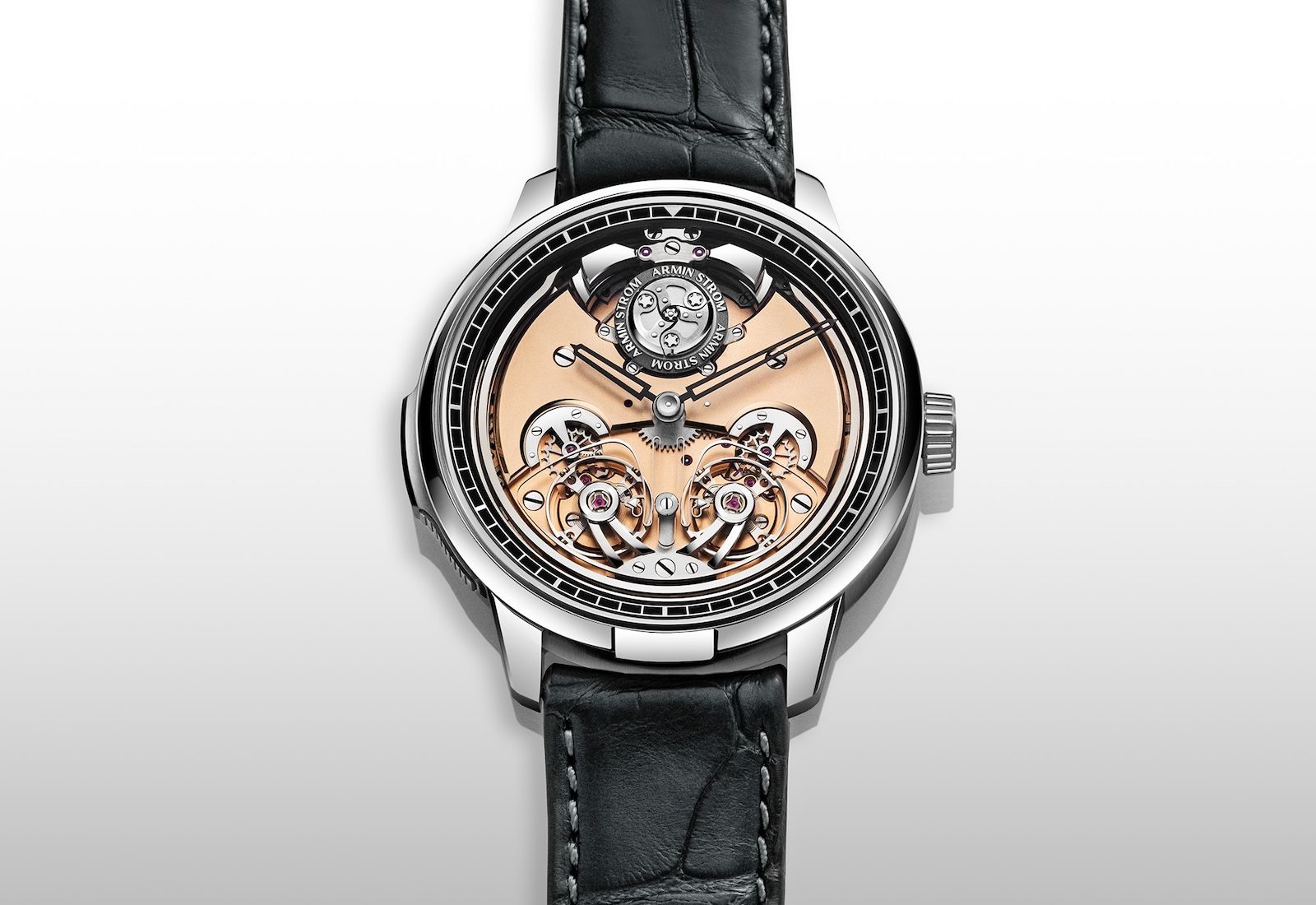
Armin Strom has built its entire identity around resonance — two balance wheels linked by a clutch spring, synchronizing to average out positional errors and improve rate stability. The Mirrored Force Resonance has been doing that reliably since 2016, and we've covered several iterations here. The Masterpiece Minute Repeater Resonance from 2019 pushed the concept into striking complication territory, but it was enormous: 47.7mm wide and 16.10mm thick, a watch that wore more like a statement than a timepiece. The new Minute Repeater Resonance 12:59 First Edition takes that same ambition and finally makes it wearable. And I know this was just the first day of seeing watches at W&W, but let me just say that I’ve been thinking about how much I could get for my apartment. Because I’m sure my wife and child would understand if we would have to sell our home for this watch.
The case is titanium, 42mm wide and 11.7mm thick. Titanium here isn't just a weight decision — it serves the acoustics, transmitting sound more efficiently than steel. There’s a slider at 9 o'clock that activates the striking mechanism. That slider also has a few tricks up its sleeve. First, there are two barrels in the watch, one for the time telling and the other for the chiming mechanism, and every time you engage the slider, that winds the chiming barrel with enough power to do the chiming sequence. The other trick is the ability to switch between normal chimes and activating "12:59" mode which triggers the longest possible Westminster sequence: 12 hours, three quarters, and 14 minutes. Water resistance is 30 meters.
The dial is openworked and centrally organized — a departure from the off-center subdial layout of the earlier Masterpiece version. Hours and minutes are indicated with black skeletonized hands. The lower half is claimed almost entirely by the twin balance wheels and their resonance clutch spring, and the hammers and four gongs arc symmetrically across the top. A small aperture left of center turns white or red to indicate which striking mode is active. The flying governor sits just below the hammers; when the repeater fires, it spins visibly, regulating the speed and evenness of the strike sequence.
The movement is calibre ARR25, an in-house hand-wound mechanism with 506 components. Unlike the ARR18 in the old Masterpiece, which was co-developed with Le Cercle des Horlogers, the ARR25 is fully Armin Strom's own. Each of the two independent oscillators has its own barrel, gear train, escapement, and balance wheel — the clutch spring couples them without merging them. Most minute repeaters use two hammers and two gongs; the ARR25 uses four of each for a Westminster chime, the four-note sequence you know from clock towers, which divides time into hours, quarters, and minutes. The watch comes on a grey alligator strap with a titanium pin buckle.
The new Armin Strom Minute Repeater Resonance 12:59 First Edition is limited to 25 pieces, and priced at CHF 390,000. See more on the Armin Strom website.
7/
Moser Releases The Funniest Duo Of Watches At W&W, Styled After The Iconic Rebook Pump Sneakers
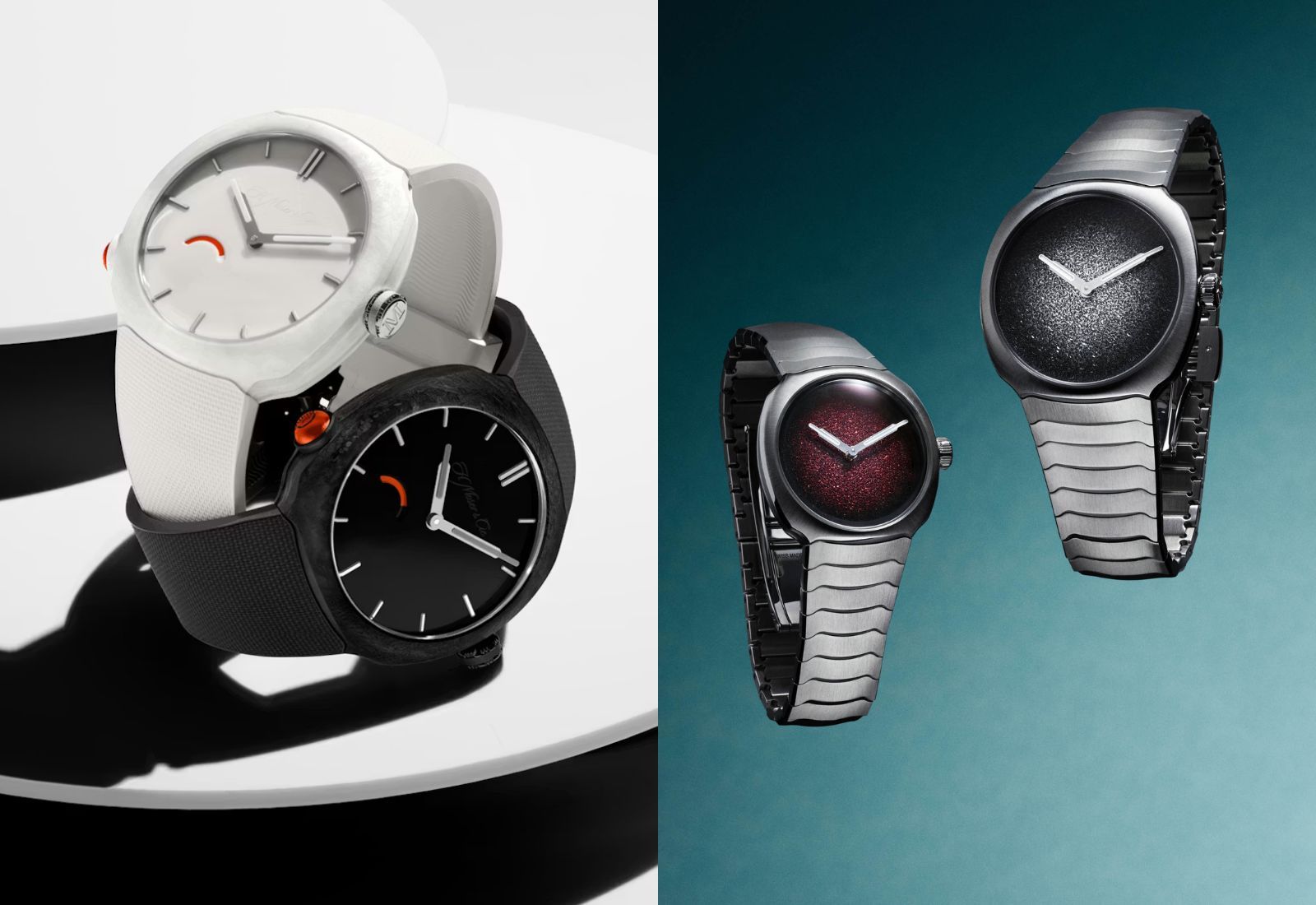
The Moser Streamliner Pump has been all anyone wants to talk about this week in Geneva, and fair enough — it's perhaps the most fun thing at Watches and Wonders. We got just three new watches from Moser this week, but it’s three that count, landing at completely different ends of the brand's personality spectrum. On one end: a collab with Reebok that turns a sneaker gimmick into an actual functioning watch complication with just the right amount of humor. On the other: two new small Streamliners that open up a brand new market for Moser.
The Streamliner Pump is the kind of thing Moser does better than almost anyone — a genuinely weird concept executed with complete seriousness. The hook is the orange anodised aluminium pusher on the left side of the case, lifted directly from Reebok's 1989 Pump sneaker. By lifted, I don’t mean stolen. This is actually a collaboration between Moser and Reebok. And like the pump pusher of the sneakers tightened the fit of your shoes, pumping this pusher winds up the movement. One press delivers more than an hour of power reserve. The pusher also drives an orange power reserve bar at 8 o'clock, which means you can watch it climb as you pump. Is it completely unnecessary? Absolutely. Is it sensationally fun, in the best possible way.
The case is forged quartz fibre, available in black (DLC-coated) or white, 40mm wide and 9.7mm thick without the sapphire crystal (11.4mm with). Water resistance is 100 meters. The dials are stark, even by Moser’s standards, likely because they’re black and white lacquer. You get applied markers, Globolight hands, and the orange power reserve indicator. The movement is the new hand-wound HMC 103, beating at 21,600vph with a 74-hour reserve. The new Moser Streamliner Pump is limited to 250 pieces, priced at CHF 31,360.
The other release is the Streamliner Two Hands duo with a brand new size. Up to now, the smallest Streamliner, if I’m not mistaken, was 39mm. These two new versions come in at 34.2mm and 28.3mm, which is super interesting for the model. Both keep the signature cushion case, the integrated steel bracelet with the wave-link design, screw-down crowns, and 120 metres of water resistance. The 34mm is 9.7mm thick; the 28mm comes in at 8.9mm. Hours and minutes only — no seconds hand, no date, nothing else. The dials are fumé, frosted via manual engraving before being finished with a gradient lacquer: silver fumé on the 34mm, burgundy on the 28mm. No hour markers, no text, no logo. The 34mm has the HMC 400, while the 28mm gets the smaller HMC 410. Both beat at 25,200vph, offer 60 hours of power reserve, and have 18k red gold rotors visible through the sapphire caseback. Both are priced at $27,600 USD. For all three new releases see the Moser website.
IAT REVIEW: The Chronograph Sternglas's Fans Wouldn't Stop Asking For: The Hamburg Chrono Silver Is Great Looking, Considered, And Well Priced
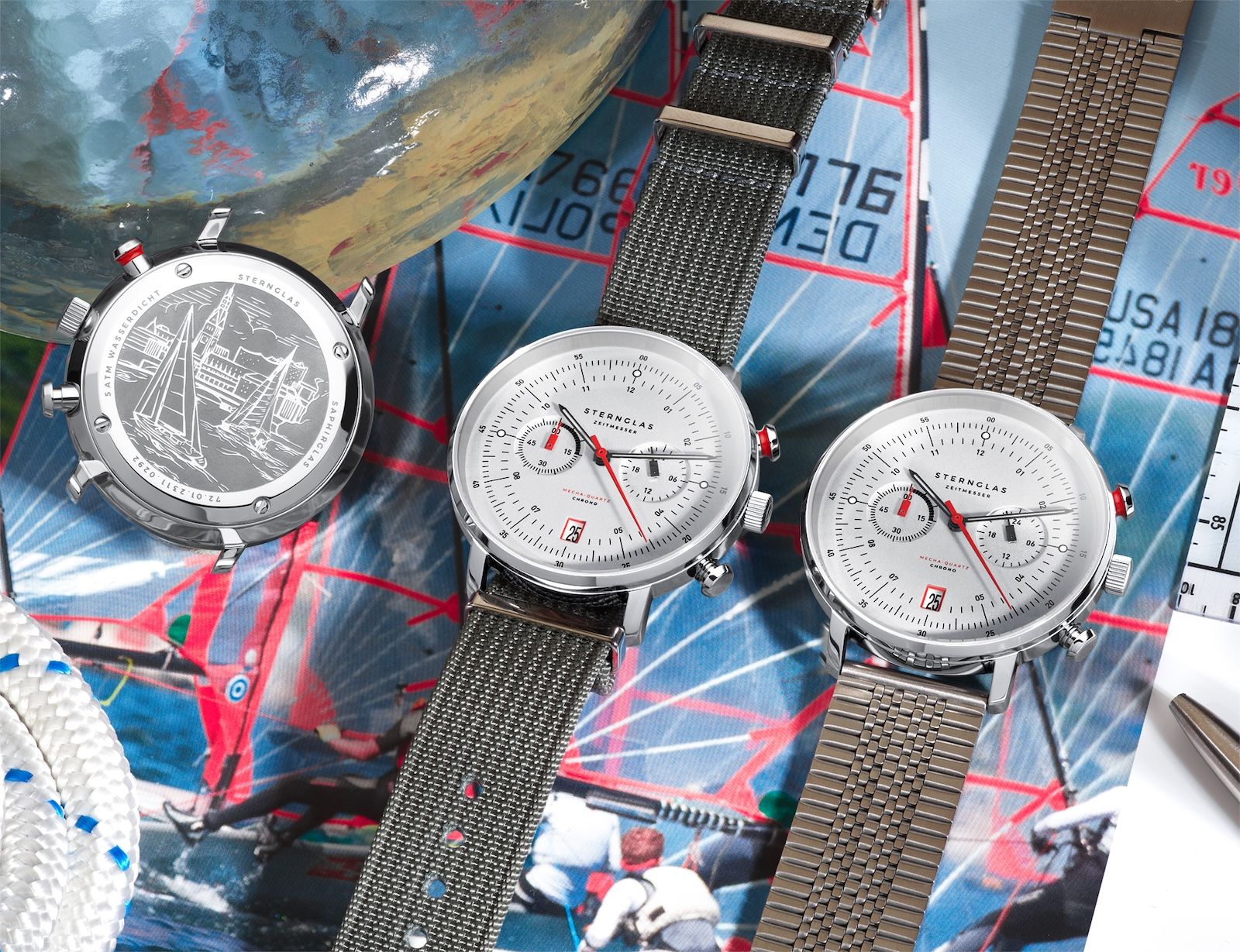
Sternglas has a special deal for readers of It’s About Time. Promocode is 10% for the whole collection: ABOUTTIME10
The gun goes off at exactly ten past ten. Five seconds later, twelve boats have crossed the line, their white sails snapping as they catch the wind off the Alster, a right tributary of the Elbe river right next to Hamburg. From the shore, someone starts a stopwatch. From the water, someone else is already reading the current, calculating the angle, watching for the moment the leading boat makes its first mistake.
Regatta watches exist because of this window — the five minutes before the gun, the countdown that every competing boat runs simultaneously, the margin between a good start and a disqualifying one. The real ones, the instrument-grade ones, have countdown bezels and specialized timers built around exactly this scenario. They are used by people who race. What proliferated outside of the sport instead was the look: the primary colors of the buoys and signal flags and Bauhaus color theory, put on watches that would never get closer to a starting line than a café terrace with a view of the water.
Sternglas, which is actually based in Hamburg, spent two years building a chronograph version of their Hamburg model. The ask had been sitting in their community for a while. The original Hamburg was already their best-selling line, a clean Bauhaus-inspired watch with minimal bezel and almost no distance between the crystal and the edge of the case — all dial, short lugs, the result of removing everything unnecessary. Adding a chronograph meant pushers and sub-dials without breaking what already worked. And they pulled it off with style.
The Hamburg Chrono comes in three versions. The Dark Green Bronze pairs a PVD bronze case with a dark green dial and orange chronograph hand. The Regatta goes full primary: red, yellow, and blue in a Bauhaus arrangement, with the added trick of signal flags appearing in the date window on alternating days. Read the rest of the review here.
📢 Closing message
Atelier Wen — The Franco-Chinese Independent Giving Chinese Craft Its Long-Overdue Moment
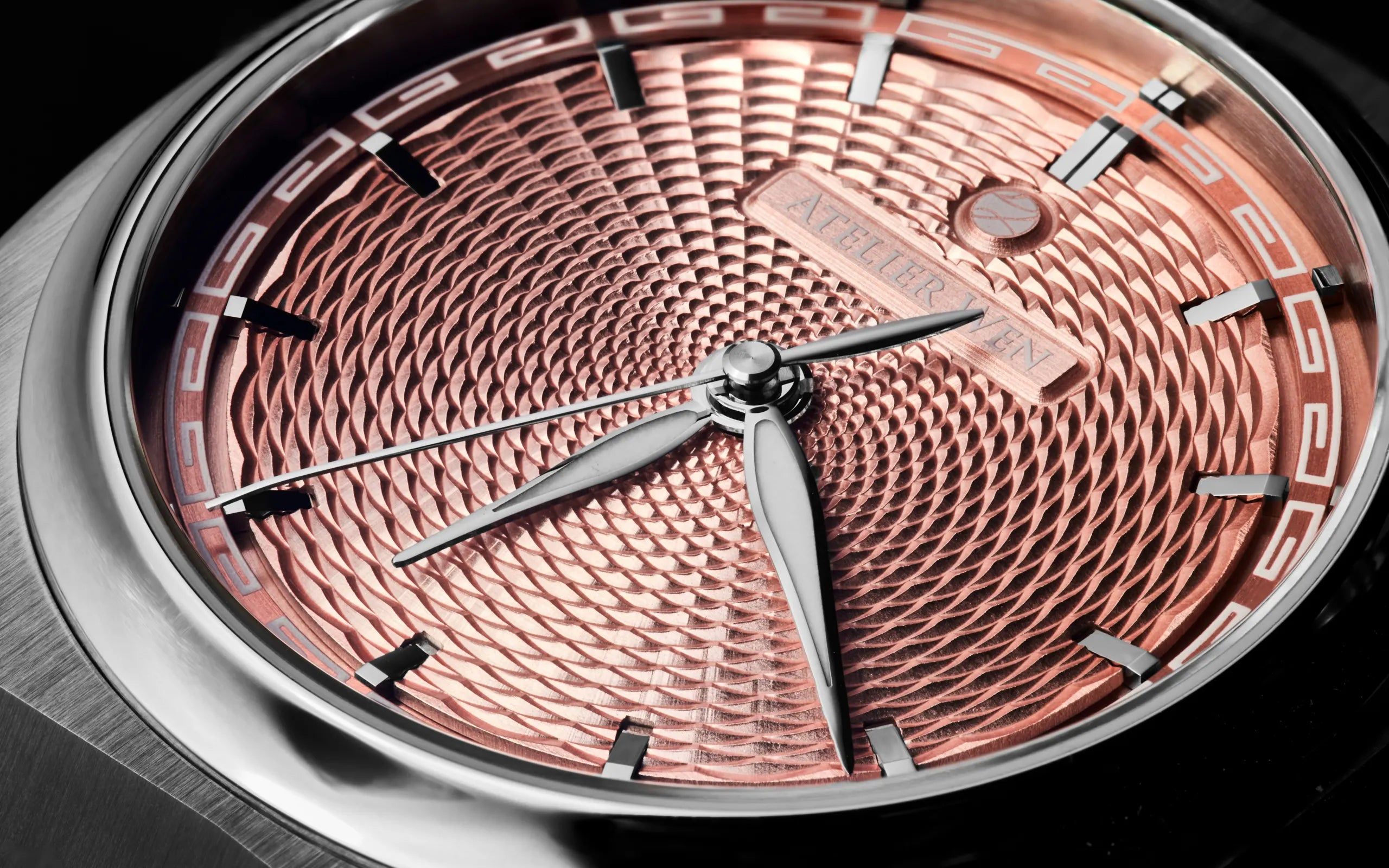
Atelier Wen was founded by Robin Tallendier and Wilfried Buiron, two Frenchmen who arrived in China and found themselves captivated by a question the watch world had largely ignored: why had Chinese artisanship never been celebrated at the level of Swiss or Japanese craft?
The brand they built is their answer — an independent operating at the intersection of French design sensibility and millennia of Chinese culture and craftsmanship.
Every watch Atelier Wen produces is anchored to a specific Chinese art form, historical artefact, or philosophical concept, worked into the case, dial, movement finishing, or all three simultaneously. The result is a brand unlike anything else in independent watchmaking, one that is neither a Swiss house romanticising the East, nor a Chinese manufacturer chasing Western validation, but something genuinely new: a fluent, equal dialogue between two great cultures, expressed in miniature on the wrist. To learn more about them, visit the Atelier Wen website.
⚙️Watch Worthy
A selection of reviews and first looks from around the web
⏲️End links
A bunch of links that might or might not have something to do with watches. One thing’s for sure - they’re interesting
Once upon a time, not so long ago, the Alamo Drafthouse felt like the future of movie-going. Then, at shocking speed, it all fell apart, hitting rock bottom with the nonsensical introduction of QR-code ordering alongside the company’s famous prohibition on cell-phone use. In a balanced cocktail of fury and humor, David Ehrlich describes the consequences of bad management—which is to say, management schooled in the idiocy of late-stage capitalism.
With the publication of London Falling, his new book, Patrick Radden Keefe has been absolutely everywhere lately, including New York‘s “Grub Street Diet” and our very own Longreads Questionnaire. And yet he’s still found time to deliver a new stunner. From New Orleans, Keefe delves deep into a complex network of personal-injury lawyers and “slammers” who worked together to stage accidents with tractor-trailers for lucrative insurance payouts. A dazzlingly intricate, quintessentially local scheme, with a rich cast of characters. In short: It’s a Patrick Radden Keefe story.
For The Globe and Mail, Andrea Woo explores the logistics behind growing and installing natural grass pitches for FIFA’s 2026 World Cup stadiums. The upcoming tournament spans 16 fields across three countries. Over five years, a team led by John Sorochan, a distinguished professor in turfgrass science—what a title!—conducted research to ensure every playing field performs consistently, regardless of whether it’s on the British Columbia coast, or in humid Miami, or over 7,350 feet above sea level in Mexico City. “This is not grass,” a North Vancouver city official tells Woo. “This is an entire system of devices, of build-up. It is complex—far more complex than people realize.” Woo writes a fun behind-the-scenes look at how a World Cup pitch is built.
👀Watch this
One video you have to watch today
Regular Care Reviews doesn’t review cars. He creates modern poetry. This is incredible.
What did you think of this newsletterYour feedback will make future issues better |
Thanks for reading,
Vuk
Reply