- It's About Time
- Posts
- Alpina's First Solar Watch Is A Better Looking, Affordable Solargraph; A Sharp Tsuyosa From Citizen And seconde/seconde/; No-Date Bambino; Horage's Molokini GMT Diver; Moser's First Ceramic Watch
Alpina's First Solar Watch Is A Better Looking, Affordable Solargraph; A Sharp Tsuyosa From Citizen And seconde/seconde/; No-Date Bambino; Horage's Molokini GMT Diver; Moser's First Ceramic Watch
I really, really like solar powered quartz watches

Vuk Radic
February 20, 2026
Hey friends, welcome back to It’s About Time. Had to cut things short today because I have to run, but there are some pretty amazing watches here today. The Alpina is my next watch, and that Horage is super cool.
HELP RUN THIS NEWSLETTER
If you like this newsletter, and would like to support it, there’s two ways you can do it. First, the completely free one — just share it with your friends. That’s it.
However, if you would like to help me pay for all the services that are needed to run it, you can get a premium subscription, one that gets you a TON of extra content every week.
A paid subscription will get you:
In this issue
👂What’s new
1/
Alpina Releases Their First Solar Watch And It’s A Better Looking, More Affordable TAG Heuer Solargraph

For quite some time, I’ve been looking at the TAG Heuer Solargraph. I love the look of the watch. I dig the idea of a solar movement in a chunky sports watch. I just couldn’t get over the price. Especially in the titanium package, which crosses the $3k line. I’m no stranger to expensive quartz movements, especially if they are ana-digi, but this was just a bit too much. Then in September, at Geneva Watch Days, I saw a watch that would replace the Solargraph itch for me. It was the Alpina Alpiner Extreme Solarmetre. Built on their cool and rugged Alpiner model, it used the exact same movement as the TAG Solargraph, both made by La Joux-Perret, but at a fraction of the price. They told me the watch was going to come out by the end of last year, but that was postponed a bit. And Alpina didn’t make a big enough deal of this watch, when they quietly launched it a few weeks ago. Even I, who want one, missed it. So, here is the new Alpina Alpiner Extreme Solarmetre, a banging sports watch with a great movement and a competitive price.
On the outside, this is a very familiar Alpiner Extreme, with the angular lines, symmetrical bumps on the sides and vertically brushed bezel secured by six exposed screws engraved with the brand’s mountain emblem. Of the three available sizes, this one comes in the mid-size one. That means 37.5mm wide, 10.19mm thick, with a 38.9mm lug-to-lug thanks to the very compact lugs with an integrated bracelet. The case is made out of stainless steel, with a brushed finish and polished bevels. Alpina makes the Alpiner Extreme in titanium as well, so I expect this to come down the line, which would more closely match the more expensive TAG Heuer. Water resistance is 100 meters, which is in line with the rest of the collection.
The dials are sensational. They come in five colors — burgundy, light green, light blue, navy blue, and white — and all of them have a slight translucency to them. I particularly dig the light green and light blue, which have an almost pastel appearance. All of the dials have a 3d textured mountain motif pattern. You get applied hour markers, lumed hands and a date aperture at 3 o’clock. Exclusive to the Solarmetre models is the blue-outlined triangle at 12 o’clock, paired with a matching blue triangular counterweight on the seconds hand.
Inside is the AL-140 solar quartz caliber, developed in collaboration with Swiss manufacture La Joux-Perret. It is essentially the same movement that shows up in the TAG Heuer Solargraph. You get 10 months of battery life with 40 hours of charging in sunlight and the battery needs to be replaced every 15 years. The burgundy and light green dials come on stainless steel bracelets, while the other three come on color matched rubber straps.
The new Alpiner Extreme Solarmetre is available now, priced at €995 on rubber and €1,195 on the bracelet. You might think this is a lot for a quartz movement, but I’m a fan. See more on the Alpina website.
2/
Citizen Teams Up With seconde/seconde/ For A Very Sharp Tsuyosa

If you don’t know who seconde/seconde/ is, his name is Romaric André and he is a banker-turned-watch-customizer. There was a period of a couple of months about a year or year and half ago when seconde/seconde/ watches were coming out almost weekly. He almost overdid it with the collaborations and we got a bit desensitized by them. Now, seconde/seconde/ is spreading out his releases once again, and they are becoming exciting again. Recently, we got the very cool Raymond Weil Toccata Heritage collaboration. Now, seconde/seconde/ is returning to his roots with a watch that uses the pixelated sword hands he used when he was breaking out. The iconic sword hands now shows up on the new Citizen Tsuyosa x seconde/seconde/.
On the outside, this is a classic and unchanged Tsuyosa. That means you still get the barrel shape that measures 40mm wide and 11.7mm thick. The case is still made out of steel, with a brushed finish and polished details, and the crown is still recessed at 4 o’clock. On top is a sapphire crystal with a cyclops over the date, while the caseback uses mineral glass. Water resistance remains 50 meters.
Where the collaboration happens is on the dial. seconde/seconde/ replaces the minute hand with a pixelated katana. As the minute hand made its way around, it has cut everything in its way. There are bright blue gouges in the beautiful blue sunray brushed dial, but even cooler are the applied hour markers that have been sliced in half, with the cut off part being offset as if it was just flying off the dial. This is a very good look, perhaps one of the best seconde/seconde/ has done.
This doesn’t come with the updated Tsuyosa movement, but that’s not that huge of a deal. Inside, you’ll find the in-house calibre 8210, beating at 3Hz, with a 42 hour power reserve. It features an openworked rotor and silver-toned bridges and plates. The watch comes on a brushed and polished 3-link steel bracelet that closes with a folding clasp that has the Citizen and seconde/seconde/ logos and engraved sword slashes.
The new Citizen Tsuyosa x seconde/seconde/ is a limited edition of 3,600 peices, available now and priced at €449. This will go fast. See more on the Citizen website.
3/
Orient Finally Releases A Coveted No-Date Version Of The Bambino

If you’ve been reading this newsletter for a while, then you must know my love-hate relationship with Orient (and Orient Star). On one hand, they make great looking watches that fit pretty much every scenario, with in-house movements to boot, and sell it at an unbeatable price. On the other, they have the most infuriating business model in which they never tell anybody that they released a new watch and their websites are just a mess of new and old models with no indication what’s happening with the brand. But they’re fixing that with a new website (but still no online ordering). They’re also fixing their watches by listening to the wishes of their customers. Ever since the Bambino came out, people were asking for a no-date version of it. And here we go, we’re getting the 38mm Orient Bambino, now with no date.
OK, technically, this isn’t a 38mm Orient Bambino, because that’s no such thing. This one comes in a stainless steel case that measures 38.4mm wide, 12.5mm thick and with a 44mm lug-to-lug. Those are some pretty good proportions. On top is a domed mineral glass which I wish they would change out for a plexiglass one if they won’t spring for a sapphire. It would have way more character. Water resistance is 30 meters.
Five color are available right now: white, ivory, green, brown, and grey, which is a limited edition of 3,300 pieces. You get the Roman numerals that the dials are so well known for rendered in either silver or gold color, depending on the dial color and also depending on the dial color you get either blue or gold-colored hands. There’s no date aperture, of course, which makes for a cleaner look.
Inside is the well known and in-house made F6524 automatic, same as the regular Bambino but without a dial. It beats at 3Hz, has a 40 hour power reserve and is rated to +25/-15 seconds per day. The watches come on either a 20mm brown or grey calf leather strap.
Four of the new colorways of the Orient Bambino 38mm are parts of the regular collection, while the grey one comes in 3,300 pieces. Price is set at €340. See more on the Orient website.
4/
Horage Does What They Do Best On Their New Molokini GMT Diver

I love Horage. They are one of those if-you-know-you-know brands. They create incredible movements, including one of the most affordable Swiss-made tourbillons, as well as the very advanced silicon-filled K3 and the wild MicroReg which brings impossibly precise regulation to the masses. Everything they do is very intentional, measured and well made. So, when they set their sights on a dive watch, you knew it would be special. And it really is. Powered by their fantastic K2 micro-rotor movement, and named after the popular diving spot in the Molokini Crater in Hawaii, this is the new Molokini GMT Diver.
The dimensions of the 904L stainless steel case are pretty perfect for a diver, especially one with so much functionality. It’s 38mm wide, 9.65mm thick and has a pretty amazing 44.6mm lug-to-lug. On top is a domed sapphire crystal while out back is a flat sapphire that gives you a look of the fantastic movement inside. The top crystal is surrounded by a thin, unidirectional, rotating bezel that has a 60 minute scale with the first 15 minutes fully graduated. Water resistance is 200 meters.
There are three dial colors available, each with its own finish. The Sand colorway gets a grained surface, the Coral gets a sunray brushed finish, while the Ocean has a subtle vertical brushing. All three versions have printed Arabic numerals filled with lume, and it’s a surprisingly legible thing, considering the impressive amount of complications the watch has. Aside for the central hours, minutes and seconds, you get a fourth hand for the GMT, a date at 6 o’clock, a day/night indicator at 9 o’clock and a power reserve display at 10 o’clock. It’s a unique but great look.
Inside is the K2 caliber, a micro-rotor automatic that the brand has used before. It’s incredibly cool for its thinness of just 2.9mm, beats at 25,200vph and has a modern 72 hour power reserve. The micro-rotor is made out of tungsten and then gold plated. It also has the hairspring, escape wheel, and anchor done in silicon. They use a screw-balance system for regulation and the movement is COSC certified. The watch comes a matching stainless steel bracelet fitted with HMAC (Horage Micro Adjustable Clasp) folding clasp, and you get an additional OTAN fabric strap in white/black, white/sand or white/coral.
The new Horage Molokini is available for pre-order until February 28th, after which the price will increase. And the price will take a bit of a double take if you don’t know Horage. The pre-order price is CHF 5,990, after which it goes up to CHF 6,490. But if brands like Norqain and Bremont can charge similar prices for much more generic watches, this almost starts looking like a deal. See more on the Horage website.
5/
H. Moser Introduces their First Ceramic Watch, the Streamliner Tourbillon Concept Ceramic
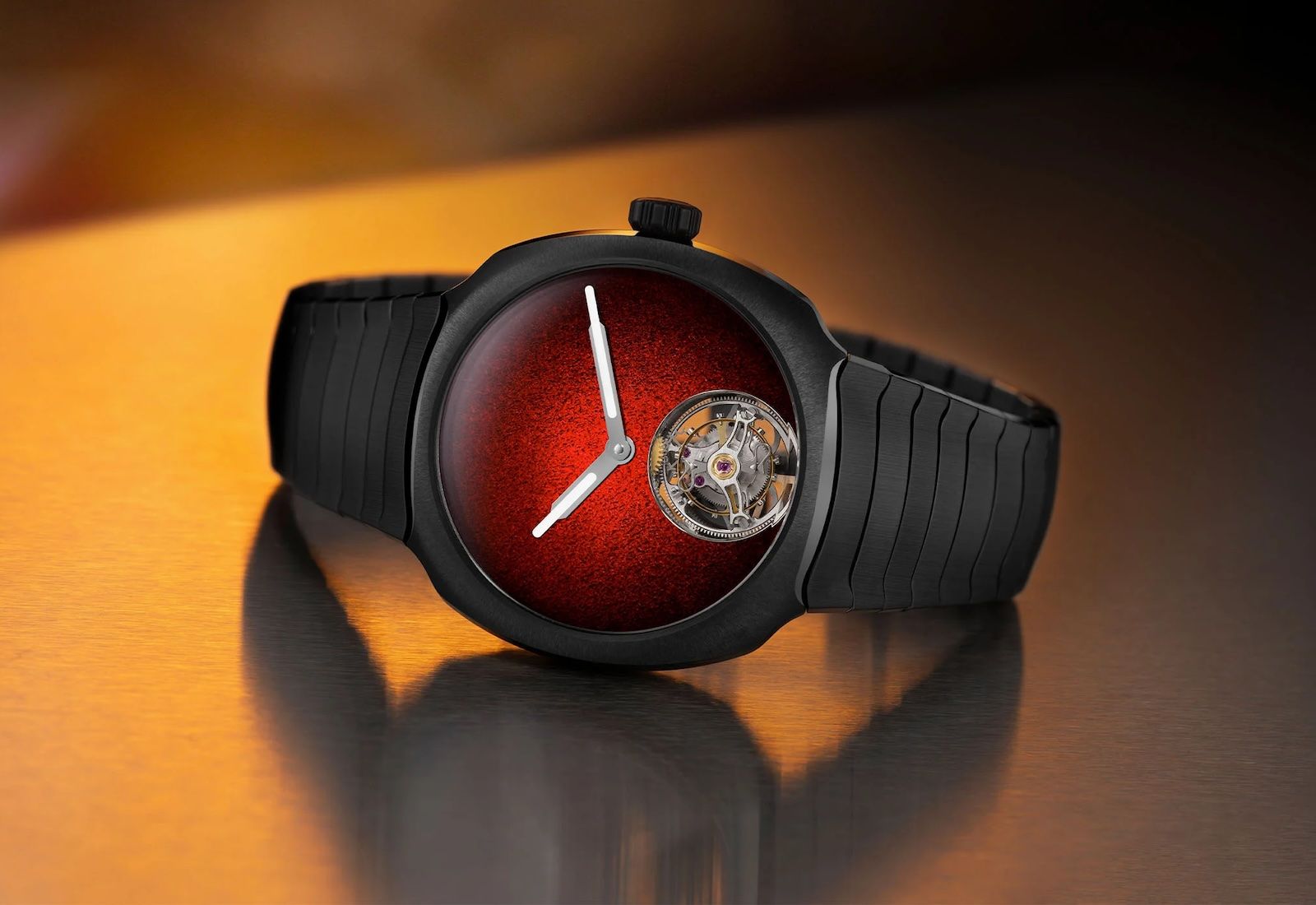
In an gigantic ocean full of integrated-bracelet luxury sports watches that all kind of look the same and draw on Genta designs from the 1970s, the one that really stands out is the H. Moser & Cie. Streamliner, inspired by a subgenre of Art Deco, the Streamliner Moderne period of the 1920s and was marked by fluid, rounded and aerodynamic shapes. This style is perfectly translated on the Streamliner, with a cushion shaped case and fluid links on the integrated bracelet. Now, the Streamliner is also the first Moser model to get a full ceramic treatment. This is the new Streamliner Tourbillon Concept Ceramic.
The case of the Concept Ceramic remains almost exactly the same as the steel version, only now it’s made out of dark grey high-tech ceramic. The case is given a brushed finish applied by hand with polished bevels on the edges. It measures 40mm wide and 12.8mm thick, including the heavily domed sapphire crystal. The Streamliner is also a sports watch, which means that the 120 meter water resistance is appropriate.
While the case is quite subdued with it’s brushed and grey finish, the dial is much more expressive. It’s a fumé Grand Feu enamel dial done in a pretty wonderful shade of red that fades to black around the edges. Contributing to the drama of the dial is a subtle hammered pattern done on the white gold base. Like other Concept Moser watches there are no markings at all, and the only thing breaking up the textured base is the large aperture at 6 o’clock for the flying tourbillon. The hands are recognizably cool with their chunky Globolight inserts.
Inside, you’ll find the calibre HMC 805, an automatic movement that has a double-hairspring flying tourbillon, visible through the dial at 6 o’clock. It beats at 3Hz and has a 72 hour power reserve. The two hairsprings instead of one improve its accuracy. Decorations include an anthracite finish on the bridges and mainplate and Moser’s signature double stripes. The watch comes on Moser’s recognizable single-link bracelet that is done in the same grey ceramic.
The new Streamliner Tourbillon Concept Ceramic is, surprisingly, part of the regular collection and priced at CHF 89,000, without tax. See more on the H. Moser & Cie. website.
⚙️Watch Worthy
A selection of reviews and first looks from around the web
⏲️End links
A bunch of links that might or might not have something to do with watches. One thing’s for sure - they’re interesting
Three innocent Jeff Epsteins—a Sinatra crooner, warehouse boss, flooring king—endure endless jabs, blocked calls, and wary glances, all thanks to the financier's crimes haunting headlines. From doctor visits to open mics, they dodge the stigma, craving resolution amid partisan file fights. When notoriety poisons a common name, who reclaims their identity?
If you’re of a certain age, you may recall the thrill of receiving actual snail mail, of opening the mailbox to find a letter addressed to you. In this piece for The Dial, Anna Juul mulls the end of mail delivery in Denmark. There are no more red postboxes, no more mail carriers, no more physical correspondence—except through an expensive private company nobody trusts. Juul grew up playing with a toy post office, fantasizing about stamping envelopes. Now she watches her aggressively digital country pat itself on the back while a quarter of its citizens can’t navigate the government’s digitized services. In its bid to put all processes online, Denmark has inadvertently created an underclass of people who do not or are unable to use the internet.
A few weeks ago, after the murders of Alex Pretti and Renee Good, Tom Homan of the Department of Homeland Security arrived in the Twin Cities to announce a winding down of immigration enforcement. But as Gaby Del Valle shows, the city remains under siege—and locals are resisting in every way they can think of.
👀Watch this
One video you have to watch today
The Rocky Horror Picture Show is one of my favorite movies of all time and it’s so good to see Tim Curry still be enthusiastic about his career.
What did you think of this newsletterYour feedback will make future issues better |
Thanks for reading,
Vuk
Reply