Farer Releases The Field III, Better Than Ever; And New Watches From RZE, CWC, Ulysse Nardin And Arnold & Son
Hey friends, welcome back to It’s About Time. I think today might be the most depressive day of the year where I am. It's been dark since morning and pouring rain. But we still get to like watches, so it's a good day.
I write this newsletter on my own, and paid subscribers are what keep it running. If you'd like to support it, you'll also get The Caseback, a weekend magazine with longer writing, every Sunday.
👂What’s new
1/ Farer Rebuilds Its Field Watch Around a New Movement And It's Better Than Ever

Farer is a British brand that designs its watches in the UK, builds them in Switzerland and is perhaps best known for their masterful use of color. I don't think there's another brand that is as good at using color than they are. A lot of people were introduced to Farer through their field watches, which have seen two iterations so far. Now, we're getting the Series III and it's the best version ever. Not just because it uses an improved movement, but also because it has sensational color combinations.
The case is 40mm wide and 11.7mm thick, with a lug-to-lug of 44mm and 20mm wide lugs. It’s made out of 316L steel in a monobloc build, so the movement holder is part of the body instead of a separate part. The sides are now rounded and brushed vertically, with polished chamfers and a knurled bezel edge. The bezel is thinner, which gives the dial more room. Two of the watches get untreated steel and two get a dark blue coating Farer calls the Midnight models. The crystal is flat sapphire with six layers of internal anti-reflective coating, and water resistance is 150 meters. These are sensible proportions for a field watch, thanks to the relatively short 44mm lug-to-lug that will sit well on most wrists.
All four dials are equipped with a pointer date, a fourth hand with an inverted Farer “A” that points at a date scale on the sloped chapter ring. The Pembroke III comes in ivory with navy markers, a nod to early military watches that had white dials, and the dial is fully lumed in Grade X1 Super-LumiNova. The Lomond III gets a gravel-textured navy with custard yellow markers and grey hands. On the Midnights, the Lomond gets an aquamarine dial and the Pembroke an orange sorbet colored one, both fully lumed, with a navy chapter ring and navy hands. The seconds hand has a lollipop tip with BGW9 lume, and the last four dates are red on the standard models and match the dial color on the Midnights.
The movement is the Sellita SW221-2 Power+, a major update tot the very familiar movement, with hacking seconds and a quick-set pointer date. Sellita reworked the gear train, barrel, mainspring and regulation system compared with the SW200, which also improves timekeeping stability and winding efficiency. Power reserve goes up to 65 hours, compared to the 40 hours of the regular SW200 series. It also gets a custom Farer rotor. Every watch ships with a navy sailcloth strap plus a second strap of your choice in leather, suede or rubber.
The new Farer Field Series III goes on sale now, at different pricing. The Lomond III is priced at €1,210 the Pembroke III is €1,280, and the two Midnight models are priced at €1,335. See way more (really fantastic) photos here and the watches on the Farer website.
2/ The New RZE Seeker Packs a Titanium Case and Solar Movement Into A Great Price

RZE is a young Singapore brand that makes titanium watches for active wear and coats them in its own UltraHex treatment to resist scratches. The new Seeker is its new field offering and it comes with a solar quartz movement, which is always a great thing with a field watch that's meant to be grabbed before going on a hike. It looks great and comes in at a pretty fantastic price.
The case is made out of Grade 2 titanium, 38mm wide and 10.2mm thick, with a lug-to-lug of 45.7mm. It weighs 33.6 grams on its own and 44.7 grams on the included strap. Two versions use RZE’s UltraHex treatment, which takes the surface scratch resistance to about 1,200 Vickers. The black version uses DLC instead. The chamfered sapphire crystal has antireflective coating underneath, the case back screws in, and water resistance is 100 meters. 10.2mm is a little thick for a quartz watch, though the low weight helps and I assume it will have good proportions.
The dials will be available in Carbon Black, Spruce Green or Metropolis Blue, which is paired with the black DLC case. All three have a fine grain texture. Big numerals cover the 12-hour scale, smaller ones the 24-hour scale, and a white minute track carries five-minute markers. The hands and markers use C3 and BGW9 Super-LumiNova.
Inside is the Epson AS01, a solar quartz movement accurate to ±20 seconds per month. A full charge lasts about four months, and ordinary light keeps it topped up, so you will essentially never have to change a battery. RZE backs the movement with a lifetime guarantee, which is pretty great, especially from a young brand at this price. The strap is recycled polyester with DLC-coated titanium hardware. The 20mm lug width lets you swap it, and RZE sells HexLink titanium bracelets and HexaFlex rubber straps.
The Seeker goes on pre order today, with shipping expected in early December. Price is set at $299. See more photos here and the watch on the RZE website.
3/ CWC Brings Back the Royal Navy Clearance Diver With the Navy Eighty CD-1
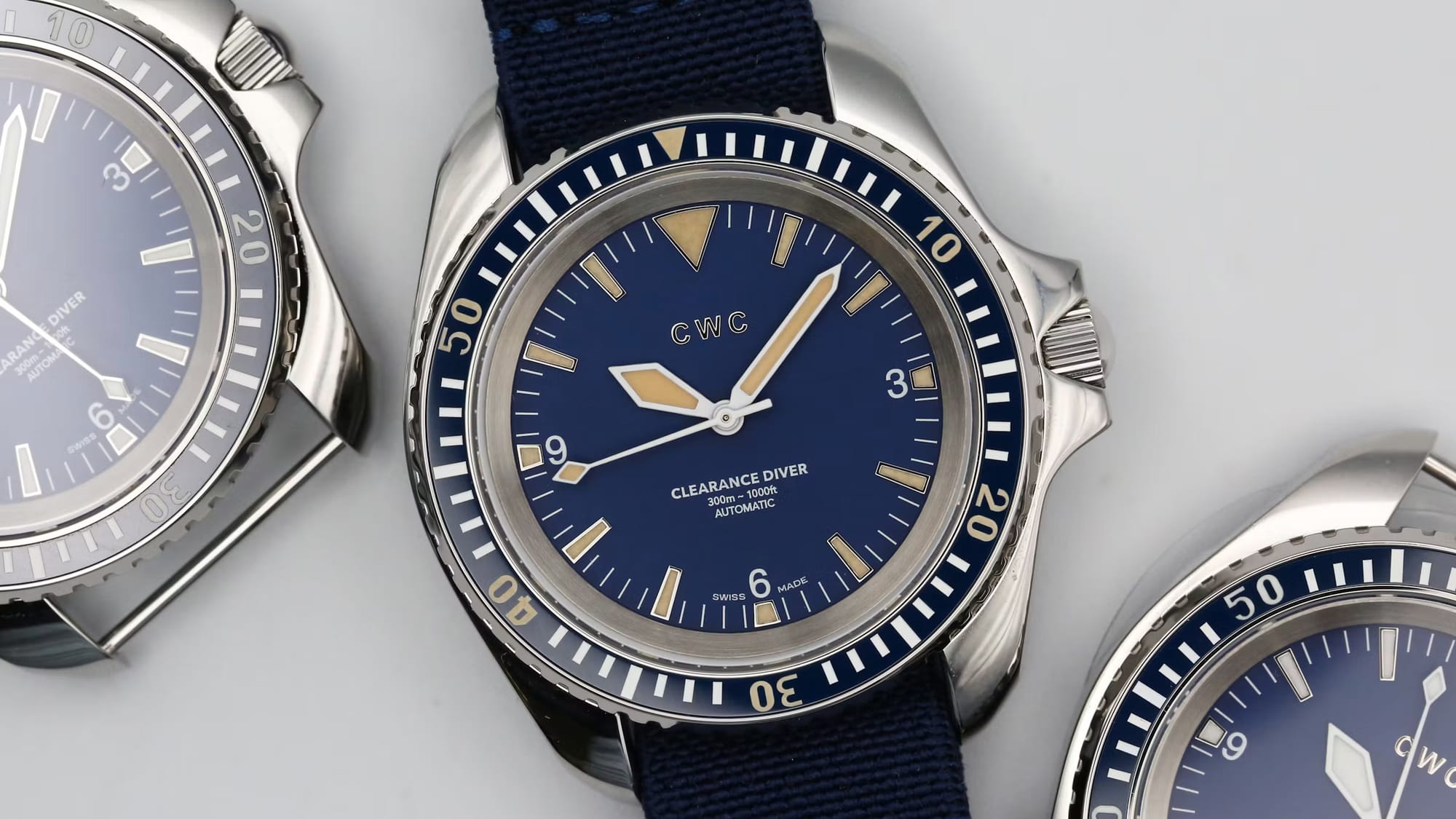
CWC, if you're not familiar with them, is the Cabot Watch Company, a British brand best known for military watches. In 1980 it replaced Rolex as the Royal Navy’s watch supplier, and its first job was an automatic designed for the Navy’s Clearance Divers. The new Navy Eighty CD-1 revives that 1980 watch. CWC has changed very little: a ceramic bezel insert, a sapphire crystal and a Sellita movement are the updates, but everything else follows the original.
The case is made out of steel, 41mm wide and 12.7mm thick, polished, with a rounded profile. The bezel is unidirectional with a ceramic insert, and the crystal is sapphire. The spring bars are fixed into the case, so only pass-through straps fit, which is often the case with military issue watches. Water resistance is 300 meters.
The dial keeps the original layout: applied markers, a triangle at 12, Arabic numerals at 3, 6 and 9, and the CWC logo beneath the triangle. The lower half carries the Clearance Diver name, the depth rating and the automatic text. The hour and minute hands are sword shaped, and the seconds hand ends in a diamond, a CWC signature. Lume is Super-LumiNova X1 and varies by reference. There are five versions. Blue dials come with white hands and BGW9 lume that glows blue, white hands and vintage lume that glows green, or silver hands with BGW9. Black dials come with white or silver hands and cream lume that glows green.
Inside is the Sellita SW200-1 Top Grade, which replaces the ETA of the 1980 watch. It beats at 4Hz, and has a power reserve of about 40 hours. It’s an easy movement to get serviced anywhere, and works fine for its price. Blue versions ship on blue stretch pass-through straps and black versions on striped NATO-style straps.
The CWC Navy Eighty CD-1 is available now, priced at £2,083.33 plus VAT. It isn’t limited, though production is low. See more photos here and the watches on the CWC website.
4/ Ulysse Nardin Adds Purple Enamel to the Freak S

As watch enthusiasts, we all have watches that we MUST have in our collections. Some are more affordable, others are virtually unattainable. I already have some of these, like the Omega Speedmaster, but there are many more that are still to make their place into the watch box. And I’ve sworn that I will have at least one Ludwig Oechslin watch. This will likely be an Ochs und Junior, but I really wouldn’t mind owning an Ulysse Nardin Freak, a wild thing designed by Oechslin. Until then, I can write about the Freaks, like this new duo of Freak S watches. The Freak S is now about three or four years old, and we haven’t seen that many iterations of it. Which is a shame, because the S in the Freak S doesn’t mean small, it means superlative. These are the best of the best of the Freak models. And here, we’re getting them with a beautiful purple handmade enamel hour disc, following the red and turquoise variants we saw last year.
While the case of the Freak S is cool, it’s nothing compared to what’s happening on the dial side. But let’s still cover it. It’s made out of titanium, measures 45mm wide and 16.65mm thick, with a titanium notched and angular bezel used to set the time and a titanium caseback. On top is a domed sapphire box crystal with anti-reflective treatment on both sides, and these are all things we’ve seen before on the Freak S, including the 30 meter water resistance.
Where things get really freaky, is on the dial. Produced at Donzé Cadrans, an enamel workshop owned by Ulysse Nardin, the dial has a very deep 18k white gold disc treated with enamel in purple. The discs are then treated with guilloché flinqué pattern done by hand, covered with a translucent coat of enamel. Above the enamel discs is the super complicated time telling mechanism. The entire thing looks like a spaceship that rotates once every hour, indicating the minutes, while below it you’ll find a disc that rotates every 12 hours and indicates the hours.
The central chunk is an integral part of the calibre UN-251, meaning that 95% of the components of the movement are in motion. That is so cool. The movement beats at 2.5Hz and it has a 72 hour power reserve. The watch comes on a purple calfskin strap with white stitching and a titanium folding buckle.
The new Freak S Purple Enamel is available now, priced at €171,200. See more photos here and the watch on the Ulysse Nardin website.
5/ Arnold & Son Gives the Time Pyramid a Very Cool See-Through Agate Dial

Arnold & Son launched the Time Pyramid in 2013 as a symmetrical, triangular skeleton movement powered watc, modelled on old British regulator clocks, with the barrels at the bottom and the gear train climbing to the balance at 12. The first ones were 44.6mm and see-through front and back. In 2023 the brand shrank it to 42.5mm and closed off the dial with an aventurine glass plate. This new duo uses agate stone in red or blue, but it's so much cooler than a description might suggest. The stones are sliced 0.4mm thick for the dial so the gear train still shows through, as a silhouette. So nice.
The case is 42.5mm wide and 10.72mm thick, polished 18k red gold or 950 platinum, with the crown at 6 o’clock and a domed sapphire crystal coated with anti-reflective treatment on both sides. Red agate goes on the red gold version, blue on the platinum. Water resistance is 30 meters, so no swimming, but come on... The caseback is also agate, 0.8mm thick, which gives you a coloured, slightly hazy view of the movement from the back. I think this looks even better than the front.
The hours sit on a suspended Roman numeral ring made from agate. Below it, the movement keeps its triangle: two barrels at the base, a vertical gear train, and the balance wheel at 12 under a triangular cock. The small seconds hand sits under the ring, and the twin power reserve indicators use the agate caseback as their backdrop. The hour and minute hands are heat-blued, as are the seconds hand and the screws on the ring’s frame.
Inside is the in-house calibre A&S1615, manual-winding and finished by hand. It beats at 3Hz, and two barrels give it 90 hours of power reserve. The red gold watch comes on an amber brown alligator strap with a red gold pin buckle, the platinum on an azure blue alligator strap with a platinum pin buckle.
Each version is limited to eight watches. The red gold is priced at CHF 49,700 and the platinum at CHF 60,500, both including tax. See more pictures here and the watches on the Arnold And Son website.
I write this newsletter on my own, and paid subscribers are what keep it running. If you'd like to support it, you'll also get The Caseback, a weekend magazine with longer writing, every Sunday.
⚙️Watch Worthy
⏲️End links
- The idea of a hotly anticipated video game isn’t new, but the runup to Grand Theft Auto VI certainly seems unprecedented. It’s been 13 years since the last title in the massive open-world franchise, and the cultural appetite is undeniable. The game’s “extended reveal” crashed Netflix’s servers in August. Other video games’ sales are suffering because of it. NBA fans joke that this week will feature lethargic games and questionable injury reports—all because athletes will have stayed up all night playing GTA VI. For The Guardian, Christian Donlan talks to developers, fans, and critics to get a handle on what exactly makes the Rockstar Games series such a juggernaut.
- “We can’t grasp the depth of the ocean,” writes Elisa Gabbert, “until we throw a skyscraper down there.” How about the edges of early human civilization? For The Atlantic, Toby Lester offers a fascinating, mildly haunting overview of the underneath—specifically, the “submerged prehistory” buried beneath the oceans, and the researchers salvaging it, bit by bit. Reading, I felt awestruck, not merely for the scale of history that lurks beneath our rising waters but the implications for the future of humanity. “What if archaeologists of the future could study only what remained above sea level, in places that today sit well inland from the coast?” an archaeologist suggests to Lester. It’s a wonder to watch Lester play with the hypothetical, to help us better grasp the depths and imagine their future reach.
- For Dispatch, Chantalle Edmunds joined a dozen people at a Sheffield hotel during a Cryonics UK training event, where they practiced preparing a body for cryopreservation. Among the attendees was Garret Smyth, who became the first person in the UK, 40 years ago, to sign up for the procedure (though he now plans to undergo neuropreservation, which aims to preserve only the brain). Edmunds’s dispatch offers a sense of why some people make this bet, even when their future is not guaranteed.
👀Watch this
This dude made a career out of destroying expensive cars. There's way worse things you could have to do in life.
Thanks for reading
Vuk
P.S. If you have any questions, suggestions, gripes or anything else, just reply to this email. It comes straight to me and I try responding to everyone.
Subscribe to It's About Time to get daily watch news