
An Oxblood Oris Big Crown Pointer Date; And New Watches From Jack Mason, Sicura, Chopard And Armin Strom
Hey friends, welcome back to It’s About Time. A bit of a classic day today, and I don't mind it.
THIS IS SUPER IMPORTANT! Ever since I moved to this new platform, deliverability of emails has been so-so. Some are delivered to a lot of inboxes, some are routed to people's promotions tabs. In case you haven't been getting your emails, check the promotions or junk folders and move it to the primary. That way you'll always get it.
I write this newsletter on my own, and paid subscribers are what keep it running. If you'd like to support it, you'll also get The Caseback, a weekend magazine with longer writing, every Sunday.
👂What’s new
1/ Oris Moves the Oxblood Dial to the Modern Big Crown Pointer Date

The Big Crown Pointer Date is Oris’s subtle pilot’s watch, built around a large crown and a central hand that tracks the date around the edge of the dial. Until now, oxblood was reserved for the vintage-style version with the fluted bezel and cathedral hands. This new reference brings the color to the cleaner contemporary line, with a smooth bezel and a steel bracelet.
The steel case is 40mm wide and 12mm thick, with a lug-to-lug of 47.5mm, a size that will work on a lot of wrists. Most surfaces are brushed, with polish on the bezel, the flanks and the big fluted crown, which screws down. A domed sapphire crystal covers the dial, with anti-reflective treatment on the underside. Water resistance is 50 meters, which is low for a watch with a screw-down crown. The display back is mineral glass instead of sapphire, an odd saving at this price.
The red is deep and the white printing stands out clearly against it. The hour numerals are applied and filled with lume, and so are the pencil hands. Date numerals run around the outer edge, inside a railroad minute track with lumed triangles every five days. The pointer hand has a red arrow tip and the seconds hand is white.
Inside is the Oris calibre 754, based on the Sellita SW 200-1, running at 4Hz with 41 hours of power reserve and hacking seconds. Oris’s red rotor is visible through the back. The 41 hours is on the short side for a CHF 2,000 watch. It comes on a steel H-link bracelet, brushed and polished, with a hidden butterfly clasp.
The Oris Big Crown Pointer Date Oxblood (ref. 01 754 7798 4038-07 8 20 06) is part of the regular collection, available from November 2026, priced at CHF 2,000. See more photos here and the watch on the Oris website.
2/ Jack Mason Puts a Meteorite Dial on the Strat-o-timer GMT
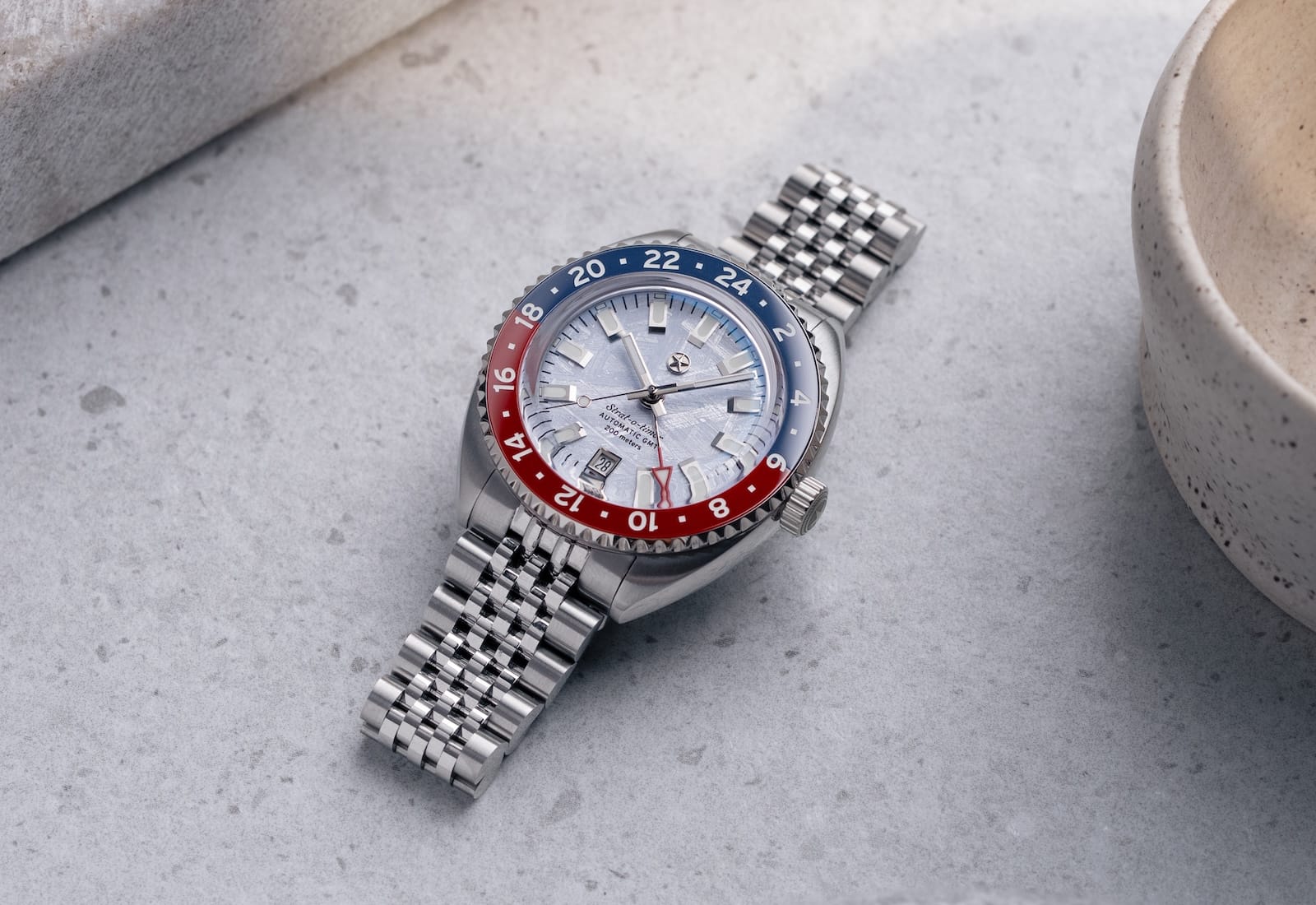
Most meteorite dials in watches are cut from one of two meteorites: Gibeon, found in Namibia, and Muonionalusta, found in northern Sweden. Both are iron-nickel, and both show a crosshatched crystal pattern once the surface is etched with acid. Jack Mason, a Texas brand, is using Muonionalusta for a limited edition of the Strat-o-timer GMT, the model it’s best known for, and it has a pretty nice color to it.
The steel case is 40mm wide and 13.2mm thick, with a lug-to-lug of 47mm and 20mm lugs. Those are sensible proportions for a GMT that's also dive capable. Water resistance is 200 meters with a screw-down crown, there’s sapphire crystals front and back, and the case and bracelet get a hardened coating to better resist scratches. The bezel turns both ways with 48 clicks. On the bracelet the watch weighs 160 grams.
The dial is a slice of the Muonionalusta meteorite, etched with acid to bring out the Widmanstätten pattern. Those crosshatched lines are iron-nickel crystals that formed as the metal cooled over millions of years, so no two of the 200 dials will look alike. Jack Mason calls the color icy blue, and it looks great. Hands and markers follow the standard Strat-o-timer layout and are lumed with BGW9.
Inside is the Miyota calibre 9075, an automatic running at 4Hz with 42 hours of power reserve and 24 jewels. It’s a flyer-style GMT, so the local hour hand moves in one-hour jumps without stopping the watch, while the 24-hour hand stays on home time. That is the setup you want if you actually travel. Jack Mason regulates each movement in-house to ±5 seconds per day, and final assembly happens in the United States. The steel bracelet tapers from 20mm to 16mm, uses quick-release bars, and has a clasp you can adjust without tools.
The Jack Mason Strat-o-timer GMT Triton Meteorite is limited to 200 numbered examples and priced at $1,449. It goes on sale November 6. See more photos here and the watch on the Jack Mason website.
3/ Sicura Adds a Sea Green Dial to the Newly Revived Hexa 400 Collection
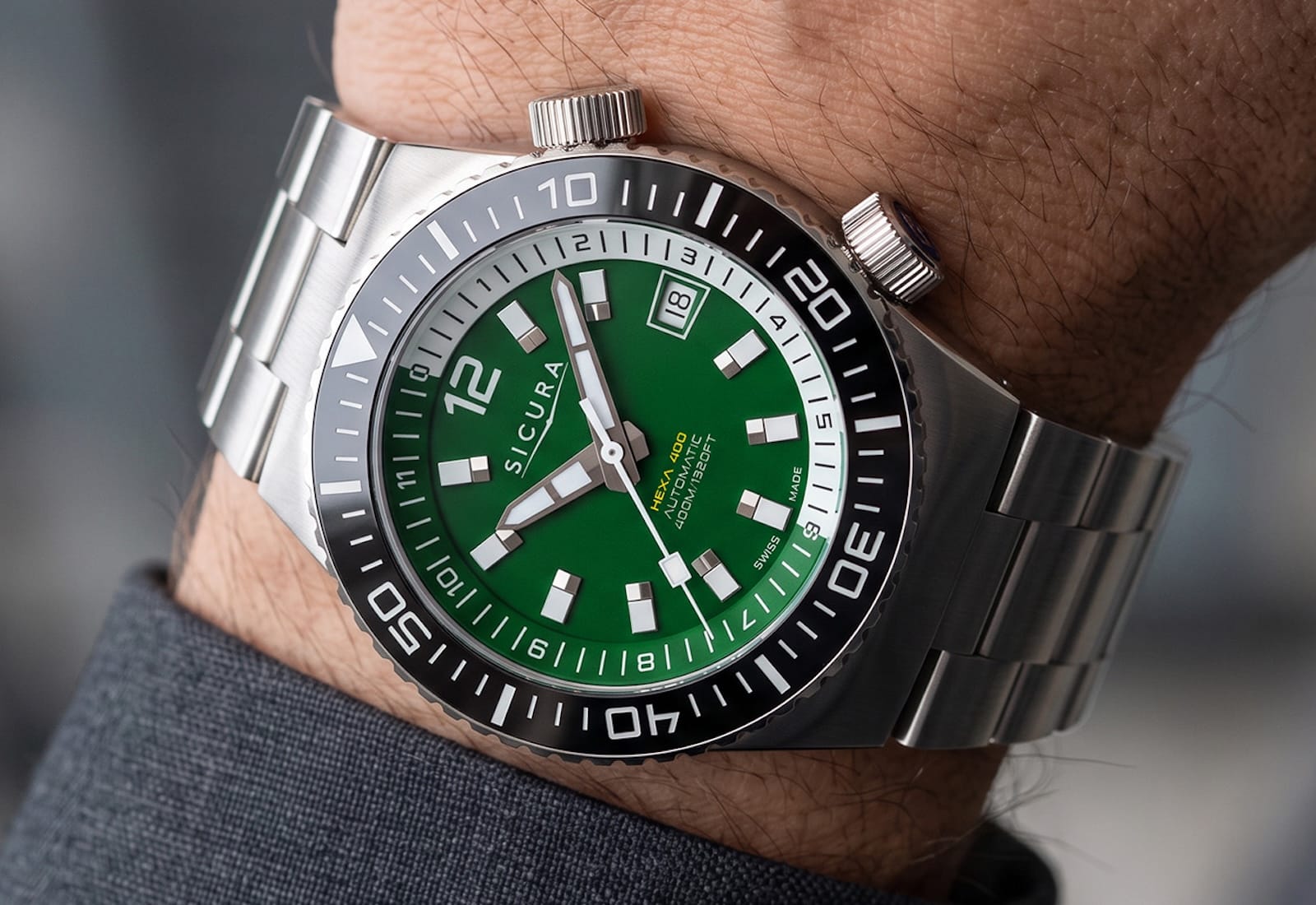
Sicura’s Hexa 400 now comes in green. If the name is new to you, Sicura was the company Ernest Schneider owned when he bought Breitling in 1979, and it was gradually wound down once Breitling became the main business. The name came back this summer under D Group, a Dutch company with no ties to Breitling, and the Hexa 400 is based on Sicura’s Diver 400 from 1968. Sea Green is the fourth dial in the collection.
The case is 316L steel, 40mm wide and 14mm thick, with a lug-to-lug of 46mm. It has a hexagonal profile, two screw-down crowns, a black ceramic dive bezel, sapphire with anti-reflective coating and a screw-in caseback. Water resistance is 400 meters. 14mm is thick for a 40mm watch, though not unusual for a 400-meter diver carrying two bezels.
The green is bright and fairly light, closer to shallow ocean water than to the dark greens most brands use. Inside the dial sits a green-and-white 12-hour ring, turned by the second crown, so you can track another time zone without a GMT movement. Indices are applied and filled with plenty of lume, the hands are broad and plain, and there is a date at 3 o’clock.
Inside is the Sellita SW200-1, a Swiss automatic running at 4Hz with hacking seconds, hand-winding and 38 hours of power reserve. The movement is reliable, but 38 hours is becoming annoyingly short in this day and time. The watch comes on an integrated three-row brushed steel bracelet tapering from 24mm to 20mm, with a push-button deployant clasp, safety lock, dive extension and toolless micro-adjustment.
The Sicura Hexa 400 Sea Green is available now, priced at €1,450. See more photos here and the watch on the Sicura website.
4/ Chopard Puts Dan Gurney’s Racing Stripes on a US-Only Mille Miglia Chronograph

The Mille Miglia is Chopard’s racing collection, named after the Italian road race the brand has sponsored and timed since 1988. But it's not all about Italian racers and cars. Chopard’s newest Mille Miglia chronograph is a 50-watch edition sold only in the United States and it takes its colors from Dan Gurney’s All American Racers team of the 1960s, whose cars were blue with white stripes.
The case is 40.5mm wide and 12.88mm thick, the same size as the regular Mille Miglia Classic Chronograph, and it’s made from Lucent Steel, Chopard’s own steel alloy. A tall box sapphire sits on top. The pushers are knurled, and the screw-down crown has a steering wheel engraved on it. On the display back you get an American flag crossed with a chequered one. Water resistance is 50 meters, which is on the low side for a chronograph with a sporty attitude.
The dial is blue lacquer over a circular satin finish, so it shows some texture in the light. The counters are snailed, with pale outer rings around blue centers: running seconds on the right, chronograph hours at the bottom, chronograph minutes on the left. There’s a navy railway track and a tachymeter around the edge. Red is used sparingly, on the central chronograph hand, the tips of the two counter hands and a small Mille Miglia arrow under the logo. Grade X1 Super-LumiNova is applied to the hour and minute hands and the Arabic numerals. The angled date at 4:30 is a bummer, but we can't all be perfect.
Inside is an automatic chronograph built on the ETA A322-11, COSC-certified, running at 4Hz with a 54-hour power reserve. A third-party base is standard for this part of the Mille Miglia range. The strap is navy rubber with a tread pattern copied from a Dunlop race tire of the 1960s, closed with a Lucent Steel pin buckle.
The Chopard Mille Miglia Classic Chronograph American Racing Stripes (ref. 168619-3021) is limited to 50 numbered examples, sold only in the United States. Price wasn't given, but these run somewhere around $11,000. The watch isn't online yet, but seem more photos here and keep an eye out on the Chopard website.
5/ Armin Strom Moves the Mirrored Force Resonance Zeitgeist 1665 to Yellow Gold and Black Lacquer

The Zeitgeist 1665 was Armin Strom’s idea of what the Mirrored Force Resonance might have looked like if someone had built it in the 17th century. At first, it was rendered with a white dial over rose gold-coloured bridges. This new Zeitgeist 1665 3N edition keeps the same concept and changes the colours, with yellow gold bridges and a black lacquer chapter ring. For anyone new to the watch, it has two balance wheels that are linked so they settle into the same rhythm, an effect called resonance that Christiaan Huygens first saw between two pendulum clocks in 1665.
The steel case is 43mm wide and 11.55mm thick, with a lug-to-lug of 49.6mm. That is large, but there is a lot going on with this watch. The flanks are brushed vertically and the top surfaces are polished, and the recognizable small lip at the bottom of the case is still there. There is sapphire crystal front and back, both anti-reflective, and water resistance is 30 meters.
There is no dial in the usual sense. A polished black lacquer chapter ring sits over the movement and shows the hours, the off-centre minutes and the two seconds tracks, indicated by blued steel hands that Armin Strom makes themselves. Everything around it is movement: a matte mainplate and bridges in 3N yellow gold, bevelled and polished edges, and black-polished screws. The left side is skeletonised, so you can watch both balances and the clutch between them. The black ring gives the layout a clean edge, and the yellow gold looks warmer than the rose gold did.
The calibre ARF21-ZG is made in-house and manual-wind, running at 3.5Hz (25,200 vph) with 80 hours of reserve from two barrels. It has 39 jewels and 260 components. A pusher at 10 o’clock is a flyback that resets both seconds hands together. The strap is grey Alcantara with grey stitching and a steel pin buckle.
The Armin Strom Mirrored Force Resonance Zeitgeist 1665 3N (ref. ST26-ZG.90) is limited to 25 pieces and priced at CHF 82,000. See more photos here and the watch on the Armin Strom website.
I write this newsletter on my own, and paid subscribers are what keep it running. If you'd like to support it, you'll also get The Caseback, a weekend magazine with longer writing, every Sunday.
⚙️Watch Worthy
⏲️End links
- London’s feral parakeets are an invasive species—but they are also beautiful, and David Wingrave takes the chance to linger on their nightly roost at Hither Green Cemetery before asking whether they should be here at all. As calls for culls grow—backed by fears of crop damage, disease, and pressure on native wildlife—he probes what we really know about the harm these birds cause. Along the way, he asks deeper questions: how we decide where an animal “belongs,” when (if ever) it becomes native, and why we are so uneasy about seeing bright green birds in London’s parks.
- We’ve all heard about Phineas Gage, the railroad worker who, in 1848, survived an accident that sent a metal rod through his skull, a brain injury that altered his personality in lasting ways. Sadie Dingfelder’s story of Edward Freytag is no less compelling: Following a motorcycle accident, Freytag discovered he could flawlessly identify and even visualize musical notes. Dingfelder’s account of Freytag, while succinct, is surprising, and given a lush animation treatment by artist Daniel Barreto that complements and elevates her narrative into a special experience. Not to be missed.
- Barbed and wire fencing covers hundreds of thousands of miles of the American West. It is highly effective, and can be unsparing. It is also costly—”$15,000 per mile or more to replace,” Kylie Mohr writes, a devastating expense for any rancher who may’ve lost miles of boundary during a wildfire. Mohr’s feature on the dawn of virtual fencing is a stimulating history of manmade borders and the inexpert ways in which they are deployed; it’s also an optimistic bit of technology reporting on an innovation that may prove wildly beneficial for ranchers and their herds.
👀Watch this
A trailer almost as good as the movie itself.
Thanks for reading
Vuk
P.S. If you have any questions, suggestions, gripes or anything else, just reply to this email. It comes straight to me and I try responding to everyone.
Subscribe to It's About Time to get daily watch news