
A Pretty Seiko GMT That Will Be Hard To Get, And New Watches From Citizen, Rado, Sinn And Arnold And Son
Hey friends, welcome back to It’s About Time. Late one today, sorry for that, it's a bit chaotic at the IAT headquarters.
THIS IS SUPER IMPORTANT! Ever since I moved to this new platform, deliverability of emails has been so-so. Some are delivered to a lot of inboxes, some are routed to people's promotions tabs. In case you haven't been getting your emails, check the promotions or junk folders and move it to the primary. That way you'll always get it.
I write this newsletter on my own, and paid subscribers are what keep it running. If you'd like to support it, you'll also get The Caseback, a weekend magazine with longer writing, every Sunday.
The paid subscription is discounted for just a few more days, so get it now.
👂What’s new
1/ Seiko Gives American Buyers the Best-Looking SKX GMT So Far
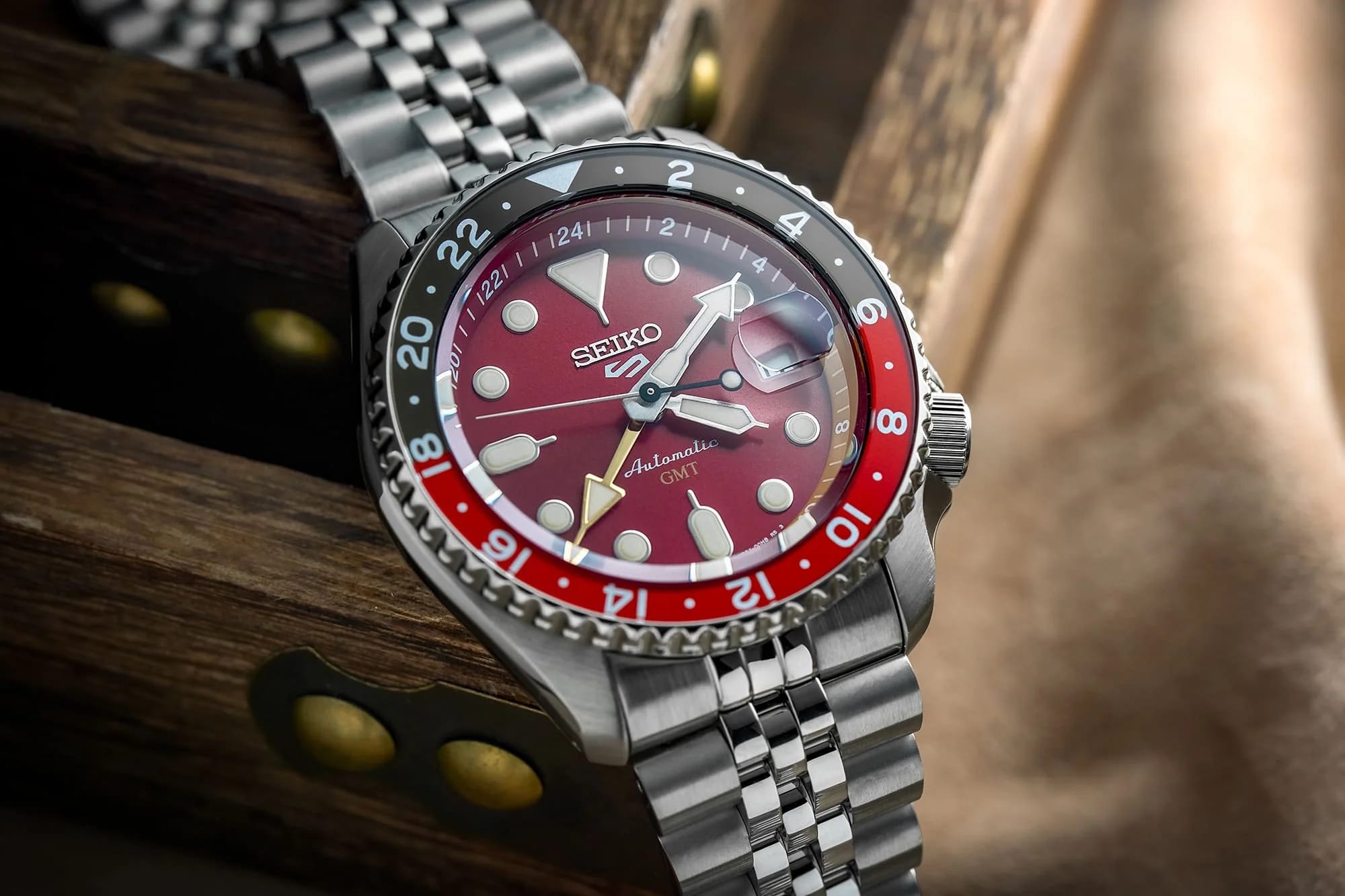
Since it launched in 2022, the SKX GMT has mostly been a way for Seiko to try out colors. The first three came in black, blue and orange, the 2023 U.S. specials added yellow, a charcoal Pepsi and a gold-accented version, and the SSK036 brought root beer. The new HDB016, another U.S. limited edition, goes maroon with a red and brown bezel. Out of all of them, I think this one might be my favorite.
The case is unchanged: 42.5mm wide, 13.6mm thick, with a lug-to-lug of 46mm and 22mm between the lugs. The thickness makes it wear bigger than the diameter suggests, but the short-ish lugs keep it manageable on a mid-sized wrist. The crown is still at four, and I still can't decide if I hate that or not. The bidirectional bezel has a 24-hour scale split between red and a very, very, very dark brown. So dark, it took me minutes to realize it's not black. Water resistance is 100 meters.
The maroon dial has a sunray finish, so it shifts in the light. Gold shows up in two places, the GMT hand and the lower half of the sloped flange that holds the 24-hour track. The applied indices, chunky hands, LumiBrite and date window all remain unchained.
Inside is the Seiko calibre 4R34, the automatic this line has used since 2022. It beats at 21,600 vph and has a power reserve of 41 hours. It’s a caller GMT, so the GMT hand sets independently while the hour hand stays on local time. The steel bracelet closes with a folding clasp, has a push-button release and safety lock, and it’s just OK.
Now, for availability. Sites and instagram accounts are reporting that this is on sale already in the US, but I can't find it on any websites just yet. I would bet that it goes on sale in November. Price is supposed to be $525. See more photos here and keep an eye out on the US Seiko website.
2/ Citizen Dresses Up the Attesa Moonphase With The Attesa Ever Since

Citizen’s second Attesa Moonphase limited edition of 2026 shares its case and movement with February’s Shades of Red, yet it looks like a completey different watch. Sure, the soft blue compared tot hat wild red is a huge difference, but look at the hour markers. Replace chunky batons with Roman numerals and you have an Attesa that could almost be worn with a suit. Almost.
The Attesa Ever Since is 41.5mm wide and 10.8mm thick, made out of Citizen’s Super Titanium. The Shades of Red had a black DLC finish. This one gets Duratect Platinum, a pale silver-grey hardening layer that protects the titanium from scratches. Two pushers sit either side of the guarded crown, and water resistance is 100 meters. The thickness of 10.8mm won't be a problem, but that width is the thing keeping it from being a more elegant watch.
The blue starts pale at the top and darkens toward the bottom. Citizen made the gradient irregular on purpose, as it's supposed to look like mountains fading into a snowstorm, with small white specks scattered across the surface for the snow. The moonphase at six o’clock is an icy pale blue. I can’t really see the mountains, but it's a pretty dial. The indices are Roman numerals alternating with faceted arrowheads. Citizen also flattened the dial by removing some of its levels, so it looks calmer overall. It still displays a lot of information, such as a perpetual calendar, world time and a power reserve indicator.
Inside is calibre H874, Citizen’s radio-controlled Eco-Drive. It sets itself from time signals, charges from any light source, and in power save mode it will keep going for two and a half years in a drawer. The bracelet is also made out of Super Titanium with the same Duratect Platinum coating, so it matches the case and weighs very little.
The Attesa Ever Since is a limited edition, but in Citizen terms that means 2,300 watches. It goes on sale in November and it's priced at $1,200. See more photos here and the watch on the Citizen website.
3/ Rado Gilds the DiaStar Original Skeleton in Yellow and Rose for Autumn

Rado has released two new versions of the DiaStar Original Skeleton for autumn, one in yellow gold tone and one in rose gold tone. It’s the same watch as the colorful summer editions from earlier this year, with gold finishes in place of the bright colors. Rose is new for the DiaStar, and it’s quite the looker.
The case is 38mm wide and 11.9mm thick, with a lug-to-lug of 45mm, so it wears small and relatively flat. The bezel is made out of Ceramos, Rado’s ceramic and metal composite, tinted with PVD and brushed in a radial pattern. The bezel, Rado says, will not scratch. The rest of the case is steel under polished gold PVD, and that could scratch. The faceted DiaStar crystal is still there: a flat square in the center with angled sides falling away from it. Water resistance is 100 meters.
There’s no dial here in the usual sense. A chapter ring in black or brown, depending on the variant, is used to mount white minute markers, and gold indices hang off it over the open movement. The bridges are gold-plated too. The central seconds hand is white or black, and the pivoting Rado anchor sits at 9 o’clock.
The movement is Rado calibre R808, a skeletonized Powermatic 80 from the ETA family. It beats at 21,600vph, has 80 hours of reserve, uses a Nivachron hairspring for magnetic and temperature resistance, and is adjusted in five positions. It’s a dependable movement. Through the sapphire caseback you see an anchor-shaped rotor with Geneva stripes. The strap is brown rubber on Rado’s EasyClip quick-release system, closed with a gold PVD pin buckle.
The DiaStar Original Skeleton is available now, priced at €2,600 in either color. See more photos here and the watches on the Rado website.
4/ Sinn Marks a 45-Minute Football Half on the Bezel of the 105 Eintracht
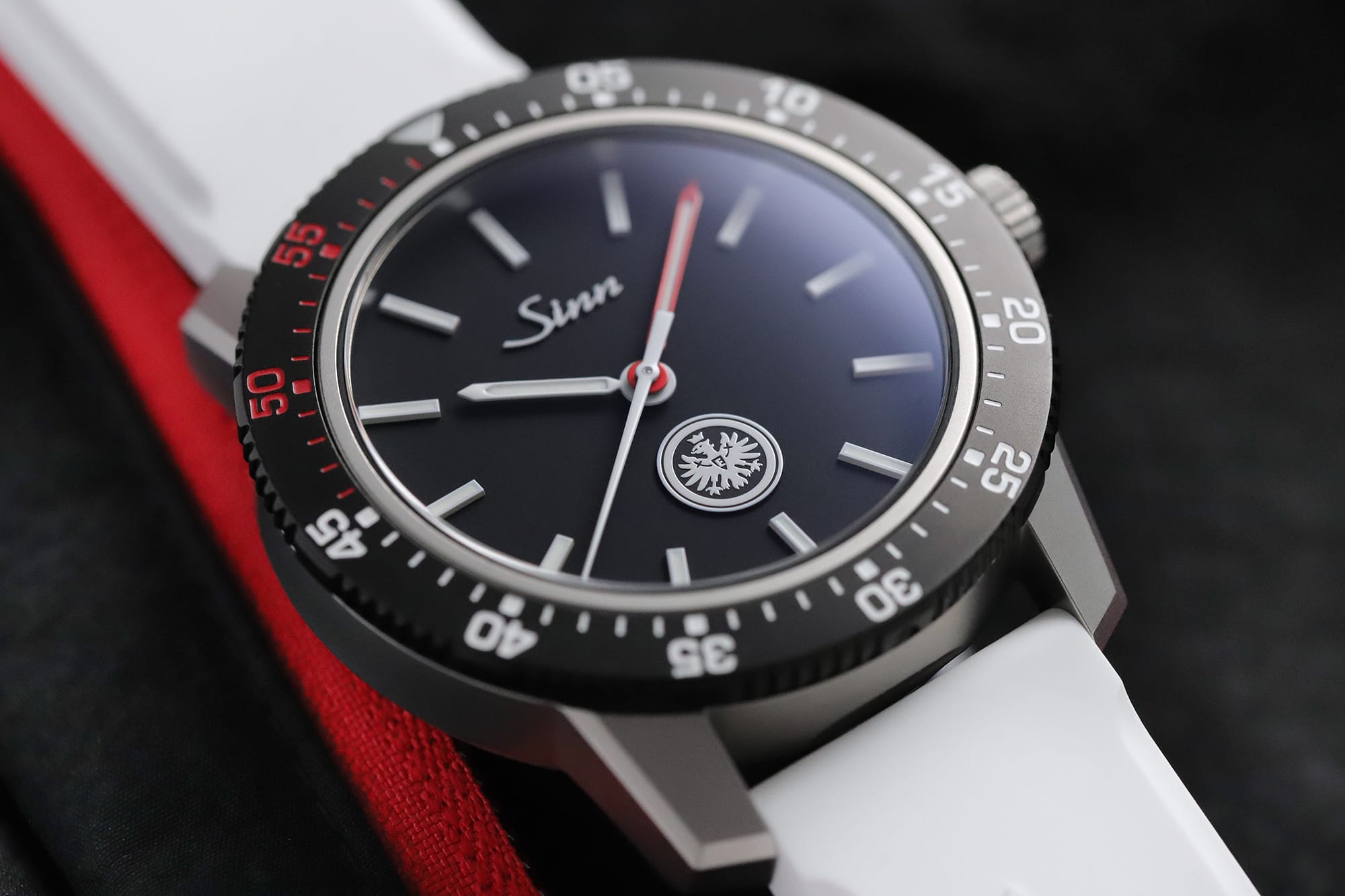
Most football club-themed watches stop at a crest on the dial or a color on the bezel. Now, I'm not saying that Sinn’s new 105 Eintracht, made for Eintracht Frankfurt, the football club, is revolutionary in any sense. It has the crest on the dial, but it also implements a football-specific function onto the bezel – the first 45 minutes of the bezel are colored in, so you can set it at kickoff and track a half. It’s a simple idea, and I like the move despite not being a huge fan of the game. Also, this watch marks the link between the Frankfurt watch brand and the Frankfurt club that goes back a long way: one of the men who founded the club in 1899 was a Frankfurt watchmaker named Albert Pohlenk.
The case is the familiar 105 in bead-blasted steel, 41mm wide and 11.9mm thick. There’s sapphire crystals front and back, with anti-reflective coating on both sides of the front crystal, a screw-down crown and 200 meters of water resistance. The bezel turns in both directions with one-minute clicks. The blasted finish suits a tool watch like this, and the proportions are as easy to wear as they are on the standard 105.
The dial is black with a silk-matt finish, applied indices and an applied Eintracht Frankfurt logo at 6 o'clock. Hands and indices are lumed, as is the marker on the bezel at 12. For a club edition it’s restrained, so if you are a fan, you can still pull it off without it being too loud.
Inside is the Sellita SW 200-1, an automatic running at 4Hz with 40 hours of power reserve, hacking seconds and magnetic resistance to the DIN 8309 standard. Through the caseback you’ll see the rotor, engraved with the club’s name and the watch’s individual number. It comes with two straps on 20mm lugs: a black textile strap and a white silicone one with an embossed Sinn logo and quick-release spring bars.
The Sinn 105 Eintracht (ref. 105.031) is limited to 500 numbered examples and priced at €2,290 including VAT. See more photos here and the watch on the Sinn website.
5/ Arnold & Son Gives the DSTB a Stop-Seconds, So You Can Finally Set It to the Second

The DSTB is Arnold & Son’s deadbeat seconds watch, part of the brand’s chronometry line. The name stands for Dial Side True Beat: the seconds hand jumps once a second instead of sweeping, and the mechanism that drives it sits on top of the movement, facing you, so the whole thing is on display. The DSTB has always been a watch about seconds, yet until now you couldn’t stop the hand to set it precisely. Two new limited editions fix that with a crown-operated stop-seconds.
The case is 42mm wide, available in red gold or platinum, with a domed sapphire crystal over on top and a flat sapphire crystal caseback. Thickness is decent at 12.95mm, of which a chunk is used up by the domed crystal. Water resistance is 30 meters, which will keep the thing safe enough.
The red gold model gets a grey dial Arnold & Son calls Cliff Grey, and the platinum gets a golden tone called Kingsand. Both are PVD-treated with a grained finish, and the names are references to John Arnold’s Cornwall and the brass plates of his movements. Time is indicated on a small opal subdial at four o’clock, with a slight concave shape. Most of the main dial, however, is used up by the seconds mechanism: three mirror-polished, wishbone-shaped gold bridges, openworked so you can see the wheels and a blued lever shaped like an anchor. A long blued hand jumps around a blue printed track above it all.
The movement is the in-house calibre A&S6303, automatic, beating at 4Hz with 55 hours of power reserve. It’s derived from the compact A&S6003 used in the 2023 DSTB, with the stop-seconds added. The brand ties the feature to how Royal Navy navigators set a deck watch against the ship’s chronometer. Finishing includes radiating Côtes de Genève on the bridges, a circular-grained mainplate, blued screws and hand-chamfered edges, plus an openworked 22k gold rotor engraved with guilloché and the anchor logo. The red gold model comes on a grey alligator strap with a pin buckle in red gold. The platinum comes on an alligator strap in ink blue with a platinum pin buckle.
The Arnold & Son DSTB Stop-Seconds is limited to 18 pieces per metal. Red gold is priced at CHF 46,000 and platinum at CHF 56,800, both including VAT. See more photos here and the watches on the Arnold & Son website.
I write this newsletter on my own, and paid subscribers are what keep it running. If you'd like to support it, you'll also get The Caseback, a weekend magazine with longer writing, every Sunday.
The paid subscription is discounted for just a few more days, so get it now.
⚙️Watch Worthy
⏲️End links
- Jim Morrison has endured almost unimaginable loss—first his wife and two young children in a plane crash, then his partner and climbing companion Hilaree Nelson in a Himalayan avalanche. But rather than stepping back from danger, he kept pursuing ever more risky objectives, culminating in the first ski descent of Everest’s nearly unclimbable north face via the Super Direct route. This profile explores Morrison’s perseverance and shows how, for some people, a life defined by extreme risk can never be retreated from.
- In 1993, an audience member at the Citizen Cup tennis tournament stabbed Monica Seles, then a 19-year-old phenom who was then dethroned from the top of the world tennis rankings. The attack, writes Terrence Doyle, “was a physical manifestation of a logic that has since become our default: the idea that an athlete is not a human to be witnessed, but a data point to be managed, edited, or deleted.” I briefly mentioned Doyle’s disturbing essay a week ago, but it has stayed with me since: a worrying meditation on the ease with which athletes are abstracted into mere data sets. It deserves your deeper consideration.
- More than a few readers may squirm as they nibble their way through Sophie Haigney’s latest, about eaters who are rejecting “the usual sources of authority” and tinkering with optimization through unconventional diets—upping their intake of raw buffalo brain, for instance, or swearing off vegetables. But Haigney’s not in it for the disgust or the judgment. Instead, she moves among “dark nutrition” practitioners with a deep curiosity for how they try to manage uncertainty through appetite.
👀Watch this
Oh, I think I found a new favorite channel on YouTube.
Thanks for reading
Vuk
P.S. If you have any questions, suggestions, gripes or anything else, just reply to this email. It comes straight to me and I try responding to everyone.
Subscribe to It's About Time to get daily watch news